Tuesday, September 29, 2009

Goldstone Endorses Palestinian Witness Who Claimed Israel Distributed Aphrodisiac Gum

CAMERA/Snapshots
29 September 09


Islam Shahwan.png
Islam Shahwan, of aphrodisiac gum fame

While the Goldstone Report humiliated an Israeli doctor who was a victim of a Palestinian rocket attack, and relegated her testimony to passing mention, it dedicated an entire paragraph (414) to Gaza police spokesman Islam Shahwan. As Israel Matzav observes,

Does the name Islam Shahwan ring a bell with any of you? If not, please recall this article:

Is Israel targeting the Palestinian population in Gaza by distributing libido-increasing chewing gum in the Strip?

A Hamas police spokesman in the Gaza Strip Islam Shahwan claimed Monday that Israeli intelligence operatives are attempting to "destroy" the young generation by distributing such materials in the coastal enclave.

Shahwan said that the police got their hands on gum that increases sexual desire that, according to him, reaches merchants in the Strip by way of the border crossings. According to him, a Palestinian drug dealer admitted that he sold products that increase sex drive. The dealer said that he received the materials from Israeli sources by way of the Karni crossing.

A number of suspects have been arrested.

The affair was exposed when a Palestinian filed a complaint that his daughter chewed the aforementioned gum and experienced the dubious side effects.

Shahwan even claimed that Israeli intelligence operatives encourage dealers in Gaza to distribute the gum for free.

"The Israelis seek to destroy the Palestinians' social infrastructure with these products and to hurt the young generation by distributing drugs and sex stimulants," said Shahwan.

Yes, that's the very same Islam Shahwan. Does he sound like a reliable to witness? To Richard Goldstone he did.

Are there any 'Palestinians' Richard Goldstone didn't believe?

To read about another Palestinian witness who gave more than a dozen versions of his story, but whom nevertheless was deemed reliable by the Goldstone Report, see here.

Talking Iran Down The Nuclear Road


Obama's outstretched hand encourages Iran's quest for the bomb.


Amir Taheri
Wall St. Journal
29 September 09

The way the Obama administration portrays them, this week's talks between Iran and the so-called 5+1 group of nations represent a diplomatic breakthrough. Indeed they do—for Iran, that is.

The group, consisting of the five permanent members of the United Nations Security Council plus Germany, talked to the Islamic Republic for almost five years with no results. The U.S. played a key part throughout—first indirectly, then with a high-level presence. Until Mr. Obama entered the scene, the talks had a clear purpose: First, to persuade the Islamic Republic to stop uranium enrichment, or to face additional U.N. measures. Second, to offer Tehran inducements to abandon its nuclear ambition. Mr. Obama's policy of the "outstretched hand" has changed all that. Using what diplomats term "creative ambiguity," the new administration has tried to circumvent U.N. resolutions by offering unconditional talks.

Sources in Tehran say neither of the two letters that Mr. Obama has written to Supreme Leader Ayatollah Ali Khamenei demands compliance with U.N. resolutions. The view from Tehran is that Mr. Obama has already accepted Iran's nuclear program as fait accompli.

As Iran's official news agency, IRNA, put it in an analysis on Sept. 14, "Based on real indicators of its national interests and possible threats, America has no problem with Iran's nuclear project."

It went to note that "[America's] extensive problems originate in that country's military presence in the Middle East. And, since Iran is the most powerful nation in the region, America will have to cooperate with it under any circumstances."

Iran's clarity going into the talks contrasts with Mr. Obama's uncertainty.

"Iran wants its regional supremacy to be recognized by America and the West," says Hussein Pour-Ahmadi, an advisor to the Iranian foreign ministry. "Once Iran's regional dominance is acknowledged, Iran would be ready to help with regional security."

President Mahmoud Ahmadinejad has repeatedly claimed that Iran's nuclear program is non-negotiable. Iran enters the talks assuming that the negotiations that began five years ago have ended, and that a new process is about to start. The mandate in Geneva for Saeed Jalili, Iran's top negotiator, now is to assert Iran's claim of a share in global leadership. The Islamic Republic resents that some small Third World nations are invited to the G-20 summit while Iran, the self-proclaimed regional superpower, is excluded.

"Our package covers a range of issues such as energy security, reducing poverty, economic development, nuclear disarmament, fighting terrorism and protecting the environment," Mr. Jalili told reporters in Tehran on Wednesday.

Confident that the nuclear issue is off the table, the Tehran leadership has just revealed the existence of a hitherto secret plant for uranium enrichment. In a letter to the International Atomic Energy Agency or IAEA, the Islamic Republic last week told of a new facility, built in a mountain stronghold southwest of Tehran. This could operate 3000 centrifuges.

Earlier, the man in charge of Iran's nuclear project, Ali-Akbar Salehi, had made another startling revelation. In a 5,000-word press release, the nuclear czar reported the existence of "a generation of new and much more efficient centrifuges." He offered no details and, more significantly perhaps, did not say why these superior machines were not being used to enrich uranium instead of the old and inefficient ones operating in Natanz.

The two revelations reinforce suspicions that Tehran may be running a parallel nuclear program of which the IAEA has no knowledge. And yet, Mr. Jalili's brief is to talk about everything except Iran's nuclear program. Iran analysts dub this the "Bikini Strategy"—showing everything except the most interesting parts.

Paradoxically, Mr. Obama's outstretched hand may have made a negotiated resolution of the Iranian nuclear problem more difficult. The perception in Tehran is that Mr. Obama, who has apologized for America's unspecified misdeeds against Iran, is acting from a position of weakness mixed with a desire to score points against his predecessor.

Over the past months, Iranian think tanks have organized a number of seminars on the coming talks. The participants have been divided into two camps, the first advising that Iran go for full victory over the American "Great Satan". Their argument is that the world has already entered a post-American era and that Mr. Obama's weakness and naïveté offer an opportunity for driving the U.S. out of the Middle East.

Last week, advocates of that view published a collection of essays under the title "America Is Coming to an End". The book, published by Ahmadinejad's office, claims that Mr. Obama's election indicated American popular support for a "strategic global retreat". They claim that the world is looking for "an alternative vision" that only Iran can offer.

Or, as Hamid Mowlana, former American University professor and current advisor to Ahmadinejad, says: "Today, only two men count: Ahmadinejad and Obama. As American influence fades, Iran must assert leadership with Ahmadinejad's message of justice."

To persuade the Islamic Republic to climb off its high horses was never easy. If the "End of America" camp wins the debate in Tehran, that task could become even more difficult.

The other view in Tehran says the Islamic Republic should not press its advantage too far. According to Manuchehr Muhammadi, a foreign ministry advisor, Mr. Obama has already acknowledged the Islamic Republic's regional power status.

Therefore, it would be counter-productive to inflict diplomatic humiliation on Washington. The Khomeinist regime committed such a mistake with President Jimmy Carter in 1979, after Mr. Carter went out of his way to give Khomeini everything he wanted. Mr. Carter's humiliation was a factor in Ronald Reagan's election victory. Advocates of this view argue that Iran should offer Mr. Obama a fig leaf to let him claim success where George W. Bush failed, though without conceding an inch on Iran's nuclear ambitions.

Tehran's reading of Mr. Obama's intentions may be off the mark. For the time being, however, the outstretched hand, far from persuading the regime to consider changing its trajectory, has encouraged its nuclear quest.

Mr. Obama may have encouraged those in Tehran who urge an even faster pace in developing a nuclear arsenal, and all with the best of intentions.

Mr. Taheri's new book, "The Persian Night: Iran Under the Khomeinist Revolution," is published by Encounter Books.

Obama Doesn’t Understand: The Alternative to Victory is Defeat


Barry Rubin
The Rubin Report
29 September 09

The problem with President Barack Obama is not that he makes gaffes or factual errors when he speaks but because he expresses an ideological framework so shocking and dangerous.

Take the latest such remark, made in the
G-20 press conference, referring to Iran’s nuclear program:

"I'm not interested in victory. I'm interested in resolving the problem."

Totally detached from actual international conflicts, this is a rational and noble statement. Hey, says Pragmatic Man, I’m not seeking something to brag about, a total victory and my opponent's humiliation. I just want to solve problems and leave everyone happy.

Yet he's not playing a game of bridge here but dueling with a dictatorship that thinks it has divine support and wants to build a massive totalitarian empire. The fact that Obama thinks this way makes him a person not fit to deal with real enemies.

Briefly, here are several reasons why:

--In a misunderstanding with those who are otherwise friends, this "no victory" approach makes sense. If the United States has some minor problem with, say, Canada or the United Kingdom, it would be good to seek a resolution in which it wasn’t a victor. Sure, get the blip in an otherwise good relationship out of the way so the two allies can get back to cooperating on a hundred other matters.

But Obama doesn’t seem to understand the profound difference between friends and enemies. As Obama has repeatedly shown, he is more eager to resolve conflicts with enemies than to back up friends. For him, enemies don’t exist but have only been created by mistaken U.S. policy. Apologies or concessions will suffice to end any friction.

--Obama assumes the other side is rational and well-intentioned. Whether its Libya or North Korea, Cuba or Syria, Iran or Venezuela, Obama simply doesn’t get the idea that dictatorship and ideology, greed and passionate hatred can create forces which don’t want to be friends.

In effect, such regimes have the precise opposite approach to that of Obama: They aren’t interested in resolving the problem. They are interested in victory.

--By making such a statement, Obama speaks as if Iran is a blank slate rather than a country which has repeatedly broken promises on the nuclear issue; called for genocide against Israel; been the world’s leading sponsor of terrorism; killed Americans through terrorist operations in Lebanon, Iraq, Saudi Arabia, and other countries; is ruled by a regime that just stole an election; has violently repressed the opposition and put peaceful activists on trial for their lives; and has a defense minister who is a wanted terrorist.

Iran is not ruled by a regime with which you can just solve problems. And any solution without victory of a sort will not be a solution.

--If Iran intends to build nuclear weapons and the United States opposes this goal how can there be any resolution of the problem without victory? If the Iranian regime builds deliverable nuclear weapons then it wins; if Tehran is stopped from doing so, the United States wins. What kind of conceivable compromise can there be without a victory for one side or the other?

--Obama’s formulation could be sensible with another side whose feelings one didn’t want to hurt unnecessarily. Assuring the other side you don’t insist on total victory can be a soothing factor. Unfortunately in this case it is the radical side which needs to say so. (The Palestinian side and most Arab states need to say this to Israel but never do so. Israel has already said so to the other side but it hasn’t done much good.)

--But most important of all is Obama’s seeming inability to understand the concepts of deterrence and credibility. I’m not exaggerating here. He has never made a single statement incorporating these ideas.

Yes, you need to be tough. Yes, you sometimes have to make threats. Yes, you need to show yourself willing to use force. Yes, you sometimes have to win victories. The leader of a great power needs to do these things to discourage enemies from being more aggressive and disregarding his country’s interests. In addition, the leader of a great power must do these things to encourage friends to rely on him and his country for help and protection.

Obama thinks he is reassuring America’s enemies by apologizing, avoiding conflict, and insisting he doesn’t seek victory. He is reassuring them—reassuring them that they can walk all over the United States without cost.

In totally misconceiving the nature of his own responsibilities and of international affairs, Obama is creating an extremely dangerous situation. One of the many things he doesn’t understand is that his approach makes crisis, bloodshed, and war far more likely.

It is sobering to see the man who holds the world's most powerful job for dealing with international affairs on the planet has no previous experience dealing with this topic. It is horrifying that his ideas ensure disaster for the democratic forces and successes for the dictatorial ones.
.

Land for Peace (1991)


Click on this "full page" cartoon to open a larger, more readable version.
1991 Dry Bones cartoon -Land For Peace

Camp David Syndrome


Ken Blackwell
The American Spectator
25 September 09

Readers who are familiar with the Stockholm Syndrome will recall that it refers to a hostage-taking 1973 incident in that Swedish capital city. Over time, the hostages began to look to their captors as friends and protectors rather than the murderous kidnapers that they truly were.

We are seeing something similar in what I call the Camp David Syndrome. President Obama has just announced the latest effort toward crafting a Middle East Peace Settlement. That grand-sounding title is Beltway-speak for "let's lean on Israel to gain some street cred with the Euros." He's chosen Hillary Clinton as his negotiator.
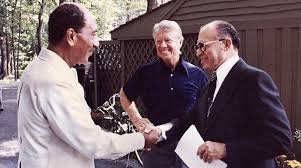
In 1978, Jimmy Carter brought Egypt's Anwar Sadat and Israel's Menachem Begin together to his mountain top presidential retreat in Maryland's beautiful Catoctin Mountains. There, over days of intense negotiation, Carter brokered what became known in diplomatic lore as the Camp David Accords. Under those agreements, Israel agreed to withdraw her forces from the Sinai Peninsula that she had seized in the lightning Six-Day War of 1967, and re-captured during the 1973 Yom Kippur War. That war had been launched by Egypt's Sadat -- showing the characteristic respect for other faiths that Muslims habitually show -- the Jewish High Holy Days of that year.

Carter hailed his achievement as something just shy of the Second Coming. It wasn't. Carter was led up to that mountain by growing problems on the plain below. Americans were becoming increasingly disenchanted with Jimmy's fecklessness on the domestic front. High interest rates made home ownership impossible for young couples, long gas lines frayed nerves, and rising unemployment made everyone edgy. But Carter felt that success on the international scene could bring him and his embattled party some goodwill from American voters.

It didn't. Barely six weeks after the media hullabaloo over the Camp David Accords, voters trooped to the polls and spanked Carter's party. Between 1978 and 1980, voters gave Republicans 46 seats in the House of Representatives, five more seats than the GOP had lost in the watershed post-Watergate election of 1974.

Still, the myth persists that a Middle East peace agreement will translate into electoral success at home. Carter proved to be a one-trick pony. He received a sharp kick from voters in 1980. They put the pony permanently out to pasture.

What Carter achieved at Camp David is not replicable today. That's because the Israelis in 1978 did not want to occupy Sinai. They agreed that it did not materially contribute to their security. (Israel's Prime Minister Golda Meir used to joke that the Almighty had led the Children of Abraham out of bondage in Egypt, called them to wander for forty years, and told them to settle on the only piece of real estate in the Middle East that has no oil!)

So Carter's fabled diplomacy was not really necessary to persuade the Israelis to disgorge territory that had never been Israeli and that they did not really want. And President Anwar Sadat had a firm grip over Egypt, which one Egyptian diplomat described as the only real nation in the Arab world. "The rest are just tribes with flags," that Arab diplomat memorably said. Besides, Sadat needed money. And the U.S. was ready to purchase a peace.

Despite the fact that Jimmy Carter got a shellacking at the polls in 1978 and 1980, Presidents persist in pursuing the brass ring, or an elusive Nobel Prize, for brokering a Mideast Peace Settlement.

Bill Clinton tried it in 2000. He was playing out an exhausted presidency, grasping for straws. He summoned Israeli Prime Minister Ehud Barak and the "reformed" terrorist leader, Yassir Arafat, to the U.S. He tried to arrange another Camp David breakthrough. Barak made extraordinary concessions, even dangerous ones. No dice. Arafat fomented a second "intifada" against Israel. Clinton's party lost the next Presidential Election.

Then, there was the 2007 Annapolis Conference on Mideast Peace. President George W. Bush chose that week after Thanksgiving to bring a wide range of Arab and Israeli negotiators to the U.S. Naval Academy's historic Yard. Some of the Arab delegates refused to enter the same doorway as the Israelis had entered. Some peace talks. The best we can say for this effort is that it could have been worse. It might have lasted two days instead of just one. And Bush's party lost the next Presidential Election.

What was considered historic about the Annapolis Conference is that for the first time all parties agreed to a "two-state solution." Did the Arab delegates who attended, the ones who refused to enter the same doorway as the Israelis, agree that Israel would be one of those two states? Don't ask.

What we have yet to hear is why the U.S. should want a Palestinian state to be formed in the Mideast. When the Israelis evacuated from Gaza and the local residents held elections, they promptly voted in Hamas, the terrorist organization. Hamas supporters stormed the residence of the late Yassir Arafat and stole his Nobel "Peace" Prize. Now, there's poetic justice.

On the West Bank, Arafat's loyal lieutenant, Abu Abbas, maintains a precarious perch. The U.S. is giving $900 million in aid to his so-called Authority for allegedly humanitarian purposes. This is where bombers use ambulances to run rockets to and from Palestinian hospitals and where children dance in mock explosive belts before PTA meetings in schools named for suicide bombers. This is what we want more of? For Peace's sake? For Pete's sake!

I was amazed to see President Obama come on TV so soon to call for a Mideast breakthrough. I didn't think he was in that much trouble on the domestic front already.
Ken Blackwell is a former U.S. ambassador to the United Nations Human Rights Commission and a senior fellow at the Family Research Council.
.

Monday, September 28, 2009

Terrorism: Hizballah's Brand is Tarnished


Jonathan Spyer
Gloria Center
24 September 09

A famous Hizbullah marching song, "Hizbullah ya ayuni" (Hizbullah - my eyes), contains the following verse: "And today through the blood of the brave, the merciful creator has given us victory, and the whole world and all people have begun to speak of our glory." Unfortunately for the Lebanese Shi'ite Islamist movement, the main world news story in which it currently features concerns matters of a distinctly inglorious type, with which it would undoubtedly prefer not to be associated.

The revelations concerning the activities of the so-called Lebanese Bernie Madoff - Salah Ezz el-Din of the south Lebanese village of Ma'aroub - are serving to tarnish the image of selflessness and idealism in which Hizbullah likes to present itself. The movement has long sought to differentiate itself from the notoriously corrupt, distinctly nonidealistic political and financial practices with which Lebanon is often associated. Ezz el-Din's activities suggest that on close observation, Hizbullah may be less different from its surroundings than its admirers (especially in the west) like to think.

Ezz el-Din, a Lebanese Shi'ite in his 50s, is accused of embezzlement and defrauding investors of hundreds of millions of dollars. The means by which he chose to part his victims from their money are familiar. He promised quick returns on investments in what he claimed were construction, oil and gas projects outside of Lebanon. He is reported to have guaranteed investors 20 percent-25% profits within 100 days on certain investments.

It now appears that Ezz el-Din was running a Ponzi scheme - paying clients with funds gleaned from newer investors. The sums involved are large - though nowhere near Madoff-like proportions. He is believed to have defrauded investors of around $500 million.

But Ezz el-Din was no ordinary financier. Rather, he enjoyed close links to Hizbullah. He ran a variety of enterprises associated with the group - most importantly the Dar al-Hadi Publishing House - named after Hadi Nasrallah. Hadi Nasrallah was the son of Hizbullah leader Hassan Nasrallah who was killed fighting the IDF in southern Lebanon, and is somewhere near the top of the movement's pantheon of "martyrs." The publishing house which bore his name was responsible for the publication of a number of books by senior Hizbullah officials.

THE PERCEPTION of Hizbullah patronage was a major factor in encouraging investors to place their trust in Ezz el-Din. As one disappointed client put it, "people put money with him because he was wearing the Hizbullah cloak." The presence of people like him does not fit with the puritanical image of Hizbullah. But it is not especially out of place with the broader pattern of the movement's activities.
As a major Lebanese political force, Hizbullah offers patronage to powerful families and individuals from the Lebanese Shi'ite community. The organization effectively operates a state within a state. Its areas are off limits to the army and police. This is particularly useful for individuals close to the movement engaged in criminal activities.

The lucrative hashish trade in the movement's heartland in the Bekaa Valley in eastern Lebanon offers an example of this patronage. Families engaged in this trade receive the protection of Hizbullah, ensuring that neither the authorities nor their rivals interfere with their activities. In return, Hizbullah takes a generous helping of the considerable profits.

The movement controls 13,000 acres in the Bekaa, which produce at least 300 tons of hashish annually. Hizbullah is reckoned to rake in profits of $180 million annually from this trade.

Most of the hashish is exported to Europe. Not all, though. The problem of drug abuse among residents in the Hizbullah-controlled Dahiyeh area of south Beirut is well known in Lebanon. Not all residents of the Dahiyeh are Shi'ite puritans.

Hizbullah is not reinventing the wheel. Rather, it is behaving in the manner of other Lebanese political forces. These activities are not particularly demonic - though the less powerful members of the various Lebanese communities are most likely to be hurt by them. But they serve to indicate the extent to which Hizbullah's pose of purity and incorruptibility and standing above the base practices of its rivals is largely a product of good public relations, rather than any observable reality.

The gradual tarnishing of the Hizbullah brand is, of course, good news for Israel. With past enemies - Arab nationalist regimes, the Yasser Arafat-led PLO - it was in the end the unbridgeable gap between proclamations and reality which served to initiate their slow decay and decline more than any single military defeat.

In this regard, another explanation for the Ezz al-Din affair is predictably doing the rounds in southern Lebanon. Haj Kamal Shour, who lost $1.03 million investing with the financier told reporters that he was sure that the "Israeli Mossad and Zionist lobby" were in some unaccountable way behind it all.

The reliable Zionist foe is enlisted to explain away failures and corruption scandals. But wasn't that exactly the political style that Hizbullah, with its selfless martyrs and its blood-curdling marching songs, was supposed to be doing away with? As Lebanon's former colonial governors might have put it - the more things change, the more they stay the same.

Related: Hizbullah: Still Strong, Getting Weaker

Jonathan Spyer is a senior research fellow at the Global Research in International Affairs (GLORIA) Center, Herzliya, Israel
.

Silencing Dissent


Something is rotten in the state of Egypt

Lee Smith
The Weekly Standard
27 September 09

The Obama administration's Arab-Israeli peace process is in more trouble than even the White House realizes. To be sure, the Israelis and Palestinians are both dug in, and when the president sought baby steps from the Arabs toward normalizing relations with Israel, Saudi Arabia, Jordan, and Kuwait rebuffed the administration. But now even Cairo, where Obama hit his reset button with the Muslim world, has made its stand, albeit much less publicly. The campaign against Egyptian editor and analyst Hala Mustafa for meeting with Israel's ambassador to Cairo is sufficient evidence that the first country to have a peace treaty with Jerusalem is no closer to normalization than it was when Anwar Sadat signed the Camp David Accords 30 years ago.

Recently, Israel's envoy to Egypt, Shalom Cohen, visited Mustafa at her office in the Al-Ahram newspaper building, home to the semi-official daily to which Mustafa often contributes, and where she edits the quarterly Arabic-language journal, Democracy.

"The ambassador had a proposal to convene a symposium and asked me to participate," Mustafa told me by phone. "Egyptians, Israelis and Palestinians were to discuss Obama's initiatives and the peace process. Since we would need authorization from Al-Ahram and other state institutions, I didn't give him any final decision."

Nonetheless, chairman of the Egyptian press syndicate Makram Muhammad Ahmed claimed that Mustafa's brief interview with Cohen violated the boycott of the Zionist enemy that the syndicate adopted in 1983.

"But there have been many exceptions" over the past two decades, Mustafa says. "A lot of journalists at Al-Ahram have met with Israelis and even traveled to Israel. Even the chairman of Al-Ahram met with Israelis when he took part in the Copenhagen movement in the '90s. There is no way my act could be considered a violation."
A member of the ruling National Democratic Party's policy planning staff, Mustafa says that the regime still considers her an independent intellectual, and wants to limit interactions with Israel to intellectuals and journalists with connections to the security establishment. "The issue with me is not a legal one," she says, "since the constitution endorses the right of individuals to think and act freely, and we have a peace treaty with Israel and Cohen is the ambassador whose credentials have been accepted by the state. Rather, it is a political issue."

The context is not just normalization, but an Egypt gorged, fat, and sleek with anti-Israel sentiment as well as anti-Semitism.

"The press syndicate's probe is part of a paranoid reflex against any contact with Israel or Israelis," says Raymond Stock, an American writer and academic who has lived in Cairo for nearly two decades. "It harms not only Egypt's psyche but also makes it more difficult for them to actually understand their alleged enemy to the northeast."

It also affects Egypt's soft power, or those intangible qualities of national honor that enable states to advance their interests by way of what statesmen once called prestige.

Related: Where Bookburners Are Heroes

Egypt's Culture Minister Farouk Hosni was considered the front-runner to take over UNESCO, the United Nations' organization devoted to cultural diversity and cooperation until some of his less tolerant opinions were aired in public. For instance, to prove his anti-Zionist credentials at home, Hosni, as Stock reported in a recent Foreign Policy article, told the "Egyptian parliament that he would 'burn right in front of you' any Israeli books found in the country's libraries."
(Continue)

Lee Smith is the author of 'The Strong Horse: Power, Politics, and the Clash of Arab Civilizations' (Doubleday), forthcoming in January.
.

Harsanyi: How to lose friends ...


David Harsanyi
Denverpost.com
25 September 09

The United States does not negotiate with terrorists — but we insist Israel do without preconditions.

We will not get entangled in the distasteful internal politics of Iran — but we define Israel's borders.

We will remove missile defense systems in Eastern Europe so we do not needlessly provoke our good friends in Russia — but we have no compunction nudging Israel to hand over territory with nothing in return.

This week, President Barack Obama spoke to the United Nations' General Assembly and insisted that Israel and the Palestinians negotiate "without preconditions." (Well, excluding the effective precondition that Israeli settlements are "illegitimate," according to the administration — so no pre-conditions means feel free to rocket Israel while you talk.)

This tact, Obama hopes, will lead to "two states living side by side in peace and security — a Jewish state of Israel, with true security for all Israelis; and a viable, independent Palestinian state with contiguous territory that ends the occupation that began in 1967, and realizes the potential of the Palestinian people."

Hate to break the news to you, but there already exists a Jewish state of Israel with true security for all Israelis. This security is attained through a perpetual war against terrorism and Arab aggression.

And the last time Israel withdrew from disputed lands without pre-conditions to allow the potential of the Palestinian people to shine through was in Gaza. The Arabs, hungering for the light of freedom, used the gift to elect Hamas — now an Iranian proxy and always a terror organization — to rain rockets down on the civilians that voted to allow the first democratic Arab entity in history.

If Obama expects Israel to end the "occupation" that began in 1967 he is also demanding Israel abandon parts of Jerusalem. If he really anticipates a Palestinian state will be "contiguous territory," what he expects is that Israel can't be contiguous.

And when he uses the word "occupation" he is negotiating for the Palestinians. None of the lands up for discussion are "occupied" territory. The president, a highly educated man, knows well that there has never been an ultimate agreement on borders, nor has there ever, in history, been a Palestinian state to occupy.

There is an ethical question that the president might want to answer, as well. Why would the United States support an arrangement that scrubs the West Bank of all its Jews? Why is it so unconscionable to imagine that Jews could live among Muslims in the same way millions of Arabs live within Israel proper? Not many international agreements feature ethnic cleansing clauses.

Isn't this, after all, about peace?

Of course, we all know the answer to this question: Jews would be slaughtered, bombed from their homes, rocketed from their schools. This indisputable fact reveals the fundamental reality of these negotiations.

Instead of reaffirming the importance of our relationship with Israel, Obama has renewed our membership in the United Nations Human Rights Council, presided over by exemplars of self-determination and human dignity like Libya, Syria and Angola. The hobbyhorse of this organization is accusing Israel of war crimes, which isn't surprising.

Noted intellectual George Gilder argues in his recent book, "The Israel Test," that where you stand on Israel — not always, but in general — is an indication about how you feel about the ideals of liberty and capitalism. The debate over Israel, he claims, is the manifestation of a deeper moral and ideological war around the globe.

"The real issue," writes Gilder, "is between the rule of law and the rule of leveler egalitarianism, between creative excellence and covetous 'fairness,' between admiration of achievement versus envy and resentment."

This nation has no inherent duty to wage endless wars to secure freedom for the world's masses — often against their will. But shouldn't it stand with those nations that already value the basics tenets of a free and peaceful society?

Or, are all people now equally deserving of our friendship simply because they exist?

E-mail David Harsanyi at dharsanyi@denverpost.com.
.

Intolerance on the Temple Mount


David Kirshenbaum
JPost Opinion
27 September 09

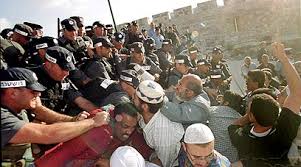
(Erev Yom Kippur all Jewish visitors were turned away as Arabs rioted on Har HaBayit to prevent their ascent)

Last week, our synagogue in Beit Shemesh made its annual High Holy Day week visit to the Temple Mount. We began the tradition six years ago when the site was reopened to non-Muslims. During the first three years following the start of the September 2000 war launched against Israel by the Palestinian Authority, Hamas and Hizbullah, the government decided to reward Arab terror by barring all non-Muslims from even setting foot on the Temple Mount.

Visiting the Temple Mount is a schizophrenic experience. When standing there, it is impossible not to be awestruck by the magnitude of where you are and the enormity of the colossal events that took place there. It is on the Temple Mount that both the First and Second Temple stood for nearly 1,000 years, where millions of Jews from all over the Land of Israel and the Diaspora made the three festival pilgrimages and where, according to Jewish belief, the Third Temple, ushering in the days of the messiah, is destined to be built. Throughout history, whenever and wherever Jews were engaged in prayer, they faced Jerusalem. And when in Jerusalem, they pray in the direction of the Temple Mount.

It boggles the mind to imagine your family tree and to consider when the last time anybody in the family line had been on the Temple Mount. Might that ancestor have been one of the survivors of the fighting that took place there prior to the destruction of the Second Temple by the Romans in 70 CE? Might it have been on Shavuot of that year, the final pilgrimage festival celebrated by the Jewish people prior to the destruction?

But now that I was standing in that holiest of places, which generations of Jews for 2,000 years could only dream of visiting, I was forbidden to pray. Simply moving my lips in whispered prayer could be grounds for removal. Why? Because I am a Jew. And only a Muslim can pray on the holiest site in Judaism. A Jew may not.

DURING THE War of Independence in 1948, the Old City of Jerusalem fell to the Jordanians. Nearly 1,500 Jews, including many women and children, were killed. While it was under Jordanian control, dozens of Jewish synagogues, many centuries old, were destroyed and the cemetery on the Mount of Olives, where Jews have been buried for 2,500 years, was desecrated. For 19 years, no Jew was allowed to set foot in the Old City or pray at the Western Wall, the retaining wall of the Temple Mount closest to where the Temples stood.

In June 1967, when Egypt, Syria and Jordan embarked on a war to annihilate the Jewish state, Israel recaptured Jerusalem's Old City. One of the most stirring announcements in Jewish history was the message transmitted from the front during the Six Day War: "The Temple Mount is in our hands."

But then, in a mind-boggling display of attempted appeasement of an enemy that just days before had sought Israel's destruction, defense minister Moshe Dayan decided to allow the Muslim religious council, the Wakf, to retain administrative authority over the Temple Mount. Thus, a truly bizarre and unacceptable situation developed.

Israel has scrupulously upheld Muslim worship at the Aksa Mosque, which was built just off the supposed site of the Temples, even when the site has been used to stone Jewish worshipers at the Western Wall and sermons are delivered calling for the demise of Israel and the US. Nor have Muslim prayer services been banned even in the worst periods of Arab terror attacks. During the just-completed Ramadan, hundreds of thousands of Arabs prayed at al-Aksa and held nighttime picnics on the Temple Mount breaking their fast. The garbage and leftover food items we saw strewn over the Temple Mount during our visit was appalling.

But in glaring contrast, Israel has, for the past 43 years, failed to challenge the Muslim ban on Jewish worship on the Temple Mount. On our visit, the number of Jews allowed up at one time was severely limited, we were checked for any religious items, which cannot be brought onto the Temple Mount by a Jew, and we were warned by the police not to even whisper a prayer.

THE STATUS quo is woefully offensive and intolerable. Never mind that at no time during the lengthy Muslim control over much of the Middle East did the Muslims ever designate Jerusalem as an imperial capital or even as a provincial or subprovincial capital. Even if we choose to overlook this very relevant history, the pattern of Islamic religious imperialism, exemplified by the Wakf's contemptible conduct on the Temple Mount, must not be ignored.

The problem is not simply that the Arabs have attempted to take as their own every site in Israel holy to Judaism, whether it be the Temple Mount in Jerusalem, the Cave of the Patriarchs in Hebron, Rachel's Tomb in Bethlehem or Joseph's Tomb in Nablus. But in doing so, they have consistently attempted to obliterate the historic Jewish connection and claim to each of those sites.

In the same manner, in the years following the Oslo Accords and Israel's withdrawal from Bethlehem, a concerted policy by the Palestinian Authority to Islamicize the city and terrorize the Christian population resulted in a reduction in the percentage of Christians living there from 60 percent to less than 15% today.

We pay a terrible price when we close our eyes to the trampling of human rights and religious freedom out of fear of enraging the Muslim world. The Temple Mount is a huge area. It is the length of nearly five football fields north to south, and nearly three football fields east to west. It is certainly large enough to accommodate the ancient call of the prophet Isaiah recited in fervent prayer by Jews on Yom Kippur: "My house shall be called a house of prayer for all the nations."

The sooner we take action to help bring this about, the better.
.

Multi-culturalists distort Nazi past to placate Muslims in Germany


Robin Shepherd
Think Tank Blog
27 September 09

What happens when multi-culturalist, anti-Israeli pieties clash with a full and rounded rendition of the Nazi past? If recent events in Berlin (of all places) are anything to go by the answer may be as follows: important truths will be denied so that those multi-culturalist, anti-Israeli pieties may be preserved.

In the most important commentary on the subject for quite some time, Daniel Schwammenthal of the Wall Street Journal Europe relates a story about such events which everyone should read and internalise. It is not only shocking in itself, it holds up an image of one of Europe’s possible futures.

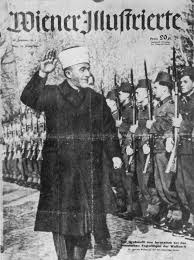
Schwammenthal’s piece pegs off an attempt by a German journalist, Karl Rössel, to stage an exhibition at a state funded multi-cultural centre in an Arab and Turkish dominated area of Berlin. The exhibition was entitled “The Third World in the Second World War” and included a small section on the Grand Mufti of Jerusalem, Haj Amin al Husseini — the Palestinian leader and national hero who was an admirer of Hitler, a prolific propagandist for the Nazi cause and an active recruiter for the SS in wartime Yugoslavia where he participated in genocide.

Such facts, unfortunately, do not fit with the multi-culturalist narrative in which the people of the third world can only be counted as victims. Nor do they fit with important elements of the anti-Israeli narrative in which, as Schwammenthal notes, the notion that the Palestinians are “paying the price for Germany’s sins” as “the second victims” of the Holocaust is deeply rooted. The event was, therefore, cancelled. The Berlin authorities initially supported the decision but then belatedly and reluctantly backed down following accusations they were pandering to historical revisionism.

In Schwammenthal’s words:

“Mr. Rössel [the author of the exhibition] says this episode is typical of how German historians, Arabists and Islam scholars deny or downplay Arab-Nazi collaboration. What Mr. Rössel says about Germany applies to most of the Western world,where it is often claimed that the mufti’s Hitler alliance later discredited him in the region. Nothing could be further from the truth. In the Mideast, Nazis were not only popular during but also after the war—scores of them found refuge in the Arab world, including Eichman’s deputy, Alois Brunner, who escaped to Damascus. The German war criminals became trusted military and security advisers in the region, particularly of Nazi sympathizer Gamal Nasser, then Egypt’s president. The mufti himself escaped to Egypt in 1946. Far from being shunned for his Nazi past, he was elected president of the National Palestinian Council. The mufti was at the forefront of pushing the Arabs to reject the 1948 United Nations partition plan and to wage a “war of destruction” against the fledgling Jewish state. His great admirer, Yasser Arafat, would later succeed him as Palestinian leader.

“The other line of defense is that Arab collaboration with the Nazis supposedly wasn’t ideological but pragmatic, following the old dictum that “the enemy of my enemy is my friend.” This “excuse” not only fails to consider what would have happened to the Jews and British in the Mideast had the Arabs’ German friends won. It also overlooks the mufti’s and his followers’ virulent anti-Semitism, which continues to poison the minds of many Muslims even today.”

But not, it seems, if you listen to the BBC or read the Guardian or most other bien pensant organs of the media in western Europe. The inconvenient truths about Arab and Muslim anti-Semitism must be denied even if this means providing a distorted picture of the Holocaust and its participants and collaborators.

The other significant part of this story, of course, is that the furore arose in large part because of the location of the planned exhibition in an area dominated by Muslims. But since any discussion of potential problems arising from Europe’s soaring Muslim populations has been a prioridesignated as “racist” by multi-culturalist ideologues, that issue cannot be properly discussed either.

I’m afraid that this is the way things are going in modern Europe. And, be warned, this is just the start of it.

To read Schwammenthal’s excellent piece, click here:

http://calevbenyefuneh.blogspot.com/2009/09/mufti-of-berlin.html#links

For a broader discussion of such issues as they relate to Israel, click here to purchase my recently published book, A State Beyond the Pale: Europe’s Problem with Israel:

http://www.amazon.co.uk/State-Beyond-Pale-Europes-Problem/dp/0297856642/ref=sr_1_1?ie=UTF8&s=books&qid=1254042089&sr=8-1


The Master Plan


Ted Belman
Israpundit
25 September 09

Conventional wisdom tells us that western Europe and America are pressing Israel for concessions in order to placate the Arabs. In my recent Israel can and must act in her own best interests. I wrote

    Shortly thereafter (1938) Ben Gurion made his case to Malcolm MacDonald, the Colonial Secretary, who suggested, that the Arab and Muslim world could rise up and threaten the British Empire and therefore to prevent this, Britain had to make sure that the Jews in Palestine remained a minority.

But Menachem Begin had a different take which he set out in his 1948 book, The Revolt. This book is Begin’s reflection on the Jewish revolt against the British, which he lead. He likened this revolt to the revolt by the Maccabees against the Greeks in Second Century BCE and by the Jews against the Romans in the First Century CE and by Bar Kochba against the Romans in the Second Century. But he also foresaw a Maccabee-like victory rather than Bar Kochba-like defeat.

Begin advises that Britain had long wanted Palestine for itself well before the Balfour Declaration. When Herzl was still alive, Lord Cromer of Britain, said “When the Ottoman Empire crumbles, as sooner or later it will, we (Britain) must have Palestine.”

Britain generally had a policy of cloaking their goals with a lofty ideals, such, as in this case, giving the Jews a national home. So in furtherance of her “Master Plan” in the late Nineteenth Century she kept complaining of Turkey’s treatment of the Jews.

The best way for Britain to gain control of Palestine was to act ostensibly on behalf of the Jews. This was born out in the Balfour Declaration in 1917 in which the British Government backed the creation of a Jewish homeland in Palestine, mind you, not Palestine as the Jewish homeland. Britain would have Palestine and the Jews would have a homeland in it. Britain had no fears that too many Jews would want to come. Afterall they were not pioneers and certainly not fighters. The blueprint evolved: the Arabs when required would “revolt” against the “foreign invasion”; the Jews would be forever a threatened minority. Thus Britain would be called upon to maintain the peace. Unfortunately for them, as Robbie Burns wrote, “The best laid schemes o’ mice an’ men gang aft agley,”

Throughout the twenties and thirties the British encouraged the Arabs to “revolt”. But because of the Holocaust, the Jews kept coming. Britain in order not to lose control had to limit their entry.

Thus the Peel Commission in the late thirties recommended in a White Paper that only 75,000 Jews more, be allowed into Palestine by 1944. The Jews had to be kept to a minority at all costs. In fact Hitler’s Final Solution played into their hands as there would be less Jews left to emigrate to Eretz Yisroel. The British spin machine went into overdrive and overtime. “Afterall, couldn’t let German spies into Palestine, could we.”

During this period, the Jewish leadership followed a policy of self-restraint known as “havlagah”. But Vladiimir Jabatinsky, the founder of Betar, would have none of it. He preached resistance and revolt until his death in 1940. Out of his teachings was born the Jewish underground army The Irgun and another underground group, Fighters for Freedom of Israel which later became known as the The Stern Gang after their slain leader.

In early 1944 The Irgun declared war on Britain demanding an “immediate transfer of power to a Provisional Hebrew Government” and announced a call to arms for all Jews. The British reaction amounted to, “What chutzpah!”.

Shortly thereafter, the revolt brought about the neutralization of the Arab factor. They ceased to do the British bidding. Only after the British announced that they were leaving Palestine and the Arab countries declared war on the future Jewish state did the local Arabs return to their attacks.

Britain expected that the Stern Gang and The Irgun would fight them and maybe even the Haganah would join in. They were confident they would crush them just as the Romans crushed the Jews 2000 years earlier. They would force the Jewish leaders to collaborate and hunt them down just like the Nazis did. They planned to get the support of the US for their plan arguing it was necessary to prevent Russian expansion into the Middle East. All this was set out in a document marked “Secret” prepared by the British “Cairo Bureau” which came into the hands of The Irgun.

The revolt depended on the willingness of the Jews to fight to the death. And they were not found wanting. According to Begin, but for the revolt, the state of Israel would not have come into existence. According to Ben Gurion, who usually opposed Begin, but for him the state would not have survived the war waged by the Arab counties after the state was declared. They were both right. Begin had forced Britain out and Ben Gurion had prepared Israel to defend itself by building an army and keeping the country unified.

A month before the State of Israel was declared, The Irgun and others, attacked Deir Yassin, an Arab village. There is much dispute on the numbers killed. Wikipedia reports

    The massacre became a pivotal event in the Arab-Israeli conflict for its demographic and military consequences. The narrative was embellished and used by various parties to attack each other—by the Palestinians to besmirch Palestine’s Jewish community, and later Israel; by the Haganah to play down their own role in the affair; and later by the Israeli Left to accuse the Irgun and Lehi of violating the Jewish principle of “tohar hanashek” (purity of arms), thus blackening Israel’s name around the world.[6] News of the killings sparked terror within the Palestinian community, encouraging them to flee from their towns and villages in the face of Jewish troop advances, and it strengthened the resolve of Arab governments to intervene, which they did five weeks later by invading Palestine, following Israel’s declaration of independence on May 14.[2]

Begin advises that it was a very important military target and that the fighting was fierce. He adds;

    Yet the hostile propaganda disseminated throughout the world, deliberately ignored the fact that the civilian population of Deir Yassin was actually given a warning by us before the battle began. One of our tenders carrying a loud speaker was stationed at the entrance of the village and it exhorted, in Arabic, all woman and children and aged to leave their houses and to take shelter on the slope of the hill. By giving this humane warning our fighters threw away the element of complete surprise, and thus increased their own risk in the ensuing battle.

Many, though not all, heeded the advice.

    Our men were compelled to fight for every house; to overcome the enemy they used large numbers of hand grenades. The civilians who had disregarded our warnings, suffered inevitable casualties.
    (Continue)
    .

Sunday, September 27, 2009

How Israel's Prime Minister Bibi Netanyahu Should Have Concluded His U.N. Speech


Batya Medad
26 September 09

On Friday I wrote my opinon of PM Binyamin Netanyahu's UN Speech. I sent it to my list and received a lot of comments. For that reason, I found myself writing what I think would have been a polite and diplomatic way of telling the world to cut off the pressure. We're not contiuing with our dangerous self-destructive policies.

Here's my suggestion as to how Bibi should have concluded the speech. How would you have written it?

"As the son a a great historian, I was raised on history and value its lessons. For that reason I can't ignore the past, and I must learn from it. I'm sorry to be forced by facts to say that Israel can no longer offer gestures, Land, to our enemies. We are not attacking them. We behave in a peaceful way. They don't. I hope and pray that some day they will. Peace is up to them. We will endanger ourselves no more."
Related: A Speech For The Ages
.

EDITORIAL: Leader of the Free World no more


The torch has been passed


Washington Times Editorial
27 September 09

Israel is looking like the new leader of the Free World. The previous leader, the United States, resigned this role last week at the United Nations to take the position of global community organizer. This was made plain by President Obama in his speech, titled "Responsibility for Our Common Future," in which he heralded "a new chapter of international cooperation." By contrast, Israeli Prime Minister Benjamin Netanyahu delivered a blunt and forceful call to action in the central challenge facing free people today. This is the struggle of "civilization against barbarism" being fought by "those who sanctify life against those who glorify death."

Mr. Obama's address was the predictable mix of criticism of the past policies of the United States, self-praise for correcting said policies and vague calls to united action on matters of collective interest. It sought to ingratiate rather than offend. But Mr. Netanyahu chastised the United Nations for its "systematic assault on the truth." He spoke truths that Mr. Obama would never whisper regarding the regime in Iran, which is "fueled by an extreme fundamentalism" and an "unforgiving creed." Mr. Netanyahu rebuked those members who countenanced Iranian President Mahmoud Ahmadinejad's diatribe before the same world body, rightly calling it a "disgrace."

Mr. Netanyahu repeatedly paid tribute to the blessings of liberty and "the allure of freedom." He marveled at the technological advances freedom made possible. He asked if the international community would support the Iranian people "as they bravely stand up for freedom." He envisioned a future of Israel and Palestine, "two free peoples living in peace, living in prosperity, living in dignity." Mr. Obama, meanwhile, touted the imperative of responding to global climate change and mentioned as an afterthought that democracy should not be an afterthought.

Israel stands out because it understands the central challenge faced by the civilized world and by its willingness to take action. Israel is readying to stem the tide of barbarism and stand up to the threat of a nuclear Iran. In return, it asks only for moral support. "If Israel is again asked to take more risk for peace," Mr. Netanyahu said, "we must know today that you will stand with us tomorrow." He challenged the countries of the world with a clear-cut test: "Will you stand with Israel? Or will you stand with the terrorists?"

Mr. Obama said in closing that "we call on all nations to join us in building the future that our people deserve." But people only deserve what they have earned. Mr. Netanyahu called on the civilized world to "confront this peril, secure our future, and, God willing, forge an enduring peace for generations to come." Sometimes the future doesn't come without a fight.
.

Saturday, September 26, 2009

The History Behind Netanyahu’s History


Rick Richman
Contentions/Commentary
25 September 09

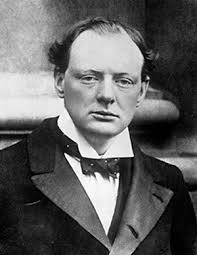
Benjamin Netanyahu’s speech to the United Nations was steeped in history–history denied by some members of the UN, and lessons of history ignored by others. He ended by stating that peace would ultimately depend on whether the international community confronted, or accommodated, the forces led by Iran. His concluding paragraphs offered a quotation from Churchill:

Over seventy years ago, Winston Churchill lamented what he called the “confirmed unteachability of mankind,” the unfortunate habit of civilized societies to sleep until danger nearly overtakes them.

Churchill bemoaned what he called the “want of foresight, the unwillingness to act when action will be simple and effective, the lack of clear thinking, the confusion of counsel until emergency comes, until self-preservation strikes its jarring gong.”

I speak here today in the hope that Churchill’s assessment of the “unteachability of mankind” is for once proven wrong.

There is a history behind the Churchill quotation, unspoken by Netanyahu, that is necessary to recount in order to appreciate its full import.

The quotation came from Churchill’s speech to the House of Commons on May 2, 1935, on German rearmament, which had proceeded much more rapidly than the government’s intelligence had indicated and had already reached a stage that was beyond the power of “engagement” to reverse. It caused Churchill to ask why steps had not been taken two or three years before, when “alarm bells [had been] set ringing, and even jangling:”

It is possible that the dangers into which we are steadily advancing would never have arisen. . . . [But] when the situation was manageable it was neglected, and now that it is thoroughly out of hand we apply too late the remedies which then might have effected a cure.

Then Churchill provided his own answer to why England had allowed the situation to reach the point where the Germans, through rearmament, would shortly be able “if they chose — and why should they not choose? — to reverse the results of the Great War:”

There is nothing new to the story. It is as old as [Rome]. It falls into that long, dismal catalogue of the fruitlessness of experience and the confirmed unteachability of mankind. Want of foresight, unwillingness to act when action would be simple and effective, lack of clear thinking, confusion of counsel until the emergency comes, until self-preservation strikes its jarring gong — these are the features which constitute the endless repetition of history.

Netanyahu left out Churchill’s references to “the fruitlessness of experience” and the “endless repetition of history.” The omission was undoubtedly intentional, reflecting Netanyahu’s concluding hope that the history he had recounted would be a teachable moment, not another instance of the “unteachability of mankind,” and that the world would not be condemned to repeat that history.

His history lesson was reinforced by the speech from the same podium by the president of Iran–who has repeatedly expressed intentions at least as clear as those Churchill discerned in 1935 and who presides over an armament program even clearer and more dangerous than Germany’s at that time.

But Netanyahu was also preceded by the president of the United States, who delivered an extraordinarily self-referential speech, with no sense of either history or the storm gathering before him. Obama’s speech may someday stun historians–except, perhaps, for those aware he began his term by packing up the bust of Churchill and writing on it “Return to Sender.”
.

Are the Iranians Worried About That New Deadline?


Jonathan Tobin
Contentions/Commentary
25 September 09

Along with the leaders of Britain and France, President Obama was forced today to take time out of the G-8 Summit to react to the announcement that Iran has been building a secret underground plant to manufacture nuclear fuel. What followed was the announcement that Iran had a deadline of two months to comply with international demands to halt its nuclear program or it would face sanctions. This makes it sound as if real pressure is about to be ratcheted up on Tehran. Supposedly, this means that unless the Iranians allow the International Atomic Energy Agency to conduct an immediate inspection of the facility, the West will press for new, tougher sanctions on Iran. Obama hopes that his recent appeasement of Russia by breaking faith with Poland and the Czech Republic on missile defense will mean that the Putin/Medvedev regime will finally play along on sanctions and drag the Chinese with them.

It’s a nice theory, but Mahmoud Ahmadinejad, fresh off another vile Holocaust-denying speech at the United Nations, may not exactly be shaking in his boots about the prospect of Western resolve. Years of feckless Western diplomacy (outsourced by the Bush administration to France and Germany) did nothing but convince the Iranians that no one outside of Israel was serious about stopping them. And after months of outreach from the Obama administration, including an astonishingly weak response to their brazen theft of a presidential election and brutal crackdown on dissidents, it’s not clear that the threat of sanctions is one the Iranians take seriously.

As for what would happen after the two months if the deadline is not adhered to, Tehran understands all too well that the negotiations between the United States, its Western allies, and Iran’s erstwhile friends in Moscow and Beijing would be long, tedious, and likely to produce something short of the draconian measures necessary to produce significant leverage.

Just as important is that the two-month deadline, though seemingly indicative of some spine on behalf of the West, is hardly the sort of ultimatum likely to spur panic among the leaders of the Islamist regime. It is, in fact, not the first multi-month deadline Iran has recently received. When U.S. Secretary of Defense Robert Gates was in Israel over the summer, he attempted to placate his anxious hosts by saying that America had given Tehran only until the United Nations General Assembly to respond to Obama’s overtures before the clock would start on stronger sanctions. So, far from being the harbinger of a new era of resolve on the issue, the new two-month deadline is in effect an extension on the previous demand placed on Iran. This must lead Ahmadinejad to reason that no matter what his government does or doesn’t do between now and the end of November, it may be a reasonable bet that this date will be merely the beginning of a new period during which Washington will say diplomacy must be given just one more chance.

We may hope that Obama’s rhetoric today is the beginning of a new era of American seriousness about the threat from Iranian nukes. But when seen in the context of what has recently preceded it, and the clear preference on the part of the president and our allies for “engagement” rather than action on the issue, optimism in Tehran about their chances of further successful defiance of international opinion may well be justified.
.

An Enfeebled Obama


Caroline Glick
carolineglick.com
25 September 09

If Zbigniew Brzezinski had his way, the US would go to war against Israel to defend Iran's nuclear installations.

In an interview with the Daily Beast Web site last weekend, the man who served as former US president Jimmy Carter's national security adviser said, "They [IAF fighter jets] have to fly over our airspace in Iraq. Are we just going to sit there and watch? We have to be serious about denying them that right. If they fly over, you go up and confront them. They have the choice of turning back or not."

Brzezinski has long distinguished himself as one of the most outspoken Israel-haters in polite circles in Washington. Under normal circumstances, his remarks could be laughed off as the ravings of a garden variety anti-Semite. But these are not normal circumstances. Brzezinski served as a senior foreign policy adviser to Barack Obama during his 2008 presidential campaign, and his views are not terribly out of place among Obama's senior advisers in the White House. In an interview in 2002, Samantha Powers, who serves as a senior member of Obama's national security council, effectively called for the US to invade Israel in support of the Palestinians.

The fact of the matter is that Brzezinski's view is in line with the general disposition of Obama's foreign policy. Since entering office, Obama has struck a hard-line position against Israel while adopting a soft, even apologetic line toward Iran and its allies.

For eight months, Obama has sought to force Israel to the wall. He has loudly and repeatedly ordered the Netanyahu government to prevent all private and public construction for Jews in Israel's capital city and its heartland in order to facilitate the eventual mass expulsion of Jews from both areas, which he believes ought to become part of a Jew-free Palestinian state.

Until this week, Obama conditioned the resumption of negotiations toward peace between Israel and the Palestinians on such a prohibition of Jewish building and so encouraged Fatah leader Mahmoud Abbas to further radicalize his positions toward Israel. Until Obama came around, Abbas had no problem negotiating with Israeli leaders while Jews were building homes and schools and other structures in Jerusalem, Judea and Samaria. But with Obama requiring a freeze of all such construction, Abbas made clear in an interview with The Washington Post in May that he couldn't talk to Prime Minister Binyamin Netanyahu without looking like a sellout.

Obama made no equivalent demands of the Palestinians. He did not precondition talks on freezing illegal Arab construction in Jerusalem, or on dismantling the Aksa Martyrs Brigades terrorist group, or even simply on setting aside the Palestinian demand that Israel release convicted terrorists from its prisons. To the contrary, he has energetically supported the establishment of a Palestinian unity government between Fatah and Hamas - which the US State Department has since 1995 designated as a foreign terrorist organization to which US citizens, including the US president, are required by law to give no quarter.

As for Iran, during his meeting with Netanyahu in May, Obama gave the clear impression that the Iranian regime had until September to accept his offer to negotiate the disposition of its nuclear installations. But it is now September, and in its belated response to Obama's generous offer of engagement, Iranian President Mahmoud Ahmadinejad's regime rejected the terms of Obama's engagement out of hand. Obama did not retaliate by taking his offer to negotiate off the table or - perish the thought - working to implement the sanctions he had pledged would follow an Iranian rejection of his open hand.

Instead, Obama announced that he is sending a senior US official to meet with the Iranians on October 1. And with that announcement, any residual doubt that Obama is willing to live in a world in which Iran is armed with nuclear weaponry dissipated completely.

In the meantime, in his address to the UN General Assembly on Wednesday and in his remarks at his meeting with Netanyahu and Abbas on Tuesday, Obama made clear that, in the words of former US ambassador to the UN John Bolton, he has "put Israel on the chopping block." He referred to Israeli communities located beyond the 1949 armistice lines as "illegitimate."

Moreover, Obama explained that Israel can no longer expect US support for its security if it doesn't bow to his demand that it surrender all of the land it has controlled since 1967.

Apparently it is immaterial to the US leader that if Israel fulfilled his demand, the Jewish state would render itself defenseless against enemy attack and so embolden its neighbors to invade. That is, it matters not to Obama that were Israel to fulfill his demand, the prospect of an Arab war against Israel would rise steeply. The fact that Obama made these deeply antagonistic statements about Israel at the UN in itself exposes his hostility toward the country. The UN's institutional hostility toward Israel is surpassed only by that of the Arab League and the Organization of the Islamic Conference.

So given Obama's positions toward Israel on the one hand and Iran and its allies on the other, it seems clear enough that the logical endpoint of Obama's policies would look something like Brzezinski's recommended course of action. Moreover, Obama's foreign policy as a whole makes it fairly easy to imagine him ordering the US military to open hostilities against a US ally to defend a US adversary - even as that adversary goes out of its way to humiliate Obama personally and the US in general.
(Continue)