Showing posts with label U.S. Iran policy. Show all posts

Friday, November 8, 2013

This is how it works - A deal, and then a war

Keep in mind that most of those, like Meir Dagan, that opposed an attack did so because they thought that the diplomatic option might work, not that Iran could be allowed to have the bomb. And diplomacy — tough sanctions — might have worked, if it were not for the cowardice, ignorance and stupidity of the Obama Administration. But it is not going to be tried. There is going to be a deal. And then there is going to be a war.

Fresnozionism.org..
07 November '13..


Benjamin Weinthal:

The Islamic Republic of Iran has laid a foundation to impose its will on the U.S. and continue its illicit nuclear-weapons program. The elements of a negotiated agreement outlined today in Geneva show the Obama administration engaging in concessionary bargaining with a rogue regime.

Abbas Araqchi, Iran’s deputy foreign minister, declared the U.S. and its partners “accepted the framework of Iran’s proposal,” the components of which entail sanctions relief in exchange for Iran’s suspension of some elements of its nuclear program.

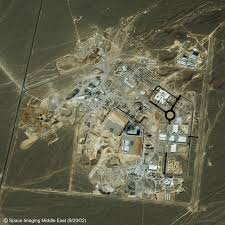
There is no sign that Iran is willing to permanently stop its uranium enrichment, close its Arak and Fordo nuclear facilities, and ship its already 3.5 percent–enriched uranium outside of the country.

Moreover, there is no definitive method of verification to ensure that Iran’s clerical regime — a notoriously deceptive group — will comply with an agreement (Remember the North Korean debacle.)

In choosing to grant Iran concessions, the U.S. ignores that it has crucial economic leverage to dismantle Iran’s nuclear program. Bloomberg recently reported that “Iran’s economy will contract 1.5 percent this year after shrinking 1.9 percent in 2012,” while Trevor Houser, an economics expert, says, “Right now, Iran needs to sell its oil far more than the rest of the world needs to buy it.”

Israel’s PM Netanyahu responded to the news,

The proposal would allow Iran to retain the capabilities to make nuclear weapons. Israel totally opposes these proposals … I believe that adopting them is a mistake of historic proportions.

That is more or less the whole story. There will be more details, but it seems that the US, which could stop Iran from building nuclear weapons, has decided not to. Not only will it not make a credible military threat, it has folded even before exhausting the option of sanctions.

Saudi Arabia understands. It is now either on the verge of procuring nuclear capability from Pakistan, or has already done so.

Tuesday, August 21, 2012

The Case for Iran Attack? Ask Obama.

Jonathan S.Tobin..
Commentary/Contentions..
20 August '12..

In his column at the Daily Beast today on the prospect of hostilities with Iran, Peter Beinart assumes his usual role: defender of Barack Obama against Israel and its supporters. In this case, it’s the chutzpah of Israel’s government to demand that the administration issue some clear red lines about how long it will wait before taking action against the Iranian nuclear threat that bothers him. Israel’s warning that it may have to act on its own is seen on the left as an attempt to force him to launch an unnecessary war. But Beinart’s complaint that we haven’t had a full-scale debate on stopping Iran is more than a bit disingenuous. Far from no one making a case for the use of force on Iran — which he compares unfavorably to the Bush administration’s efforts to justify the invasion of Iraq — the president has been doing that ever since he started running for president.

If there hasn’t been much contention about pressuring Iran it’s because it’s been one of those issues on which there’s been a clear consensus. Stopping an Islamist regime that hates the West and America and which routinely calls for Israel’s elimination while promoting anti-Semitism and subsidizing terrorism is not a controversial goal. Obama and the Democrats and Romney and the Republicans both agree on this. The only question is which of them is serious about it. Beinart’s call for debate before any promises are made to Israel is part of an effort to back the president’s desire to keep kicking the can down the road until after the November election. Rather than really wanting a debate about a feckless administration policy that has wasted four years on dead-end diplomacy and engagement with Iran and only belatedly enacted sanctions that it are being loosely enforced, what Obama cheerleaders like Beinart really want is to find a way to put on brake on the use of force. But his assertion that no one has made a case for stopping Iran being an “American interest” is simply untrue.

Wednesday, April 21, 2010

Lacking an Iran Policy, The White House Seeks Scapegoat


JINSA Report #: 980
19 April '10

According to The New York Times, "Defense Secretary Robert M. Gates has warned in a secret three-page memorandum to top White House officials that the United States does not have an effective long-range policy for dealing with Iran's steady progress toward nuclear capability."

A journalist wrote to JINSA, "It seems to me the Jewish community has contributed to that (lack of policy) by making the very mention of 'containment' politically toxic-as if even planning for that contingency, however much it is unwanted, is an act of appeasement. Where's the error in my reasoning?"

The short answer is that the Obama Administration has not taken seriously Jewish concerns regarding any foreign policy area. It is an error to think he gave credence to what "the Jews" said about Iran.

The longer answer is the reason we don't have a policy for containing a nuclear Iran, if indeed we don't, is because President Obama appears not to have believed we might have to do it. As a candidate and as President he said a nuclear Iran was "unacceptable." And because it was unacceptable, it wouldn't happen. He would engage the regime, he said, and then be prepared for "crippling sanctions" with international support he said, and then leave "all options" on the table.

He appears not to have anticipated the failure of his first two options.

(Read full report)

Please be a subscriber. Just put your email address in the "Subscribe" box on the upper right-hand corner of the page.
.

Tuesday, February 2, 2010

How Can the U.S. Stop Iran's Nuclear Program if it Doesn't Want to Scare or Hurt the Tehran Regime?


Barry Rubin
The Rubin Report
01 February '10

With virtually simultaneous editorials in both the New York Times and Washington Post, it's clear that the foreign policy establishment is becoming aware that something is wrong with the administration’s Iran policy.


The Times weighed in on January 29 with, “Iran, After the Deadline,” remembering that four years ago the UN started demanding that Iran stop enriching uranium and that President Barack Obama promised to do something about sanctions by the end of December. Since, “Tehran has shown no interest in resolving the dispute over its nuclear program. It is time for President Obama and other leaders to ratchet up the pressure with tougher sanctions.”

With the pomposity only it can muster, “We were glad to see Secretary of State Hillary Rodham Clinton publicly warn China, which seems especially intractable, that it faces diplomatic isolation if it fails to back new sanctions.”

This kind of writing shows the true isolation from reality of the establishment. Let me see now, aside from everything else, China has a huge hold on the U.S. debt. America’s economy is also dependent on imports from China. So is the United States really going to do anything to pressure Beijing? Of course not.

(Read full article)
.

Tuesday, October 13, 2009

Iranian supreme leader mocks America, hails Geneva talks as “great victory” for Iran, vows Israel will be destroyed


Robin Shepherd
Think Tank Blog
13 October 09

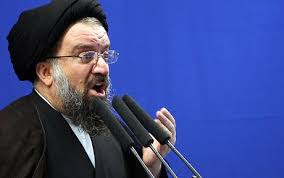
In another one of those stories that doesn’t quite fit the prevailing narratives in much of the West these days and thus went largely unreported, it has emerged that Iran’s supreme leader Ayatollah Khatami used his speech at Friday prayers last week to mock the United States and its allies over Iran’s nuclear programme while repeating old mantras about the destruction of Israel.

According to a dispatch from memri.org (see link below), Khatami scoffed at talks in Geneva the week before last which western leaders and their supine media supporters had hailed as a potential breakthrough in preventing Iran from acquiring nuclear weapons.

On the contrary, Khatami said: “The meeting was a great victory for the Islamic Republic of Iran to such an extent that even the Western and Zionist media had to admit defeat.”

And, he went on:

“Prior to the talks, they (Westerners) used to speak of suspension and sanctions against Iran, but after the talks, there has not been any word of suspension or sanctions, rather, Iran’s package of proposals was the axis.”

Well, that is not quite the version of events we were offered at the time. From President Obama to the leaders of Europe, the talks were hailed, to use Obama’s words, as “a constructive beginning”. Iran, it was widely, reported still had much to do but it was showing signs of bending to our will on everything from the inspections regime to the export of enriched uranium for reprocessing in Russia and France.

As National Security adviser Jim Jones said on CBS’s “Face the Nation” earlier this month: “We now have an Iran that is willing to come to the table.”

Fine. They’ll come to the table, string things out for a few more months, all the while telling their own people a different story and continue apace with the process of acquiring nuclear weapons.

One thing about the Iranian regime is that unless you close your ears and shut your eyes to the evidence, it is really leaving very little doubt about what its real intentions are. Anyone still labouring under any illusions should read “The Rise of Nuclear Iran: How Tehran Defies the West”, a devastating new book by Dore Gold, Israel’s former ambassador to the United Nations (see link below).

As for President Obama’s new approach to the Iranian regime, he got his answer to what they think of his new-look United States on the very day he was awarded his Nobel Prize. Memri quoted Ayatollah Khatami as saying:

“The world arrogance [i.e. the U.S.] should know that Islamic Iran is powerful and strong. Our doctrine is deterrence and not aggression. They (the arrogant states) should not erroneously think of harming the (Islamic Republic) system, because they know pretty well that if they wish inflicting the least damage on the system, they will be slapped in the face so heavily that will never be able to rise up again.”

So even after all the diplomatic initiatives it is still “the world arrogance” that will be “slapped in the face” if it pushes too hard against the Islamist regime.

He also threatened Israel with a third Intifida, which given Iran’s leverage over Hamas should not be taken as idle words. Any such Intifada, he said, “will put an end to the dirty existence of the forged Zionist regime.”

Taken together, the evidence on Iran points only in one direction. The Iranian regime remains as it has always been: an aggressive Islamist tyranny, contemptuous of western values, fully aware of how to play on western weakness, undaunted in its role as the world’s greatest sponsor of terrorism, dishonest in what it says to western journalists as opposed to what it tells its own people, fully committed to the destruction of Israel and firmly on track to get nuclear weapons.

But why face up to the harsh realities when we can just stay asleep?

To read the memri report in full, click here:

http://www.memri.org/bin/latestnews.cgi?ID=SD259309

To buy Dore Gold’s excellent new book, click here:

http://www.amazon.com/Rise-Nuclear-Iran-Tehran-Defies/dp/1596985712/ref=sr_1_1?ie=UTF8&s=books&qid=1255420365&sr=8-1

.


Tuesday, September 29, 2009

Obama Doesn’t Understand: The Alternative to Victory is Defeat


Barry Rubin
The Rubin Report
29 September 09

The problem with President Barack Obama is not that he makes gaffes or factual errors when he speaks but because he expresses an ideological framework so shocking and dangerous.

Take the latest such remark, made in the
G-20 press conference, referring to Iran’s nuclear program:

"I'm not interested in victory. I'm interested in resolving the problem."

Totally detached from actual international conflicts, this is a rational and noble statement. Hey, says Pragmatic Man, I’m not seeking something to brag about, a total victory and my opponent's humiliation. I just want to solve problems and leave everyone happy.

Yet he's not playing a game of bridge here but dueling with a dictatorship that thinks it has divine support and wants to build a massive totalitarian empire. The fact that Obama thinks this way makes him a person not fit to deal with real enemies.

Briefly, here are several reasons why:

--In a misunderstanding with those who are otherwise friends, this "no victory" approach makes sense. If the United States has some minor problem with, say, Canada or the United Kingdom, it would be good to seek a resolution in which it wasn’t a victor. Sure, get the blip in an otherwise good relationship out of the way so the two allies can get back to cooperating on a hundred other matters.

But Obama doesn’t seem to understand the profound difference between friends and enemies. As Obama has repeatedly shown, he is more eager to resolve conflicts with enemies than to back up friends. For him, enemies don’t exist but have only been created by mistaken U.S. policy. Apologies or concessions will suffice to end any friction.

--Obama assumes the other side is rational and well-intentioned. Whether its Libya or North Korea, Cuba or Syria, Iran or Venezuela, Obama simply doesn’t get the idea that dictatorship and ideology, greed and passionate hatred can create forces which don’t want to be friends.

In effect, such regimes have the precise opposite approach to that of Obama: They aren’t interested in resolving the problem. They are interested in victory.

--By making such a statement, Obama speaks as if Iran is a blank slate rather than a country which has repeatedly broken promises on the nuclear issue; called for genocide against Israel; been the world’s leading sponsor of terrorism; killed Americans through terrorist operations in Lebanon, Iraq, Saudi Arabia, and other countries; is ruled by a regime that just stole an election; has violently repressed the opposition and put peaceful activists on trial for their lives; and has a defense minister who is a wanted terrorist.

Iran is not ruled by a regime with which you can just solve problems. And any solution without victory of a sort will not be a solution.

--If Iran intends to build nuclear weapons and the United States opposes this goal how can there be any resolution of the problem without victory? If the Iranian regime builds deliverable nuclear weapons then it wins; if Tehran is stopped from doing so, the United States wins. What kind of conceivable compromise can there be without a victory for one side or the other?

--Obama’s formulation could be sensible with another side whose feelings one didn’t want to hurt unnecessarily. Assuring the other side you don’t insist on total victory can be a soothing factor. Unfortunately in this case it is the radical side which needs to say so. (The Palestinian side and most Arab states need to say this to Israel but never do so. Israel has already said so to the other side but it hasn’t done much good.)

--But most important of all is Obama’s seeming inability to understand the concepts of deterrence and credibility. I’m not exaggerating here. He has never made a single statement incorporating these ideas.

Yes, you need to be tough. Yes, you sometimes have to make threats. Yes, you need to show yourself willing to use force. Yes, you sometimes have to win victories. The leader of a great power needs to do these things to discourage enemies from being more aggressive and disregarding his country’s interests. In addition, the leader of a great power must do these things to encourage friends to rely on him and his country for help and protection.

Obama thinks he is reassuring America’s enemies by apologizing, avoiding conflict, and insisting he doesn’t seek victory. He is reassuring them—reassuring them that they can walk all over the United States without cost.

In totally misconceiving the nature of his own responsibilities and of international affairs, Obama is creating an extremely dangerous situation. One of the many things he doesn’t understand is that his approach makes crisis, bloodshed, and war far more likely.

It is sobering to see the man who holds the world's most powerful job for dealing with international affairs on the planet has no previous experience dealing with this topic. It is horrifying that his ideas ensure disaster for the democratic forces and successes for the dictatorial ones.
.

Wednesday, September 23, 2009

France throws a Pie in Obama's Face: The Increasingly Obvious Failure of Obama's Middle East Policy


Barry Rubin
The Rubin Report
22 September 09

It’s a development of such shocking proportions that it would cause an earthquake if properly noticed and evaluated. President Barack Obama’s entire Arab-Israeli and Iranian policies are miserably failing, though partly concealed by theatrical events and media protection.

Consider the latest development. French Foreign Minister Bernard Kouchner arriving at the UN General Assembly session, stated that he doesn’t favor blocking the export of refined oil products to Iran, the keystone of the new sanctions proposed by Obama.

The New York Times reported this story but grossly underplayed its implications:

“But if France is to come out against fuel sanctions analysts said, they will most likely be off the table as an option for increasing the pressure on Iran.”

Ha! If France does so it will be the end of Obama’s whole strategy against Iran. For Tehran, it will be a straight, largely untroubled run to nuclear weapons, unless derailed by an Israeli attack.
“I think this is a bit dangerous,” Kouchner said about the gas and fuel sanctions. Would that be more dangerous than Iran getting nuclear weapons? But Kouchner did not make clear to whom or what it is dangerous. He did say, however, that it would mostly harm “poor people” in Iran.

[An aside: This is the kind of phony “humanitarian” considerations that paralyze Western policy today. Sure, there is some patriotic reaction against foreign pressures in places like Iran, but do the millions opposing that regime as a repressive dictatorship really want the West to coddle and court their oppressors? Do Gazans favor Western actions ensuring Hamas remains in power? Do Iraqis retrospectively curse Western sanctions against Saddam Hussein’s regime?

[Can the West fight no war because there will be civilian casualties; cannot it not preserve its freedoms because Muslims or others might be offended? Is the “zero-harm” approach an effective way for policy to be conducted, or even for democracies to survive at all?]


Of course, French President Francois Sarkozy may reverse his foreign minister’s stance. Yet still it is extraordinarily significant that such a major ally supposedly wowed by Obama’s charisma and popularity, can publicly do the equivalent of throwing a pie into the president’s face with no consequences.

And there is a virtual parade of pie-throwers. Obama’s Arab-Israeli policy was derailed by similar responses. Israel refused to bow to American demands stated in the most extreme, public and peremptory manner and Obama gave in. Then Egypt, Jordan, Saudi Arabia, and other Arab states all publicly made clear that they would defy the president and reject any confidence-building measures with Israel.

Obama was slapped and pretended nothing happened.

Then the same thing happened with his Iran policy. First, Russia and China rejected his efforts to get their agreement to increased sanctions. Now, France may be doing the same thing. In between, the White House accepted an insulting Iranian message for talks.

Could it be any more obvious? Obama’s salient international characteristic is not popularity but weakness. Already, Obama has been defied or has buckled under to a long list of countries including: China, Iran, Israel, North Korea, Pakistan, Russia, Syria, Venezuela, and now perhaps France.

That is why the conspiratorial notion that Obama is out to sell out Israel is wrong. He will back away if anyone stands up to him. The risk posed by administration policy is not to Israel but to U.S. interests altogether as he seeks to avoid trouble with anyone.

A strong argument could be made that the United States should boycott meetings with Iran altogether. After all, even if the Tehran regime wasn’t working on nuclear weapons, the mere fact that it is a dictatorship that has just stolen an election, repressed a peaceful opposition, put on trial many dissident leaders, and appointed a wanted terrorist as defense minister should be sufficient to inspire such a boycott.

Just this week, there are reports leaked by U.S. military officials—frustrated at White House policy?—that Iran’s Qods force (whose former head is now Iran’s defense minister) is training and arming Taliban gunmen in Afghanistan. The official spin is that this poses no current threat to American forces there. Right. Only when the Taliban soldiers finish their training and go out to kill Americans will there be an immediate threat. Already, though, the same Qods force has been involved in helping to kill Americans in Iraq, according to U.S. intelligence reports.

Instead of action, the administration delivers the photo op of a meeting between Israeli and Palestinian leaders in New York that will enable Obama to portray himself as a great success in peacemaking. In fact, what he has “accomplished”—a meeting of the two leaders—would have happened months ago if Obama’s injection of the construction freeze issue had not given the Palestinians a rationale for suspending talks.

[After I wrote this article, I heard National Public Radio's report on this event. It explained clearly the main problem clearly as Israel not wanting to freeze construction and the Palestinians not wanting to negotiate unless that was done. But it never mentioned that the whole problem arose because Obama made the issue the central factor. In other words, this conflict didn't just arise from Israel or the Palestinians but is all Obama's fault. This is rather typical of how most of the media has dealt with the administration's mistakes.]

Nahum Barnea, arguably the Israeli left’s most distinguished writer, who backs a complete settlement freeze and would like to support Obama, wrote the get-together at the UN meeting, “Is a joke at the expense of an American president who tried to get involved in Middle East politics and was stung….The Americans,” Barnea continued, “discovered that they want an Israeli-Palestinian agreement more than the leaders of both sides desire one.”

Precisely. And in this regard nothing has changed much since 2000 when the Palestinian leadership rejected peace. That reality should have been clear to the Obama Administration from the beginning rather than its attitude of bravado about how it was going to hit the ground running and solve the conflict very fast.

Barnea concluded: Obama “is cool….Yet the U.S. president is not Brad Pitt or George Clooney. He’s supposed to bring results.”

Well-put. While American opinion-makers continue to focus on Obama’s “coolness” and Western Europeans cheer him—what’s not to cheer in an American president who let’s you do whatever you want?—the world is giving him the cold shoulder.
.

Wednesday, September 16, 2009

What Happened to the U.S. Deadline on Iran?


Dore Gold
JCPA /Jerusalem Issue Briefs
Vol. 9, No. 9
16 September 09


  • Iran's new proposal to the West did not provide any opening for serious negotiations on the nuclear issue, but rather vague formulations for the agenda of any future talks. Back in July, when the G-8 announced that the opening of the UN General Assembly "would be an occasion for taking stock of the situation in Iran," most international observers understood that there was a hard September deadline that Iran had to meet to begin serious nuclear negotiations. Unfortunately, at this stage, there is little evidence that the Obama administration is about to adopt effective action in a timely manner in light of Iran's policy of rejectionism, setting aside diplomatic engagement and moving to a policy of severe sanctions.


  • Glyn Davies, the U.S. ambassador to the International Atomic Energy Agency (IAEA), recently acknowledged that the Iranian stockpile of low-enriched uranium has already reached a sufficient level so that it was possible to talk about Tehran having "a dangerous and destabilizing possible breakout capacity." Tehran undoubtedly observed that no serious action was taken against North Korea for its nuclear breakout, either by the Bush or Obama administrations.


  • The common assumption in Washington policy circles today is that even if Iran reaches the nuclear finish-line, the U.S. can fall back on the same Cold War deterrence that was used against the Soviet nuclear arsenal. However, Iran is a true revolutionary power whose aspirations extend into the oil-producing states. It is involved in both the Afghan and Iraqi insurgencies, while its support for terrorism reaches into Lebanon, Gaza, Egypt, Saudi Arabia, and Sudan. With Iran threatening the flow of oil tankers through the Strait of Hormuz as well, through which roughly 40 percent of the world's oil flows, the nuclearization of Iran has global - and not just Middle Eastern - implications.


  • In 2003-2005, Tehran engaged with the EU-3 for two years, exploiting the talks to race ahead with construction of key uranium enrichment facilities, while fending off punitive measures by the UN Security Council for three entire years. Iran today is far more advanced than it was then and the time for diplomatic experimentation is extremely limited.


In the first part of September 2009, it became clear that Iran was defying the U.S. and its Western allies by again refusing to open serious negotiations over its nuclear program, thereby ignoring the deadline it had been given to respond favorably to President Barack Obama's repeated overtures to engage diplomatically. After all, President Mahmoud Ahmadinejad declared on September 7 that, from his point of view, "the nuclear issue is finished." To be clear, he added: "we will never negotiate on the Iranian nation's rights." Days later, Iran's new five-page proposal to the P-5 plus 1 (the U.S., Russia, China, the UK, France and Germany) did not provide any opening for serious nuclear negotiations either, but rather vague formulations for the agenda of any future talks.

Indeed, the Iranian document began by asserting that the world was moving beyond "the difficult era characterized by domination of empires, predominance of military powers," in essence envisioning a period in which the U.S. was no longer a dominant power. It made reference to the need for "complete disarmament," but said nothing about Iran's own nuclear program. In his Friday sermon on September 11, Supreme Leader Ayatollah Ali Khamenei further backed the uncompromising Iranian nuclear stance that Ahmadinejad had voiced and which appeared in the Iranian document. It is to be remembered that Iran is presently in violation of at least five UN Security Council Resolutions that insist it suspend its continuing enrichment of uranium.

The U.S. Sets a September Deadline for Serious Nuclear Talks

Back in July, when the G-8 announced that the opening of the UN General Assembly "would be an occasion for taking stock of the situation in Iran," most international observers understood that there was a hard September deadline that Iran had to meet to begin serious nuclear negotiations. President Obama stated at a July 10 press conference after the G-8 meeting: "We've offered Iran a path towards assuming its rightful place in the world. But with that right comes responsibilities. We hope Iran will make the choice to fulfill them, and we will take stock of Iran's progress when we see each other this September at the G20 meeting."

Unfortunately, at this stage, there is little evidence that the Obama administration is about to adopt effective action in a timely manner in light of Iran's policy of rejectionism, setting aside diplomatic engagement and moving to a policy of severe sanctions. Engagement was the centerpiece of its Middle East policy and has been hard to abandon. For example, while rejecting the newest Iranian proposals on September 10, State Department Spokesman Philip J. Crowley reminded reporters that engagement was still official U.S. policy, stating: "We remain willing to engage Iran."

Moreover, within twenty-four hours he announced the Obama administration's willingness to join the P-5 plus 1 in order to meet with Iranian leaders directly and open negotiations, despite the repeated statements coming out of Tehran. The hard-line Iranian newspaper Javan noted the dramatic U.S. shift on September 14: "One day after the hasty response to Iran's updated package of proposals, America made a U-turn and announced that because these proposals could become a basis for direct talks with Iran, it accepts the talks over this package." Indicating Iranian understanding of the new U.S. policy, the article was entitled: "The Inevitable Acceptance of Nuclear Iran."

The first meeting between the two sides reportedly will take place in early October when Javier Solana, the EU foreign policy chief, meets with Saeed Jalili, the chief Iranian nuclear negotiator. They will be joined by representatives from the P-5 plus 1, but, according to Solana's office, the meeting will not yet be a "formal negotiation," which presumably will come at a later stage. The September deadline appeared to have vanished and the Iranians have gained valuable time.

(Continue)