Showing posts with label Begin. Show all posts

Thursday, November 2, 2017

‘Revisionist’ NY Times Suddenly Discovers New Love for Jabotinsky, Begin - by Ira Stoll

If Netanyahu can take any solace from this, it is that he can be secure and confident in the knowledge that, 40 years from now, the Times will be invoking him as a model of moderation in comparison to whoever then occupies the Israeli prime minister’s office. The only Revisionist Zionist the Times likes, alas, are ones who aren’t currently prime minister. In the meantime, it’s really wonderful to see the Times finally coming to its senses on the question of Jabotinsky and Begin. May the newspaper eventually make similar progress in respect to Netanyahu.

Ira Stoll..
Algemeiner.com..
01 November '17..

The New York Times runs a truly overheated and ridiculous “Memo From Jerusalem” by Isabel Kershner under the headline “Is the End of Israeli Democracy Nigh? Israelis Debate Its Future.”

Rather than focus on the many silly aspects of the article, I decided, for once, to focus on something worth praising. Describing Israel’s president, Reuven Rivlin, the Times writes:

Mr. Rivlin champions the old-school nationalist but liberal democracy envisioned by the right-wing Zionist Revisionist movement of Zeev Jabotinsky and Menachem Begin, who pushed for a greater Israel territorially but were sticklers for defending minority rights and the rule of law.

This made me laugh out loud. The Times now declares that Jabotinsky and Begin were liberal democrats, “sticklers for defending minority rights and the rule of law.” What a change — and a welcome change — this is from how the Times covered Begin and Jabotinsky in years past.

Let’s review the record.

(Continue to Full Post)

Updates throughout the day at http://calevbenyefuneh.blogspot.com. If you enjoy "Love of the Land", please be a subscriber. Just put your email address in the "Subscribe" box on the upper right-hand corner of the page.Twitter updates at LoveoftheLand as well as our Love of the Land page at Facebook which has additional pieces of interest besides that which is posted on the blog. Also check-out This Ongoing War by Frimet and Arnold Roth. An excellent blog, very important work. 
.

Wednesday, March 7, 2012

Weinthal - Bibi, the Begin Doctrine, and the U.S.

Benjamin Weinthal..
National Review Online..
07 March '12..

Israeli prime minister Benjamin Netanyahu delivered a speech on Monday at the AIPAC conference reinforcing the Begin Doctrine — the preemptive-military-strike doctrine of Israel’s government since the early 1980s. This week marks the 20th anniversary of the death of former Israeli prime minister Menachem Begin. His administration declared that Israel’s “determination to prevent confrontation states . . . from gaining access to nuclear weapons” will be applied to hostile countries seeking to develop nuclear arms.

Bibi Netanyahu said Israel cannot “accept a world in which the Ayatollahs have atomic bombs.” With those words Netanyahu issued the 2012 version of the Begin doctrine. In short, in light of the Holocaust and the lethal anti-Semitism of the clerical regime in Tehran, Israel cannot tolerate the toxic combination of weapons of mass destruction with a regime determined to “wipe Israel off the map.”

The Begin Doctrine has been implemented twice in the young history of the Jewish state. In June 1981, Israel launched Operation Opera, sending eight F-16 fighter jets to destroy the Osirak nuclear reactor outside Baghdad. After two minutes of precision bombing, the reactor was reduced to a pile of rubble. In September 2007, Israeli jets launched Operation Orchard, targeting Syria’s secret nuclear facility at al-Kibar.

Tuesday, February 15, 2011

Peace Does Not Come from Pieces of Paper

Daniel Greenfield
Sultan Knish
14 February '11

For 33 years the Camp David accords between Egypt and Israel were used as proof that negotiated accords could and would bring peace in the Middle East. But the peace accords could not outlast Sadat and his VP Mubarak. With Sadat assassinated by the Muslim Brotherhood, and Mubarak driven out by a Brotherhood-Leftist alliance, the peace accords have proven themselves to be every bit as useless as the critics said they were.

Ayman Nour, one of the leading liberal opposition politicians, has declared that the Camp David accords are over, and might be preserved only if Israel agrees to end the demilitarization of the Sinai. There is no reason for Egypt to keep troops in the Sinai, except in preparation for another war. Nour's call actually echoed a similar call by Hamas leader Mahmoud Al-Zahar. Which shouldn't come as a surprise.. Hamas is the Muslim Brotherhood's affiliate in Israel, and Ayman Nour has been coordinating his activities with the Muslim Brotherhood. He met with Mohammed Badie, the leader of the Muslim Brotherhood, at the end of last year to discuss forming a shadow parliament.

The argument that the overthrow of Mubarak would not lead to an Islamist state was based on the liberal secular figureheads like Nour and ElBaradei. But ElBaradei and Nour are allied with the Brotherhood. While the liberals have contending candidates and parties, the Muslim Brotherhood has a single chain of command. The Brotherhood couldn't beat Mubarak, but it's child's play for them to play divide and conquer, turning into kingmakers and eventually into kings. Chaos is in their interest. The Communists and Nazis didn't take power because they were the most popular choices, they were just the most organized movements in a chaotic political landscape. While Soros's sweethearts wrangle and agitate, the Brotherhood will form their coalitions and wait in the wings. Hezbollah outwaited the Cedar Revolution. The Brotherhood will outwait the Jan 25th uprising and sweep in when the ordinary Egyptian begins to long for someone to restore order. That someone will either be the military or the Brotherhood. There are no other choices.

For Israel these events should serve as a wake up call. Far too many have romanticized the Camp David accords as an agreement between two peoples, when it was actually an accord with a regime. Sadat did an excellent job of putting on a show, but it was always a hollow spectacle. Sadat did not want peace with Israel. He had wanted peace, the Yom Kippur War would have never taken place. It was only after he had taken his best shot at destroying Israel and failed, that the Accords became possible. The Camp David accords were not motivated by peace, but by trying to make the best of a bad situation. Egypt had fought four wars with Israel. Even with a surprise attack, high end equipment, superior numbers and arguably superior tactics-- it still lost.

(Read full "Peace Does Not Come from Pieces of Paper")

If you enjoy "Love of the Land", please be a subscriber. Just put your email address in the "Subscribe" box on the upper right-hand corner of the page.
.

The legacy of a teetering peace

Caroline Glick
carolineglick.com
14 February '11

http://www.carolineglick.com/e/2011/02/the-legacy-of-a-teetering-peac.php

One of the first casualties of the Egyptian revolution may very well be Egypt's peace treaty with Israel. The Egyptian public's overwhelming animus towards Jews renders it politically impossible for any Egyptian leader to come out in support of the treaty.

Over the weekend, the junta now ruling Egypt refused to explicitly commit themselves to maintaining the treaty. Instead, under intense American pressure they sufficed with stating that they would maintain all of Egypt's international obligations.

According to news reports, the generals themselves are split in their positions on Israel. One group supports maintaining the treaty. The other supports its abrogation.

Ayman Nour, the head of the oppositionist Ghad Party and the man heralded as the liberal democratic alternative to Mubarak by Washington neo-conservatives has called for the peace treaty to be abrogated. In an interview with an Egyptian radio station he said, "The Camp David Accords are finished. Egypt has to at least conduct negotiations over conditions of the agreement."

For its part, the Muslim Brotherhood has been outspoken in its call to end the treaty since it was signed 32 years ago.

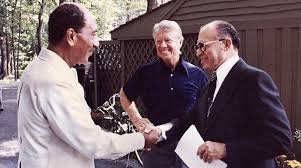
Whatever ends up happening, it is clear that Israel is entering a new era in its relations with Egypt. And before we can begin contending with its challenges, we must first consider the legacy of the peace treaty that then prime minister Menachem Begin signed with then Egyptian president Anwar Sadat on March 26, 1979.

What was the nature of Israel's agreement with Egypt? What was its impact on Israel's strategic vision? What were the strategic assumptions that formed the basis of its component parts? How did all of these issues impact Israel's perception of the long-term prospects for its relations with Egypt?

WHEN BEGIN and Sadat signed the peace treaty, their act was the culmination of 15 months of negotiations catalyzed by Sadat's visit to Jerusalem and his speech before the Knesset on November 20, 1977.

Sadat's visit to Israel's capital was an extraordinary gesture. Here was the man who just four years earlier had waged an unprovoked, brutal war of aggression against Israel that placed the country in mortal danger and killed some 2,600 of its finest sons.

Here was the leader of the country that had fought five unprovoked wars of aggression against Israel in 29 years.

And yet suddenly, here was this man, Israel's greatest foe, standing before the Knesset and declaring that he was not seeking a ceasefire, but peace.

As he put it, "I have not come to you to seek a partial peace, namely to terminate the state of belligerency at this stage...I have come to you so that together we might build a durable peace based on justice, to avoid the shedding of one single drop of blood from an Arab or an Israeli."

The effect of Sadat's visit on the Israeli psyche generally and on Begin's mindset in particular was profound. A new book of the two leaders' correspondence, Peace in the Making: The Menachem Begin-Anwar Sadat Personal Correspondence edited by Harry Hurwitz and Yisrael Medad of the Begin Heritage Center presents readers with a portrait of the Israeli leader enthralled with the belief that he and Sadat were embarking their nations on the road to a peaceful future.


shilohmuse At the Menachem Begin Heritage Center, book launch for 
Peace in the Making: The Menachem Begin - Anwar Sadat Personal Correspondence

But it was not to be. Whether Sadat was purposely deceptive or whether he was simply blocked from implementing his vision of peace by an assassin's bullet in 1981is unclear. True, he committed Egypt committed to peace. The peace treaty contains an entire annex devoted to specific commitments to cultivate every sort of cultural, social and economic tie imaginable. But both Sadat and his successor Mubarak breached every one of them.

As the intervening 32 years since the treaty was signed have shown, in essence, the deal was nothing more than a ceasefire. Israel surrendered the entire Sinai Peninsula to Egypt and in exchange, Egypt has not staged a military attack against Israel from its territory.

Wednesday, October 7, 2009

The Israeli Challenge


Will Bibi follow in footsteps of Begin or Peres in face of Iranian threat?

Yoram Ettinger
Ynet/Opinion
07 October 09

The options of deterrence and retaliation are not available in face of the Iranian terror regime, which sacrificed hundreds of thousands of its people during the 1980-88 war against Iraq. The only option available is that of prevention and preemption.

The Jewish state cannot rely on the US to prevent Iran's nuclearization, especially not on a US that opposes the military option and embraces the options of engagement and sanctions, which have played into the hands of Iran during the last seven years.

In 1981, the heads of Israel's Mossad and military intelligence, then Defense Minister Ezer Weizman and Opposition Head Shimon Peres lobbied Prime Minister Menachem Begin against the bombing of Iraq's nuclear reactor. They contended that the chance of success was negligible and that the prospect of watching the pilots dragged beheaded in the streets of Baghdad was higher than welcoming the pilots back in Israel. They warned that the operation would cause a deep rift between Israel and the US with devastating political, economic and social consequences. They projected the collapse of the Israel-Egypt peace treaty, an all out Muslim war on Israel – without US support – and a significant deterioration of the personal security of Jews around the globe. However, Prime Minister Begin demonstrated a pre-requisite to leadership, asserting that the cost of inaction (a nuclear Iraq) would dwarf the cost of action. He sacrificed short-term convenience on the altar of long-term national security.

In 1981, the US did not fully appreciate the severity of Iraq's nuclear threat. In 2009, the US is fully aware of Iran's nuclear threat. Would Prime Minister Netanyahu follow in the footsteps of Begin, or Peres, in face of a clear and present lethal, nuclear danger?

An Iranian nuclear cloud, hovering above Israel, would not require the launching a nuclear bomb, in order to wreck domestic and external confidence in the future of the Jewish state. Aliya (immigration of Jews) would come to a halt, emigration would surge dramatically, Israel's credit rating and growth projection would collapse, and oversea investors would stay away, causing economic, social and security devastation. Therefore, the Jewish state cannot await a smoking nuclear gun in the hand of Teheran; the Jewish state must prevent the nuclear gun from reaching Teheran's hand.

Ultimate leadership test
In 2009, Iran's nuclear infrastructure benefits from defensive means, which are superior to Iraq's 1981 defense capabilities: proliferation throughout Iran, deep and heavily fortified facilities and most-advanced Russian air defense systems. But, in 2009, Israel's offensive capabilities have improved geometrically, compared with 1981: destruction, precision, penetration and the capability to launch missiles away from the range of enemy radar. In 1981, Israel had only one-time offensive option, which was based on untested modifications of the F-15 and F-16. In 2009, Israel benefits from a number of offensive options, which are based on proved military systems and on superior human and satellite intelligence.

In 2009, the destruction of a few critical nuclear installations would paralyze, or substantially delay, Iran's nuclear effort.

In 1981, the American public and Congress shared the relative-indifference of the Free World toward Iraq's nuclear threat. In 2009, the American public and Congress are fully cognizant of Iran's nuclear threat to US soldiers in the Gulf and in the Indian Ocean, to the US mainland and to Israel. They push President Obama to adopt a more hawkish policy on Iran and they identify with Israel's right of self-defense. Would Israel leverage such attitude by the American public and its representatives in both chambers of Congress, their traditional solid support of the Jewish state and the power of Congress to initiate and stop the supply of sophisticated military systems, in order to enhance Israeli capabilities to prevent the nuclearization of Iran?

A unilateral military Israeli action in 1967 (Six-Day War) and in 1981 (bombing Iraq's nuclear reactor) triggered painful short-term condemnations and sanctions, but accorded the Jewish state with long-term strategic respect. The destruction of Egypt's pan-Arab clout and Iraq's nuclear capabilities reduced Middle East turbulence, dealt a blow to the USSR, bolstered the stability of Saudi Arabia and other pro-US vulnerable regimes, advanced US interests and upgraded Israel's posture of deterrence.

The elimination of Iran's nuclear threat would trigger similar results, in addition to a possible shower of Iranian, Hezbollah and Hamas missiles on Israeli population centers, accompanied by reinforced PLO terrorism. As severe as the cost of a military offensive would be, it would be dwarfed by the cost of avoiding military offensive: A nuclear attack on the Jewish state.

The Iranian nuclear challenge constitutes – for Israel's prime minister, cabinet and Knesset members - the ultimate test of leadership. Will they follow pragmatism, driven by tenacity and the long-term survival interest of the Jewish state, or will they demonstrate "pragmatism," driven by vacillation and short-term needs, which has characterized all Israeli governments since 1992, thus eroding the foundation of the Jewish state.

Ambassador (ret.) Yoram Ettinger, expert on Middle East and US affairs, Executive Director of "Second Thought"
.

Wednesday, September 30, 2009

The Peace With Egypt: 30 Years Old and Still a Terrifying Precedent for Israel


Marty Peretz
The New Republic
30 September 09


The Camp David Accords were signed 31 years ago this mid-month. The actual Israel-Egypt Peace Treaty was sealed 30 years ago this coming March. This was negotiated between Menahem Begin and Anwar Sadat. (The immediate reward for Cairo was annual emoluments of $3 billion, just about what Israel has received for military aid.) No soldiers have taken up arms against each other ever since. No airplanes have flown hostilely over each other's air space, no tanks, no missiles, no nothing. Nonetheless, the normalization of relations that many people anticipated would emerge between the two nations (Egypt being the only historic nation in the entire Arab orbit) has never materialized. A poll taken of 1000 Egyptians in 2006 (true, in the shadow of the second Lebanon war) found that 92% considered Israeli an enemy nation.
Ali Salem, for a time one of Egypt's most popular playwrights and its fiercest satirist,visited Israel in 1994. His life has been one of near-penury ever since. He published apiece in TNR a while back and this did not make his life any better or easier. Salem's travail is not at all idiosyncratic. A few years ago, a distinguished Egyptian film director, a feminist whose name I simply cannot retrieve from my addled brain, was honored by the Jerusalem Film Festival. She was immediately thrown out of her union. And so it goes.
The only sector in Egyptian life which seems relatively content with the detente (it is never more than that) is the military. They do not want to lose their airplanes and tanks for the third time in just about four decades. There is no Soviet Union to replace them. The sectors most hostile to Israel are the political elites (whether in power or permanently out) and the intellectual and cultural elites. These latter are just the folk who in normal societies--like Israel--would be fervently on the side of peace with their neighbors.
This little meditation of mine was occasioned by the news that the Egyptian semi-official (and not so "semi" at that) Al-Ahram publishing syndicate has just banned all (yes, I say "all") contact with any Israelis. This is a most extraordinary boycott for an enormous news operation with great pretense to be to the Arab world what the New York Times is to America. It will not deal with Israelis anywhere. Not interview Israeli diplomats. Not allow Israelis into any of its offices. It all started when the board of directors of the journalistic combine decided to punish one of its editors for meeting the Israeli ambassador someplace in Cairo. This, if you'll pardon me, is completely meshugah. Journalists, indeed.
Barack Obama did not quite expect that such aggressive regressions would be virtually the first concrete responses to his Egyptian overtures. You give them a finger and they'll take an arm. Very much like the reaction of the Saudis to the president's genuflection to their king. I wrote about
.

Tuesday, September 29, 2009

Camp David Syndrome


Ken Blackwell
The American Spectator
25 September 09

Readers who are familiar with the Stockholm Syndrome will recall that it refers to a hostage-taking 1973 incident in that Swedish capital city. Over time, the hostages began to look to their captors as friends and protectors rather than the murderous kidnapers that they truly were.

We are seeing something similar in what I call the Camp David Syndrome. President Obama has just announced the latest effort toward crafting a Middle East Peace Settlement. That grand-sounding title is Beltway-speak for "let's lean on Israel to gain some street cred with the Euros." He's chosen Hillary Clinton as his negotiator.
In 1978, Jimmy Carter brought Egypt's Anwar Sadat and Israel's Menachem Begin together to his mountain top presidential retreat in Maryland's beautiful Catoctin Mountains. There, over days of intense negotiation, Carter brokered what became known in diplomatic lore as the Camp David Accords. Under those agreements, Israel agreed to withdraw her forces from the Sinai Peninsula that she had seized in the lightning Six-Day War of 1967, and re-captured during the 1973 Yom Kippur War. That war had been launched by Egypt's Sadat -- showing the characteristic respect for other faiths that Muslims habitually show -- the Jewish High Holy Days of that year.

Carter hailed his achievement as something just shy of the Second Coming. It wasn't. Carter was led up to that mountain by growing problems on the plain below. Americans were becoming increasingly disenchanted with Jimmy's fecklessness on the domestic front. High interest rates made home ownership impossible for young couples, long gas lines frayed nerves, and rising unemployment made everyone edgy. But Carter felt that success on the international scene could bring him and his embattled party some goodwill from American voters.

It didn't. Barely six weeks after the media hullabaloo over the Camp David Accords, voters trooped to the polls and spanked Carter's party. Between 1978 and 1980, voters gave Republicans 46 seats in the House of Representatives, five more seats than the GOP had lost in the watershed post-Watergate election of 1974.

Still, the myth persists that a Middle East peace agreement will translate into electoral success at home. Carter proved to be a one-trick pony. He received a sharp kick from voters in 1980. They put the pony permanently out to pasture.

What Carter achieved at Camp David is not replicable today. That's because the Israelis in 1978 did not want to occupy Sinai. They agreed that it did not materially contribute to their security. (Israel's Prime Minister Golda Meir used to joke that the Almighty had led the Children of Abraham out of bondage in Egypt, called them to wander for forty years, and told them to settle on the only piece of real estate in the Middle East that has no oil!)

So Carter's fabled diplomacy was not really necessary to persuade the Israelis to disgorge territory that had never been Israeli and that they did not really want. And President Anwar Sadat had a firm grip over Egypt, which one Egyptian diplomat described as the only real nation in the Arab world. "The rest are just tribes with flags," that Arab diplomat memorably said. Besides, Sadat needed money. And the U.S. was ready to purchase a peace.

Despite the fact that Jimmy Carter got a shellacking at the polls in 1978 and 1980, Presidents persist in pursuing the brass ring, or an elusive Nobel Prize, for brokering a Mideast Peace Settlement.

Bill Clinton tried it in 2000. He was playing out an exhausted presidency, grasping for straws. He summoned Israeli Prime Minister Ehud Barak and the "reformed" terrorist leader, Yassir Arafat, to the U.S. He tried to arrange another Camp David breakthrough. Barak made extraordinary concessions, even dangerous ones. No dice. Arafat fomented a second "intifada" against Israel. Clinton's party lost the next Presidential Election.

Then, there was the 2007 Annapolis Conference on Mideast Peace. President George W. Bush chose that week after Thanksgiving to bring a wide range of Arab and Israeli negotiators to the U.S. Naval Academy's historic Yard. Some of the Arab delegates refused to enter the same doorway as the Israelis had entered. Some peace talks. The best we can say for this effort is that it could have been worse. It might have lasted two days instead of just one. And Bush's party lost the next Presidential Election.

What was considered historic about the Annapolis Conference is that for the first time all parties agreed to a "two-state solution." Did the Arab delegates who attended, the ones who refused to enter the same doorway as the Israelis, agree that Israel would be one of those two states? Don't ask.

What we have yet to hear is why the U.S. should want a Palestinian state to be formed in the Mideast. When the Israelis evacuated from Gaza and the local residents held elections, they promptly voted in Hamas, the terrorist organization. Hamas supporters stormed the residence of the late Yassir Arafat and stole his Nobel "Peace" Prize. Now, there's poetic justice.

On the West Bank, Arafat's loyal lieutenant, Abu Abbas, maintains a precarious perch. The U.S. is giving $900 million in aid to his so-called Authority for allegedly humanitarian purposes. This is where bombers use ambulances to run rockets to and from Palestinian hospitals and where children dance in mock explosive belts before PTA meetings in schools named for suicide bombers. This is what we want more of? For Peace's sake? For Pete's sake!

I was amazed to see President Obama come on TV so soon to call for a Mideast breakthrough. I didn't think he was in that much trouble on the domestic front already.
Ken Blackwell is a former U.S. ambassador to the United Nations Human Rights Commission and a senior fellow at the Family Research Council.
.

Monday, September 28, 2009

The Master Plan


Ted Belman
Israpundit
25 September 09

Conventional wisdom tells us that western Europe and America are pressing Israel for concessions in order to placate the Arabs. In my recent Israel can and must act in her own best interests. I wrote

    Shortly thereafter (1938) Ben Gurion made his case to Malcolm MacDonald, the Colonial Secretary, who suggested, that the Arab and Muslim world could rise up and threaten the British Empire and therefore to prevent this, Britain had to make sure that the Jews in Palestine remained a minority.

But Menachem Begin had a different take which he set out in his 1948 book, The Revolt. This book is Begin’s reflection on the Jewish revolt against the British, which he lead. He likened this revolt to the revolt by the Maccabees against the Greeks in Second Century BCE and by the Jews against the Romans in the First Century CE and by Bar Kochba against the Romans in the Second Century. But he also foresaw a Maccabee-like victory rather than Bar Kochba-like defeat.

Begin advises that Britain had long wanted Palestine for itself well before the Balfour Declaration. When Herzl was still alive, Lord Cromer of Britain, said “When the Ottoman Empire crumbles, as sooner or later it will, we (Britain) must have Palestine.”

Britain generally had a policy of cloaking their goals with a lofty ideals, such, as in this case, giving the Jews a national home. So in furtherance of her “Master Plan” in the late Nineteenth Century she kept complaining of Turkey’s treatment of the Jews.

The best way for Britain to gain control of Palestine was to act ostensibly on behalf of the Jews. This was born out in the Balfour Declaration in 1917 in which the British Government backed the creation of a Jewish homeland in Palestine, mind you, not Palestine as the Jewish homeland. Britain would have Palestine and the Jews would have a homeland in it. Britain had no fears that too many Jews would want to come. Afterall they were not pioneers and certainly not fighters. The blueprint evolved: the Arabs when required would “revolt” against the “foreign invasion”; the Jews would be forever a threatened minority. Thus Britain would be called upon to maintain the peace. Unfortunately for them, as Robbie Burns wrote, “The best laid schemes o’ mice an’ men gang aft agley,”

Throughout the twenties and thirties the British encouraged the Arabs to “revolt”. But because of the Holocaust, the Jews kept coming. Britain in order not to lose control had to limit their entry.

Thus the Peel Commission in the late thirties recommended in a White Paper that only 75,000 Jews more, be allowed into Palestine by 1944. The Jews had to be kept to a minority at all costs. In fact Hitler’s Final Solution played into their hands as there would be less Jews left to emigrate to Eretz Yisroel. The British spin machine went into overdrive and overtime. “Afterall, couldn’t let German spies into Palestine, could we.”

During this period, the Jewish leadership followed a policy of self-restraint known as “havlagah”. But Vladiimir Jabatinsky, the founder of Betar, would have none of it. He preached resistance and revolt until his death in 1940. Out of his teachings was born the Jewish underground army The Irgun and another underground group, Fighters for Freedom of Israel which later became known as the The Stern Gang after their slain leader.

In early 1944 The Irgun declared war on Britain demanding an “immediate transfer of power to a Provisional Hebrew Government” and announced a call to arms for all Jews. The British reaction amounted to, “What chutzpah!”.

Shortly thereafter, the revolt brought about the neutralization of the Arab factor. They ceased to do the British bidding. Only after the British announced that they were leaving Palestine and the Arab countries declared war on the future Jewish state did the local Arabs return to their attacks.

Britain expected that the Stern Gang and The Irgun would fight them and maybe even the Haganah would join in. They were confident they would crush them just as the Romans crushed the Jews 2000 years earlier. They would force the Jewish leaders to collaborate and hunt them down just like the Nazis did. They planned to get the support of the US for their plan arguing it was necessary to prevent Russian expansion into the Middle East. All this was set out in a document marked “Secret” prepared by the British “Cairo Bureau” which came into the hands of The Irgun.

The revolt depended on the willingness of the Jews to fight to the death. And they were not found wanting. According to Begin, but for the revolt, the state of Israel would not have come into existence. According to Ben Gurion, who usually opposed Begin, but for him the state would not have survived the war waged by the Arab counties after the state was declared. They were both right. Begin had forced Britain out and Ben Gurion had prepared Israel to defend itself by building an army and keeping the country unified.

A month before the State of Israel was declared, The Irgun and others, attacked Deir Yassin, an Arab village. There is much dispute on the numbers killed. Wikipedia reports

    The massacre became a pivotal event in the Arab-Israeli conflict for its demographic and military consequences. The narrative was embellished and used by various parties to attack each other—by the Palestinians to besmirch Palestine’s Jewish community, and later Israel; by the Haganah to play down their own role in the affair; and later by the Israeli Left to accuse the Irgun and Lehi of violating the Jewish principle of “tohar hanashek” (purity of arms), thus blackening Israel’s name around the world.[6] News of the killings sparked terror within the Palestinian community, encouraging them to flee from their towns and villages in the face of Jewish troop advances, and it strengthened the resolve of Arab governments to intervene, which they did five weeks later by invading Palestine, following Israel’s declaration of independence on May 14.[2]

Begin advises that it was a very important military target and that the fighting was fierce. He adds;

    Yet the hostile propaganda disseminated throughout the world, deliberately ignored the fact that the civilian population of Deir Yassin was actually given a warning by us before the battle began. One of our tenders carrying a loud speaker was stationed at the entrance of the village and it exhorted, in Arabic, all woman and children and aged to leave their houses and to take shelter on the slope of the hill. By giving this humane warning our fighters threw away the element of complete surprise, and thus increased their own risk in the ensuing battle.

Many, though not all, heeded the advice.

    Our men were compelled to fight for every house; to overcome the enemy they used large numbers of hand grenades. The civilians who had disregarded our warnings, suffered inevitable casualties.
    (Continue)
    .