Tuesday, August 30, 2016
The only relevant question today, is what does Israel intend to do next? - by Caroline Glick
Caroline Glick..
Our World/JPost..
29 August '16..
Link: http://www.jpost.com/Opinion/Our-world-The-end-of-Mahmoud-Abbas-466366
Like it or not, the day is fast approaching when the Palestinian Authority we have known for the past 22 years will cease to exist.
PA leader Mahmoud Abbas’s US-trained Palestinian security forces have lost control over the Palestinians cities in Judea and Samaria. His EU- and US-funded bureaucracies are about to lose control over the local governments to Hamas. And his Fatah militias have turned against him.
Palestinian affairs experts Pinchas Inbari of the Jerusalem Center for Public Affairs and Khaled Abu Toameh of the Gatestone Institute have in recent weeks reported in detail about the insurrection of Fatah militias and tribal leaders against Abbas’s PA.
In Nablus, Fatah terrorist cells are in open rebellion against PA security forces. Since August 18, Fatah cells have repeatedly engaged PA forces in lethal exchanges, and according to Inbari, the town is now in a state of “total anarchy.”
In Hebron, tribal leaders, more or less dormant for the past 20 years, are regenerating a tribal alliance as a means of bypassing the PA, which no longer represents them. Their first major action to date was to send a delegation of tribal leaders to meet with King Abdullah of Jordan.
Even in Ramallah, the seat of Abbas’s power, the PA is losing ground to EU-funded NGOs that seek to limit the PA’s economic control over the groups and their operations.
All of this fighting and maneuvering is taking place against the backdrop of the encroaching PA municipal elections, scheduled for October 8.
Hamas is widely expected to win control over most of the local governments in Judea and Samaria. Hamas’s coming takeover of the municipalities is likely playing a role in decisions by Fatah terrorist cells to reject the authority of the PA. Many of those cells can be expected to transfer their allegiance to Hamas once the terrorist group wins the elections.
Given his Fatah party’s looming electoral defeat, more and more PA functionaries are wondering why Abbas doesn’t use the growing anarchy in Palestinian cities as a reason to cancel them. Abbas seems to have calculated that Israel will step in and, as it has repeatedly done over the past 20 years, cancel the elections for him.
Media organs Abbas controls are full of conspiracy theories whose bottom line is that Israel is not canceling the elections Abbas declared because it is in cahoots with Hamas and other “collaborators” to undermine the PA.
Although Israel, of course, is in cahoots with no one, it is the case that the government has apparently finally lost its patience with Abbas and is looking past him.
Repeated angry denunciations by government leaders of Abbas for his lead role in inciting violence against Israelis, leading the international movement to delegitimize Israel, refusing to negotiate anything with its leaders, and radicalizing Palestinian society, are finally being translated into policy.
Tuesday, October 2, 2012
Mohamed Morsi’s message - “It’s my way or the highway.”
Another Tack..
30 September '12..
Egypt’s new leader Mohamed Morsi is proving to be a cunning communicator, at least so far as what he puts across to undiscerning Western ears. He manages to sound exceedingly moderate and reasonable, while enunciating unreasonable, indeed radical demands that must be met or else. He in effect says that “it’s my way or the highway.”
Thus, while seeming to affirm his commitment to the 33-year-old peace with Israel, Morsi at the same time piles up impediments upon which he now makes that peace contingent.
The inescapable inference is that if his conditions are not accepted, he would consider himself absolved of his obligation to keep the peace.
Add to that the fact that his stipulations are all but impossible to accede to and a whole other picture emerges than that which is commonly perceived overseas.
Two examples are particularly disturbing. The first is the strident suggestion from Cairo that it is essential that the 1979 Camp David peace treaty with Israel be amended. What Morsi wants is abrogation of the clauses that demilitarize Sinai and prohibit Egyptian army presence there.
Morsi would rather his foreign audiences forget that Israel gave up Sinai and that its one tangible gain from its great concession was the safety of demilitarization that created a sizable buffer zone. Thus Israel was assured that it could not be surprised by a sudden attack from Egypt. No military entry into Sinai could go undetected.
Any departure from this would negate Israel’s most important security safeguard.
Therefore, what Morsi demands should more than raise a few eyebrows. Additionally, his pretext doesn’t quite hold water. Morsi insists that Israel’s refusal to allow unrestricted Egyptian military might in Sinai bars him from curtailing terrorism and crime in that lawless region.
Sunday, August 12, 2012
The real world consequences of “Land for Peace”
CiF Watch Guest Post..
12 August '12..
Does “land for peace” work?
Recent developments in the Sinai Peninsula, where the ‘Red Sea Riviera’ has spiraled into anarchy and violence, have put into sharp focus the serious consequences of Israel’s initial decision to embrace retreat as a guiding diplomatic philosophy.
The outbreak of hope that erupted following the signing of the 1979 peace treaty between Israel and Egypt was palpable.
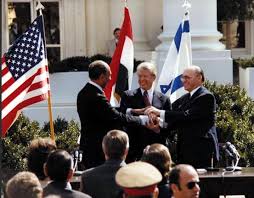
Based on 1978′s Camp David Accords, this first attempt at a comprehensive peace between Israel and one of its neighbors was a valiant attempt to end 30 years of relentless hostility and costly wars.
Did the Israelis truly desire peace?
Well, by withdrawing from Sinai, Israel gave up:
The homes of over 7,000 Israelis
The Alma Oil Field, valued at over $100 billion. Israel would have had energy independence had they held on to it.
More than 170 military installations
Dozens of early warning stations and strategic defense locations
Furthermore, Israel relinquished Taba — a resort built by Israel in what had been a barren desert area near Eilat — to Egypt in 1988. Taba’s status had not been resolved by the Camp David Accords.
In return, what was Egypt’s contribution to peace? A promise to end belligerence and military aggression.
(Read full "The real world consequences of “Land for Peace”)
Updates throughout the day at http://calevbenyefuneh.blogspot.com. If you enjoy "Love of the Land", please be a subscriber. Just put your email address in the "Subscribe" box on the upper right-hand corner of the page.Twitter updates at LoveoftheLand as well as our Love of the Land page at Facebook.
.
Tuesday, May 3, 2011
Truce or Peace? Washington Post Trips Up
CAMERA/Snapshots
02 May '11
http://blog.camera.org/archives/2011/05/truce_or_peace_washington_post.html
Did Egypt under President Anwar Sadat and Israel under Prime Minister Menachem Begin make peace, or merely suspend hostilities? The Washington Post, in an April 29 article headlined “Egypt reasserting its role as regional power broker” confused the record.
A page one teaser said “Egypt: A more assertive stance could mean closer ties to Iran and a rethinking of the truce with Israel. [Page] A 8.” Correspondent Michael Birnbaum’s report referred to “the decades-long truce [emphases added]” between Israel and Egypt.
Birnbaum also wrote that “most Egyptians are skeptical both of the United States and of the 1978 Camp David accords with Israel ....”
CAMERA requested a clarification, pointing out that the relationship between Egypt and Israel is formally defined not by the ’78 Camp David accords but by the 1979 Israel-Egypt peace treaty and is not a truce — which implies a temporary halt in hostilities — but rather a final settlement of their conflict and peace. CAMERA noted that the article did not mention the treaty or the peace.
The Post rejected the clarification request, stating that the word truce was used generically to indicate an agreement to suspend hostilities. The newspaper said that the reference to the ’78 accords conveyed to readers the sense that Israeli-Egyptian peace resulted from a formal agreement.
But what made the ’79 Egyptian-Israeli peace treaty precedent-setting was precisely that it was not a truce, like those of 1948, ’56, ’67, and ’73. In the first three cases, issues unresolved by the truces contributed to renewed warfare. In the case of the post-’73 cease-fire, it required the peace treaty to move the relationship from a suspension of hostilities to peace.
On truce or peace between Israel and Egypt, The Post had a Humpty Dumpty (“When I use a word ... it means just what I choose it to mean — neither more nor less”) moment, at readers’ expense.
If you enjoy "Love of the Land", please be a subscriber. Just put your email address in the "Subscribe" box on the upper right-hand corner of the page.
.
Sunday, February 20, 2011
Camp David destabilized the Middle East??? (updated)
17 February '11
The rhetorical hoops that Israel bashers force themselves to go through get ever more convoluted. Here's a really egregious example, from Patrick Seale in Foreign Policy:
Israel has been unnerved by Egypt's revolution. The reason is simple: it fears for the survival of the 1979 peace treaty - a treaty which by neutralizing Egypt, guaranteed Israel's military dominance over the region for the next three decades.
By removing Egypt -- the strongest and most populous of the Arab countries -- from the Arab line-up, the treaty ruled out any possibility of an Arab coalition that might have contained Israel or restrained its freedom of action. As Israeli Foreign Minister Moshe Dayan remarked at the time: "If a wheel is removed, the car will not run again."
Western commentators routinely describe the treaty as a ‘pillar of regional stability,' a ‘keystone of Middle East diplomacy,' a ‘centerpiece of America's diplomacy' in the Arab and Muslim world. This is certainly how Israel and its American friends have seen it.
But for most Arabs, it has been a disaster. Far from providing stability, it exposed them to Israeli power. Far from bringing peace, the treaty ensured an absence of peace, since a dominant Israel saw no need to compose or compromise with Syria or the Palestinians.
Instead, the treaty opened the way for Israeli invasions, occupations and massacres in Lebanon and the Palestinian territories, for strikes against Iraqi and Syrian nuclear sites, for brazen threats against Iran, for the 44-year occupation of the West Bank and the cruel blockade of Gaza, and for the pursuit of a ‘Greater Israel' agenda by fanatical Jewish settlers and religious nationalists.
In turn, Arab dictators, invoking the challenge they faced from an aggressive and expansionist Israel, were able to justify the need to maintain tight control over their populations by means of harsh security measures.
One way and another, the Israeli-Egyptian treaty has contributed hugely to the dangerous instability and raw nerves which have characterized the Middle East to this day, as well as to the sharpening of popular grievances, and the inevitable explosions which have followed.
Yes, Patrick Seale is really trying to argue that Camp David caused wars, regional instability and somehow caused Arab regimes to mistreat their people.
It takes a mind that is thoroughly twisted by hate to come up with such a scenario.
In Seale's worldview, Israel is, always has been and always will be the aggressor in the Middle East.
He does not seem to have noticed that in the thirty years before Camp David there were 4 regional multi-front wars between Israel and its neighbors; in the thirty years since there have been zero.
(Read full "Camp David destabilized the Middle East?")
If you enjoy "Love of the Land", please be a subscriber. Just put your email address in the "Subscribe" box on the upper right-hand corner of the page.
.
Tuesday, February 15, 2011
Peace Does Not Come from Pieces of Paper
Sultan Knish
14 February '11
For 33 years the Camp David accords between Egypt and Israel were used as proof that negotiated accords could and would bring peace in the Middle East. But the peace accords could not outlast Sadat and his VP Mubarak. With Sadat assassinated by the Muslim Brotherhood, and Mubarak driven out by a Brotherhood-Leftist alliance, the peace accords have proven themselves to be every bit as useless as the critics said they were.
Ayman Nour, one of the leading liberal opposition politicians, has declared that the Camp David accords are over, and might be preserved only if Israel agrees to end the demilitarization of the Sinai. There is no reason for Egypt to keep troops in the Sinai, except in preparation for another war. Nour's call actually echoed a similar call by Hamas leader Mahmoud Al-Zahar. Which shouldn't come as a surprise.. Hamas is the Muslim Brotherhood's affiliate in Israel, and Ayman Nour has been coordinating his activities with the Muslim Brotherhood. He met with Mohammed Badie, the leader of the Muslim Brotherhood, at the end of last year to discuss forming a shadow parliament.
The argument that the overthrow of Mubarak would not lead to an Islamist state was based on the liberal secular figureheads like Nour and ElBaradei. But ElBaradei and Nour are allied with the Brotherhood. While the liberals have contending candidates and parties, the Muslim Brotherhood has a single chain of command. The Brotherhood couldn't beat Mubarak, but it's child's play for them to play divide and conquer, turning into kingmakers and eventually into kings. Chaos is in their interest. The Communists and Nazis didn't take power because they were the most popular choices, they were just the most organized movements in a chaotic political landscape. While Soros's sweethearts wrangle and agitate, the Brotherhood will form their coalitions and wait in the wings. Hezbollah outwaited the Cedar Revolution. The Brotherhood will outwait the Jan 25th uprising and sweep in when the ordinary Egyptian begins to long for someone to restore order. That someone will either be the military or the Brotherhood. There are no other choices.
For Israel these events should serve as a wake up call. Far too many have romanticized the Camp David accords as an agreement between two peoples, when it was actually an accord with a regime. Sadat did an excellent job of putting on a show, but it was always a hollow spectacle. Sadat did not want peace with Israel. He had wanted peace, the Yom Kippur War would have never taken place. It was only after he had taken his best shot at destroying Israel and failed, that the Accords became possible. The Camp David accords were not motivated by peace, but by trying to make the best of a bad situation. Egypt had fought four wars with Israel. Even with a surprise attack, high end equipment, superior numbers and arguably superior tactics-- it still lost.
(Read full "Peace Does Not Come from Pieces of Paper")
If you enjoy "Love of the Land", please be a subscriber. Just put your email address in the "Subscribe" box on the upper right-hand corner of the page.
.
Tuesday, February 16, 2010
Why Isn't There Peace? One Reason: Few People Know How Much is Being Offered

Barry Rubin
The Rubin Report
16 February '10
I’ve been having a dialogue through correspondence lately with someone describing himself as a moderate Palestinian who lives in the United States. What most impressed me in the exchanges--both from what my interlocutor said and how he described the views of other Palestinians--is the total lack of comprehension on their part—those who live in the West Bank and Gaza Strip along with those who live elsewhere, both moderate and radical--about Israeli positions toward peacemaking that are easily available on the public record.
Among Palestinians, as more broadly with almost all of the public in the Muslim-majority world and a lot of the elite classes in Europe, there exists a mythical Israel, reminiscent of the fabricated antisemitic stereotypes of the past, that has little to do with reality. They believe Israel isn't interested in peace, doesn't offer the Palestinians anything, opposes any real Palestinian state, intends to keep the West Bank (until Israel's withdrawal from all of the Gaza Strip they would have added that territory as well), and is led by intransigent hardliners. Such a conception was comprehensible--if not fully accurate--describing the situation in parts of the 1980s but has nothing to do with the last 20 years.
In 2010 they have no idea what Israel actually offered in the 1990s' peace process, or at the Camp David summit in 2000, or what President Bill Clinton offered with Israel's agreement in December 2000, or what Prime Minister Ehud Olmert proffered in 2008, or what is in the current Israeli government’s peace offer in 2010. All proposed the creation of an independent Palestinian state, the first three in close to 100 percent and the last three as equivalent to 100 percent (with some small, equal land swaps) in size to the pre-1967 West Bank and Gaza Strip.
(Read full post)
.
Friday, December 18, 2009
Another Peace Process in Our Time

Rick Richman
Contentions/Commentary
18 December 09
Palestinian President Mahmoud Abbas — currently in the 60th month of his 48-month term, a declared non-candidate for re-election (in the event there is ever another Palestinian election), presently governing only half of the putative Palestinian state — has told Haaretz that a peace agreement could be reached within six months if Israel will make more pre-negotiation concessions.
Peace could be reached not only in our time but with four full months left over to complete Netanyahu’s 10-month settlement freeze. Abbas will hold the football himself.
Not even those on the Left in Israel believe in this process any more. Ari Shavit, writing in today’s Haaretz, notes that:
There’s one small problem: Similar things were said to us when the Beilin-Abbas agreement was formulated in 1995. Similar things were said to us on the eve of Camp David 2000. Similar things were promised us when the Geneva Initiative was signed in 2003. Similar things were promised us when Israel went to Annapolis in 2007.
Six months is in fact exactly what Abbas promised at the beginning of the Annapolis Process in 2007, only to reject still another Israeli offer of a state 12 months later.
.
Sunday, November 1, 2009
'Roz Al-Yousuf' Special Supplement: Normalization with Israel – For and Against
MEMRI
Special Dispatch - No. 2624
30 October 09
To mark the 30th anniversary of the Camp David Peace Accords, the Egyptian weekly Roz Al-Yousuf published a special supplement on the political, economic, and cultural aspects of normalization with Israel.
Following is an overview of the articles and interviews in the supplement: [1]
Normalization - Crime or Complex?
The editorial in the supplement states: "Although much water has flowed under the bridge of Egyptian-Israeli relations since the signing of the Camp David Accords, we still haven't developed a clear position on normalization [with Israel]. This issue has been manipulated for political purposes to such an extent that it has lost its meaning and possibly its value, so that we can no longer tell whether normalization with Israel is a crime or a complex…
"Is rejecting normalization still a useful weapon, which should be used… to cause Israel to make genuine concessions, or is it a weapon that has lost all its effectiveness?...
"Taken literally, normalization does exist; it is embodied in the [Camp David] Peace Accords, in the QIZ agreement, [2] in the export of [natural] gas to Israel, and in dozens of Egyptians who maintain ties with Israel or even are married to Israelis. However, as far as the public and the ideological [climate] are concerned, the Egyptian people has not overcome the psychological barrier of establishing relations with a country that still occupies some Arab land, and still sees Israel as an enemy in [the Arabs'] midst…"
Yes to Peace, No to Normalization
Roz Al-Yousuf editor Karam Gaber states that the publication of the supplement was motivated by several recent events pertinent to the Egyptian-Israeli relations, including the controversy over translating books by Israeli authors into Arabic, [3] the commotion over letting Jewish conductor Daniel Barenboim perform in the Cairo Opera House, a ruling by Egypt's Administrative Court to revoke the Egyptian citizenship of Egyptians married to Israeli women, [4] and others - issues that had sparked dispute between two opposing camps in Egyptian society.
Gaber writes: "While most Egyptians want peace and aren't seeking a substitute for it, they nevertheless oppose normalization… However, the Arab countries are proposing to Israel a peace initiative that includes normalization. Such a peace, as well as full normalization, seems farfetched, but that does not obviate the need for the Egyptian public, and for the Arab people in general, to consolidate a position on this issue.
"It has been 32 years since [Egyptian president Anwar] Sadat's visit to Jerusalem, and 30 years since the signing of the [Camp David] Peace Accords - yet the issue [of normalization] is still up in the air… Discussing the matter is imperative, but opening a door for such a discussion is not tantamount to calling for normalization. This is a call to extricating [ourselves] from the schizophrenic state in which [Egyptian] society has wallowed these past three decades."
A New Debate on 'Ali Salem's Visit to Jerusalem
A substantial part of the supplement is devoted to Egyptian intellectual, journalist, writer, and playwright 'Ali Salem, referred to as "the most famous among those singed by the flames of normalization." [5] In an interview, Salem speaks again of his trip to Israel 15 years ago, of his support for normalization and peace with Israel, and of the heavy price he has paid for his views. Salem - who is still boycotted by the Egyptian media and theaters - says that he has no regrets, since "there should be no regrets for a good deed."
The supplement reassesses Salem's case, with prominent Egyptian intellectuals commenting on normalization and debating whether 'Ali Salem had become a scapegoat or was ostracized for good reason. Egyptian philosopher and researcher Dr. Yousuf Zeidan, director of the Centre for Arabic Manuscripts at the Alexandria library, states that the reaction to Salem's visit to Israel was overly extreme and aggressive. He reports that Salem was not given a chance to defend his position at the meeting that preceded his expulsion from the Egyptian Writers Association. While calling Salem's excursion "an unjustifiable escapade," Zeidan says that the Egyptian intellectuals' reaction to it was irrational, and they should have found a better solution than to expel him from the writers' association.
Egyptian author Muhammad 'Abd Al-Mun'im contends that the main losers in this episode were Salem's detractors, who revealed their true faces by rejecting freedom and democracy. It is inconceivable, he says, that professional associations should impose their will on their members and deprive them of freedom. Al-Mun'im argues that it is wrong for such associations to reject a peace agreement that has been endorsed by the Egyptian People's Council and the entire nation. "Do they live in some other country?" he asks.
Egyptian Writers Association director Muhammad Salmawy refuses to comment specifically on 'Ali Salem, but says: "The Writers Association's position on normalization is clear and steadfast, and we have already made decisions in this regard, [to the effect that] serious steps will be taken against [any] member who maintains ties [with Israel in the framework of] normalization."
Prominent Egyptian author Youssef Al-Qaid states that he "adamantly rejects normalization, since Israeli society is not a normal society; it is nothing but a gang."
For the Egyptian Peasant, Israel is the Root of All Evil
The renowned Egyptian poet 'Abed Al-Rahman Al-Abnodi, who writes for the government daily Al-Akhbar, states that the attitude of the Egyptian fellah (peasant) towards Israel shows that normalization is impossible. He states that in the Egyptian peasantry's collective consciousness Israel is justifiably associated with evil and destruction, while the Arabs in general perceive it as a country imposed on them by force, and therefore consider any relations with it illegitimate.
The Egyptian fellah, Al-Abnodi explains, blames Israel for the rising prices of fertilizer and for the substandard pesticides that have damaged his land and crops. In fact, the peasants attribute all of Egypt's troubles to Israel's ongoing war against Egypt, even though Egypt has declared that the 1973 war was its last with Israel.
In his characteristic lyrical language, Al-Abnodi adds: "The illiterate fellah, who knows only his hoe, his bent back, and his cup of tea, is well aware that Israel has found its way into Egypt's arteries and is [poisoning its blood]… The Egyptians have witnessed the inhumanity with which [Israel] destroyed Gaza and thereby weakened us Egyptians. Anyone who weakens part of the Muslim nation also weakens Egypt, and its government's position vis-à-vis Israel makes no difference at all. I do not like the peace dove, and I do not like it when Egypt takes on the role [of peace dove]…"
Egyptians Marrying Israeli Women - A Demographic Advantage for the Arabs
Egyptian journalist Iqbal Baraka argues that marriages between Egyptian men and Israeli women actually benefit the Arabs, since they boost the Arab population of Israel. She condemns the Egyptian Administrative Court decision to revoke the citizenship of these Egyptian men, calling it tantamount to an ideological death sentence and more extreme and severe than physical execution. She also wonders why there should be legal measures against young people who work in or marry citizens of a country in which Egypt has an embassy and an ambassador.
(Full Article)
.
Wednesday, September 30, 2009
The Peace With Egypt: 30 Years Old and Still a Terrifying Precedent for Israel
Marty Peretz
The New Republic
30 September 09
.