Showing posts with label Israeli military doctrine. Show all posts

Tuesday, May 26, 2020

Israel’s Flight Under Fire from South Lebanon 20 Years On - by Prof. Efraim Karsh and Maj. Gen. (res.) Gershon Hacohen

Israel’s May 2000 rushed evacuation of its security zone in south Lebanon and the desertion of its longstanding local allies there tarnished the Jewish State’s deterrent posture and helped spark a string of large-scale armed confrontations with Hezbollah (2006), the PLO (the so-called “al-Aqsa Intifada”), and Hamas (2008/9, 2012, 2014). The withdrawal transformed south Lebanon into an ineradicable terror entity that can harass northern Israel at will and expedited Hezbollah’s evolvement into a formidable military power armed with 150,000 rockets and missiles capable of reaching anywhere in Israel. It also dented the IDF’s fighting ethos and operational competence, as illustrated by its lukewarm performance during the Second Lebanon War (2006) and Operation Protective Edge (2014).

Prof. Efraim Karsh and Maj. Gen. (res.) Gershon Hacohen..
BESA Center Perspectives Paper No. 1,577..
22 May '20..
Link: https://besacenter.org/perspectives-papers/israels-south-lebanon-withdrawal/

In the dead of night on May 24, 2000, 18 years after invading Lebanon with the expressed goal of removing the longstanding terrorist threat to its northern towns and villages, Israel hurriedly vacated its self-proclaimed security zone in south Lebanon and redeployed on the other side of the border. With PM Ehud Barak authorizing the operation a day earlier to avoid its disruption by the Hezbollah terror organization, which had long harassed the Israeli forces in Lebanon, the evacuation was executed without a single casualty.

Yet the humiliation attending the IDF’s flight under Hezbollah fire, leaving behind heavy weapons and military equipment (some of which were promptly bombed by the Israeli air force to deny them to Hezbollah), as well as its abandonment of the South Lebanon Army (SLA), which had aided its counterterrorist operations for years and which collapsed upon the withdrawal with many of its fighters and their families seeking asylum in Israel, was not lost on outside observers. A prominent leftwing Israeli journalist, by no means hostile to the withdrawal, even compared “the scent of humiliation [that] permeated the air” to that attending the “last helicopter on the [US] embassy roof in Vietnam.”

Shattered deterrence

Keenly aware of these disturbing images, Barak quickly extolled the flight as a glowing success that in one fell swoop ended Israel’s “18-year Lebanese tragedy” and neutralized Hezbollah’s terrorist threat to the Galilee. “To fight against terrorism is like fighting mosquitoes,” he told Time Magazine:

You can chase them one by one, but it’s not very cost-effective. The more profound approach is to drain the swamp. So we are draining the swamp [by leaving Lebanon] … Once we are within Israel, defending ourselves from within our borders, the Lebanese government and the Syrian government are responsible to make sure that no one will dare hit Israeli civilians or armed forces within Israel. Any violation of this might become an act of war, and it will be treated accordingly. I don’t recommend to anyone to try us once we are inside Israel.

This buoyant prognosis couldn’t be further from the truth. Far from draining Hezbollah’s “terrorist marsh,” the withdrawal served to expand it to gargantuan proportions. Hezbollah exploited the demise of Israel’s security zone to transform south Lebanon into an ineradicable military stronghold crisscrossed with fortified defenses, both above ground and in a complex underground tunnel system, designed to serve as a springboard for terror attacks on Israeli territory, to shelter Hezbollah’s burgeoning rocket and missile arsenal (which quickly doubled after the withdrawal from 7,000 to 14,000), and to exact a high cost from attacking forces in the event of a general conflagration. Hence the IDF’s inconclusive ground operations in the Second Lebanon War (July 12-August 14, 2006), which hardly ventured more than a few miles from the border during the 34 days of fighting—in stark contrast to the 1982 invasion, which swiftly swept across this area and reached Beirut within five days. And hence the war’s relatively high human toll: 164 fatalities, or 70% of those killed in the security zone during the 15 years preceding the 2000 withdrawal.

Nor did Barak’s warning against any attempt “to try us once we are inside Israel” (or, for that matter, FM David Levy’s threat that “Lebanon will burn” in the event of terror attacks from its territory) make an impression on Hezbollah. With Secretary-General Hassan Nasrallah famously deriding Israel as “weaker than a spider web,” the organization launched repeated attacks on targets in northern Israel at a rate of half-a-dozen per year. These began as early as October 7, 2000—a mere four months after the withdrawal—with the abduction of three IDF soldiers on a border patrol (who, it later transpired, were killed in the attack), culminating in the July 12, 2006 abduction of two more soldiers (who, too, were killed in the process) and the killing of another three in a cross-border raid that triggered the Second Lebanon War. During that war, Hezbollah fired some 4,000 rockets and missiles on Israeli towns and villages—the largest attack on the Jewish State’s population centers since the 1948 War of Independence—killing 45 civilians, inflicting massive destruction and economic damage, and driving thousands of Israelis to flee their homes to the southern parts of the country.

While the Israeli architects of the war, which was censured by an official commission of enquiry as “a great and grave blunder,” sought to portray it as a shining success that led to a prolonged period of calm, the conflagration did not deter Hezbollah from sporadic attacks on Israeli targets in subsequent years or from substantially expanding its military buildup in flagrant violation of Security Council Resolution 1701, which had ended the war. This included the expansion of its already substantial rocket/missile holdings to a monstrous 150,000-strong arsenal and the deployment of thousands of well-armed and battle-hardened fighters in south Lebanon on a constant state of alert to invade Israel en masse, either directly or via offensive underground tunnels penetrating Israeli territory (some of which were destroyed by the IDF in 2019).

Even the postwar relative lull has had less to do with the Lebanon War’s deterrent effect (though Nasrallah later admitted he would have foregone the soldiers’ abduction had he known it would lead to full-scale war) than with Hezbollah’s decade-long immersion in the Syrian civil war and the reluctance of its Iranian patron to unleash its protégé’s full might absent a direct Israeli attack on its nuclear weapons installations. Had PM Netanyahu and Defense Minister Barak’s purported intention to launch such an attack in 2010-11 not been nipped in the bud by their security establishment and the Obama administration, an all-out Hezbollah-Israel war would likely have ensued. As it is, such a conflagration remains a distinct possibility, with Hezbollah’s security threat via both its rocket/missile arsenal, which can hit any part of the Jewish State, and ability to invade Israel and occupy Israeli localities infinitely greater than it was in May 2000.

Sparking the Palestinian war of terror

Defending his Lebanon decision 20 years later, Barak argued that the withdrawal improved Israel’s military position vis-à-vis the Palestinians since the IDF’s continued presence in Lebanon would have seriously constrained its ability to launch Operation Defensive Shield (April 2002), which curbed the Palestinian war of terror (euphemized as “the al-Aqsa Intifada”) that had begun a year-and-a-half earlier.

As with his claim that the Lebanon flight neutralized Hezbollah’s terrorist threat, this assertion is not only false but the inverse of the truth: had the humiliating Lebanon flight not occurred, the “al-Aqsa Intifada” might not have ensued in the first place, at least not on its unprecedented massive scale.

Monday, February 25, 2019

Former security officials preconceived political views masquerade as impartial professional prognoses - by Maj. Gen. (res.) Gershon Hacohen

In the public debate on Israel’s national security in general and a desirable Israeli-Palestinian settlement in particular, the dividing line between “political” and “professional” has been drawn by old elites and interest groups. Proponents of concessions and withdrawals are traditionally cast as guided entirely by professional considerations, while opponents of such ideas are dismissed as driven by ulterior motives and political agendas. This presentation is not only false but the inverse of the truth.

Stifling the National Security Debate:
A Response to Shabtai Shavit
Maj. Gen. (res.) Gershon Hacohen..
BESA Center Perspectives Paper No. 1,095..
24 February '19..
Link: https://besacenter.org/perspectives-papers/stifling-the-national-security-debate-a-response-to-shabtai-shavit/

Former Mossad Director Shabtai Shavit dismisses my opinion piece “Benny Gantz’s Dangerous Ambiguity on West Bank Disengagement” as a political treatise undeserving of publication by an academic research institute. He derides the BESA Center for Strategic Studies, which published the paper and where I serve as a senior research associate, as “painted since its foundation by political colors in line with the number of its skullcap-wearing associates.” Had Shavit done his due diligence, he would have quickly learned that even by the parameters of his perverse logic, the BESA Center should be painted by quite different “political colors” given that over 80% of its research associates are not “skullcap-wearers.”

This mindboggling stigmatization notwithstanding, it is not the first time I have been accused of subordinating professional considerations to a political agenda. In a 2005 war game at the IDF’s General Staff, contemplating possible military responses to rocket/missile attacks from the Gaza Strip after the looming unilateral disengagement, I argued that the IDF’s operational maneuverability would be severely constrained and that decisions on operating in Palestinian territory across the border fence would be complex and difficult to make. I further maintained that the IDF would find it exceedingly difficult to respond effectively to Hamas missile attacks launched from densely populated areas. I was immediately accused of speaking “politically” rather than “professionally.” The same occurred three years later, when I told my fellow General Staff officers of my doubts about the IDF’s ability to defend Israel in the event of total withdrawal from the Golan Heights. The formula is clear: officers who downplay the security risks of territorial withdrawals do so on “professional” grounds; those who underscore the dangers attending such withdrawals are driven by “political” considerations.

There lies the crux of the matter. In the debate on Israel’s national security in general and a desirable Israeli-Palestinian settlement in particular, the dividing line between the “political” and the “professional” has been drawn by old elites and interest groups that exert overwhelming influence on the public discourse. Thus, proponents of concessions and withdrawals have long been cast as guided exclusively by professional considerations, while their opponents have been dismissed as driven by ulterior motives and political agendas. It is no coincidence that the piece that attracted Shavit’s mudslinging – free of rebuttal of a single fact or assertion – has been translated and thoroughly discussed by the influential Palestinian newspaper, al-Quds al-Arabi.

Tuesday, February 19, 2019

Gantz’s dangerous ambiguity on unilateral disengagement and its consequences - by Gershon HaCohen

Surrender to a potentially hostile Palestinian state would make the defense of the Israeli hinterland virtually impossible.

Gershon HaCohen..
JNS.org..
18 February '19..

Unilateral disengagement from the West Bank, which Israeli prime-minister candidate Benny Gantz seems to support, would have far-reaching adverse implications for Israel in the security, economic, social, infrastructural and ecological spheres.

For all his efforts to keep his views on key national issues under wraps, so as to make his premiership bid appealing to the largest possible number of Israelis, former chief of staff of the Israel Defense Forces has indicated his readiness to apply the highly controversial unilateral disengagement formula that Sharon applied to Gaza in 2005 to the West Bank as well.

“We need to find a way in which we’re not controlling other people,” Gantz told the daily Yediot Ahronot in his first interview as a candidate. “[The unilateral disengagement] was a legal move, a decision made by the Israeli government and carried out by the IDF and the settlers in a painful, but good manner. We need to take the lessons learned and implement them elsewhere.”

Leaving aside the ambiguity of these well-worn terms (e.g., most of the world views Jewish neighborhoods in eastern Jerusalem as “settlements,” while Israelis consider them an integral part of Israel) or the feasibility of evacuating some 140,000 Jewish residents from their homes with no Palestinian quid pro quo, Gantz’s thinking seems to be predicated on dated suppositions that have long been overtaken by events.

The political and strategic precepts underlying the Oslo “peace” process, which Gantz echoes, vanished long ago.

(Continue to Full Column)

Updates throughout the day at http://calevbenyefuneh.blogspot.com. If you enjoy "Love of the Land", please be a subscriber. Just put your email address in the "Subscribe" box on the upper right-hand corner of the page.Twitter updates at LoveoftheLand as well as our Love of the Land page at Facebook which has additional pieces of interest besides that which is posted on the blog. Also check-out This Ongoing War by Frimet and Arnold Roth. An excellent blog, very important work. 
.

Sunday, December 23, 2018

The digging of a tunnel under Israel's border is a terrorist activity by any definition - Maj. Gen. (ret.) Uzi Dayan

Our enemies must know that while the U.S. may pull out of Syria and reduce its presence in the region, we are here to stay.

Maj. Gen. (ret.) Uzi Dayan..
Israel Hayom..
21 December '18..
Link: http://www.israelhayom.com/opinions/terrorism-by-any-other-name

The fourth tunnel exposed on Israel's border with Lebanon will not be the last. The digging of these tunnels has been going on for years. The timing of the operation has nothing to do with when the tunnels were discovered and everything to do with when the officials wanted to reveal their existence to the public.

We can only hope the exposure will silence the curious criticism coming from, among some in the media, among others, over the Israel Defense Forces' use of the term "operation" to describe these efforts, whose importance was apparent with the exposure of the first terror tunnel. This is an operation that has been going on in the area for some time and involves quite a few forces, not including those on alert, including explosions and engineering work covers a wide area.

The digging of a tunnel under the border is a terrorist activity by any definition; it is tantamount to the firing of rockets over the border fence or an attempt to infiltrate the border. Terrorism must be fought on a number of fronts; diplomatic, military, economic, legal and the public conscience.

From a diplomatic perspective, Prime Minister and Defense Minister Benjamin Netanyahu was right to hold not only Hezbollah but also the Lebanese government responsible. Lebanon has been playing the part of the helpless country unable to influence Hezbollah for far too long. The time has come for Beirut to understand it could pay a heavy price for this hypocrisy. Netanyahu discussed the issue with Russian President Vladimir Putin and others and dispatched intelligence officials to the U.S. for a briefing ahead of a meeting of the Security Council. Tours of the area, press conferences, ambassador briefings and the like are part of the diplomatic efforts as well as efforts to influence public conscience. This does not ensure a just decision will be reached by the U.N. Security Council, it is nevertheless important to arrive at these meetings armed and ready.

As far as Israel's military efforts on the issue are concerned, exposing the threat of an attack on Israeli communities, border infiltration, the kidnapping of citizens and soldiers and thwarting that threat is important, but it is not enough. We must not deal solely with the barrel of the gun protruding into our territory, but also with the gun itself, the ammunition and the person planning to pull the trigger. The IDF has begun to seal off the entrances to the tunnels on our side of the border and detonate them along the way, a move one IDF spokesperson said would ensure they have been taken out of

Tuesday, December 18, 2018

The strategic importance of bolstering Israel's settlements - by Gershon HaCohen

Israel’s attitude towards its presence in a temporary space—an attitude that has us waiting for an agreement and eventual withdrawal—is what gives hope to terrorism.

Gershon HaCohen..
JNS.org..
15 December '18..

The terror attacks that took place on Highway 60 near Ofra this week demand examination on both the tactical and strategic level.

From a tactical perspective, we must urgently focus on the question as to what elements of defense are required to secure the settlements and the traffic on the roads. From a strategic perspective, the Israeli government and Israeli society must re-examine the fundamental yet controversial question: “What are we doing there?”

As far as the tactical security response is concerned, the Israel Defense Forces and the security forces must find appropriate solutions. Strategically speaking, an Israeli leadership is required that will examine the national interests that guide Israel’s presence in Judea and Samaria.

It would be wise to return to the fundamental conventions that guided Israel’s leaders up until the turning point of the 1993 Oslo Accords.

(Continue to Full Column)

Updates throughout the day at http://calevbenyefuneh.blogspot.com. If you enjoy "Love of the Land", please be a subscriber. Just put your email address in the "Subscribe" box on the upper right-hand corner of the page.Twitter updates at LoveoftheLand as well as our Love of the Land page at Facebook which has additional pieces of interest besides that which is posted on the blog. Also check-out This Ongoing War by Frimet and Arnold Roth. An excellent blog, very important work. 
.

Monday, December 10, 2018

A Ceasefire with Hezbollah Occupying Metula? Only the Tip of the Iceberg - by Dr. Aaron Lerner

...If these coming days Prime Minister Binyamin Netanyahu manages to exploit the discovery of the Hezbollah tunnels for the bloodless cessation of the missile upgrade program now underway in Lebanon that's an historic achievement. But that may not happen.

Dr. Aaron Lerner..
IMRA Weekly Commentary..
06 December '18..
Link: http://www.imra.org.il/story.php3?id=73409

Apparently Hezbollah was preparing a reasonably workable operation which would have made it possible (under certain international conditions - most out of Israel's control) for them to block off and occupy Metula long enough for a ceasefire to be declared before Israel liberated it.

Now that's a bargaining chip.

So much for the rusting Israeli "conceptzia" that viewed a Hezbollah invasion as nothing more than a suicidal flag-planting photo op.

We are acting today against the tunnels.

And while the invasion tunnels from Lebanon into Israel are most certainly important, Hezbollah's race to upgrade its missiles with guidance kits is of magnitudes greater importance.

If these coming days Prime Minister Binyamin Netanyahu manages to exploit the discovery of the Hezbollah tunnels for the bloodless cessation of the missile upgrade program now underway in Lebanon that's an historic achievement.

But that may not happen.

Thursday, November 15, 2018

Why has the Israeli government refrained (yet again) from instructing the IDF to settle the Hamas threat? - by Maj. Gen. (res.) Gershon Hacohen

The recent round of fighting between Israel and Hamas was seemingly sparked by the exposure of an Israeli special forces team during a covert operation in Khan Yunis. The Hamas leadership, which apparently is not interested in war, nevertheless chose to respond by escalating to the very brink. Why has the Israeli government refrained (yet again) from instructing the IDF to settle the Hamas threat?

Maj. Gen. (res.) Gershon Hacohen..
BESA Center Perspectives Paper No. 1,007..
15 November '18..
Link: https://besacenter.org/perspectives-papers/israel-security-concept/

The discourse that tends to swirl in the wake of events like this week’s sharp Gaza escalation generally revolves around a clichéd discussion about “the loss of deterrence.” But the gauge of deterrence, like a thermometer in a patient’s mouth, only measures a symptom; it does not explain the situation. Something deeper than “loss of deterrence” drove the event.

The Hamas leadership certainly knows the strength of the IDF relative to the strength of its own forces. But it bases its decisions not on that calculation but on its assessment of the constraints that prevent the Israeli government from making the decision to go to war. During the regular riots Hamas has led along the border since the spring, the group has learned its way through the Israeli strategic labyrinth. It understands how it can exploit the possibility of Israeli distress to advance its own interests.

The two-state solution as a conceptual fixation

Israel’s commitment to the “two-state solution” as a single and necessary solution is largely responsible for its refusal to update the strategic map. In explaining Israel’s duty to separate from the Palestinians, former Justice Minister Haim Ramon said: ” Our control over the territories is a cancer, and I will not let my enemy decide whether to undergo cancer removal surgery or not.” The Palestinians are well aware of their power of blackmail: the more Israel rushes to part ways, the more the Jewish state will have to pay for it. In accordance with this thinking, Hamas will naturally reject any agreement to implement separation in the direction of peace and stability. The need to preserve the separation achieved in Gaza has trapped Israel and made an attack on Gaza futile. What is there to recapture if Israel wants out of Gaza anyway? A re-conquest would put paid once and for all to the (supposed) panacea that “they are there and we are here.”

Hence the trap of both sides of the Israeli political map. The opposition attacked PM Netanyahu for abandoning security by restraining the use of military force against Hamas. Yet even as Israel is mired in the devastating consequences of the disengagement from Gaza, the Left continues to strive for another withdrawal in the West Bank – a withdrawal that could worsen Israel’s security situation to the point of rockets flying from Qalqiliya into the metropolitan Dan region.

On the other hand, Netanyahu, who seemingly seeks refuge from the two-state solution to which he has repeatedly committed himself, has an interest in the creation of an independent Hamas state in Gaza, as PA President Mahmoud Abbas remains entrenched in his lifelong rejection of Jewish statehood. It would therefore be desirable for Netanyahu to maintain the Hamas regime. This is where the Israeli system finds itself lost in a maze. The Hamas leadership has grasped the potential of this situation and is exploiting it to the full.

Sunday, October 21, 2018

Israeli Public Deserves to Know Cost of Destroying Gaza Weapons - by Dr. Aaron Lerner

...It has frequently turned out that the Israeli street has been considerably more willing to bear the costs of military operations than the policymakers anticipated.

Dr. Aaron Lerner..
IMRA Weekly Commentary..
20 October '18..
Link: http://www.imra.org.il/story.php3?id=73375


Israeli intelligence has devoted considerable resources to maintaining the "target bank" - a detailed listing that includes the location of every known rocket and other weapon system in the Gaza Strip as well as the location of every known facility engaged in manufacturing these weapons.

To date the Israeli policymakers have declined to order the destruction of these targets.

This is most likely out of concern for the collateral damage that would be associated with hitting targets either protected by human shields or located within sensitive targets such a hospitals, schools, mosques. etc.

To put it brutally: it would appear that Israeli policymakers are convinced that it would take an Israeli bloodbath to justify a truly effective IDF operation against these targets.

Sunday, August 12, 2018

Eliminating major Gaza targets: We don't need dead Israelis to justify defending ourselves - by Dr. Aaron Lerner

...it is the obligation of the sovereign State of Israel to eliminate these vital elements of the terrorist's war machine before they are used in an operation against the Jewish State that would cost countless Israeli civilian lives.

Dr. Aaron Lerner..
IMRA Weekly Commentary..
12 August '18..
Link: http://www.imra.org.il/story.php3?id=73339

We don't need dead Israelis to justify defending ourselves.

Human shields protect many of the most important offensive capabilities of the enemy in the Gaza Strip.

These are targets that must be eliminated for a truly effective operation.

Israeli civilians don't have to pay with their lives to "earn" us the right to eliminate these targets.

In fact, it is the obligation of the sovereign State of Israel to eliminate these vital elements of the terrorist's war machine before they are used in an operation against the Jewish State that would cost countless Israeli civilian lives.

Thursday, July 12, 2018

Reality and the Illusion of Israeli-Palestinian Spatial Separation - by Maj. Gen. (res.) Gershon Hacohen

The situation in the Gaza Strip since the 2005 disengagement debunks three fundamental assumptions that have become axiomatic in the Israeli security discourse: that total separation between Israelis and Palestinians will inevitably enhance security and stability; that the IDF will comfortably win any future confrontation in the evacuated territories; and that Israeli military activity in the previously held territories will enjoy massive international legitimacy and support.

Maj. Gen. (res.) Gershon Hacohen..
BESA Center Perspectives Paper No. 890..
11 July '18..
Link: https://besacenter.org/perspectives-papers/israel-palestinians-separation/

Ever since Israel’s hasty withdrawal from Lebanon in May 2000, it has been axiomatic among Israeli decision-makers that spatial separation between Israelis and Palestinians is a vital Israeli interest, even if not accompanied by a peace agreement. In line with this thinking, Israelis have been repeatedly promised that the implementation of spatial separation, including the removal of Jews from these territories and the construction of a security fence, would reduce daily friction and create a safer and more stable security situation.

Thirteen years after the unilateral disengagement from the Gaza Strip, there is empirical evidence with which to identify the location where a more workable security situation has developed. Is it in the territory where complete separation has been effected, or in the West Bank, where Prime Minister Yitzhak Rabin’s vision of partial separation prevails?

Since Operation Defensive Shield in 2002, the Israeli security forces have been conducting regular counterterrorism activities throughout the West Bank as a matter of course. Generally authorized by the Central Command and the Shin Bet without the need for the approval of the political echelons, this routine activity has given the security forces freedom of action and operational flexibility, which, together with other factors, has ensured relative calm and stability in the West Bank.

Imagine, for example, the launch of kite/balloon firebombs from Jerusalem’s Tzur Baher suburb into the city’s Jewish neighborhoods. The IDF or the Israel Police would send a couple of Jeeps to the neighborhood and neutralize the incident. In stark contrast, the total spatial separation between Gaza and Israel as of the summer 2005 disengagement has denied the IDF freedom of action beyond the border fence. Not that the IDF’s overall capabilities have been reduced, but by transforming the Strip into an ineradicable terror entity that can exact a heavy price from invading Israeli forces, Hamas has succeeded in placing a strategic “price tag” on a wide range of activities short of overall confrontation.

Monday, June 25, 2018

'Mowing the Grass' in Gaza (v.2018) - by Prof. Efraim Inbar

With new kite-arson fires raging daily, thousands of acres of farmland destroyed and no end in sight to Gazan attacks on the surrounding area, it may benefit all of us to take a look at some of underlying ideas that allow this to continue. Last week we reposted the 2014 version of "Mowing the Grass" by Prof. Inbar and Dr. Shamir (here) and it is certainly worthwhile to take a 2nd look at it to consider whether this concept has seen success or has run its course.

Prof. Efraim Inbar..
Israel Hayom..
24 June '18..
Linkhttps://calevbenyefuneh.blogspot.com/2018/06/revisiting-mowing-grass-in-gaza-by-prof.html

The strong desire to end the terror from Gaza, once and for all, is understandable but unrealistic. Beyond the border is a large population that hates the Jews and carried out terror attacks against Israel in the past even when Israel ruled Gaza. In addition, conquering the Strip would constitute a complex military operation that may well involve much bloodletting. Afterward, it would be Israel's responsibility to take care of Gaza's residents, which is inadvisable. Similarly, putting an end to the Hamas rulership would not end the popularity of Hamas among the Palestinians and would not serve Israeli interests. Hamas rule actually weakens the peace-rejectionist Palestinian national movement. The rift between Gaza and the West Bank proves that the Palestinian national movement is not capable of establishing a state and does not constitute a partner for peace.

The Hamas organization is aware of Israel's strategic logic and is not worried that Israel will engineer a large-scale war to end its rule over Gaza. As a result, when it runs low on cash (as happened in 2014 and recently this year), Hamas raises the bar of violence against Israel in the hopes that Israel and the international community will be convinced to send financial assistance to the Strip. Some of the money will go straight into the organization's treasury and the rest will be used to buy political silence on Gaza's streets. In order not to appear as caving into the terror organization's blackmail, the money transfer is euphemistically called "humanitarian assistance."

It is a well-known fact based on numerous studies in many countries that there is no direct connection between standard of living (poverty) and terrorist activity. For example, the Palestinian wave of terror that began in 2000 took place when the standard of living of the Palestinians in the West Bank and the Strip was higher than ever before. Similarly, Hamas chooses to use terror against Israel not because of the low standard of living of Gaza's residents but due to their extremist ideology that advocates the elimination of the Jewish state. The timing of terrorist activities is influenced also by the political and economic circumstances faced by Hamas.

Monday, June 18, 2018

Revisiting "Mowing the Grass in Gaza" - by Prof. Efraim Inbar/Eitan Shamir

With new kite-arson fires raging daily, thousands of acres of farmland destroyed and no end in sight to Gazan attacks on the surrounding area, it may benefit all of us to revisit some of the assumptions from 4 years ago that allow this to continue.

Those who forlornly ask “when is this going to end?” and use the cliché term “cycle of violence” have psychological difficulties digesting the facts that there is no solution in sight.

Prof. Efraim Inbar/Eitan Shamir..
Opinion/JPost..
First posted 22 July '14..
Link: https://www.jpost.com/Opinion/Columnists/Mowing-the-grass-in-Gaza-368516

The Israeli military offensive in Gaza reflects the assumption that Israel is in a protracted intractable conflict.

It is unlikely that Israel can purge Hamas from Palestinian society, nor is a political solution likely to be achieved.

Instead, Israel is acting in accordance with a “mowing the grass” strategy. After a period of military restraint, Israel is acting to severely punish Hamas for its aggressive behavior, and degrading its military capabilities – aiming at achieving a period of quiet.

Hamas left Israel’s government no choice but to order the Israel Defense Force (IDF) to launch a land incursion.

Hamas refused to accept Israel’s government offer of “calm for calm,” rejected the Egyptian cease-fire proposal, and violated the humanitarian cease-fire initiated by the UN. It fired over 10 days more than 1,500 missiles towards towns and cities of Israel, hoping to kill as many as possible Israeli civilians. Moreover, it uses tunnels in the attempt to kill Israeli civilians and/or kidnap them.

Israel’s goal continues to be the establishment of a reality in which Israeli residents can live in safety without constant indiscriminate terror, while striking a significant blow to Hamas’ terror infrastructure.

The Israeli government wisely has defined limited political and military goals for this offensive.

Israel’s current strategy against hostile non-state actors such as Hamas reflects the assumption that Israel finds itself in a protracted intractable conflict. The use of force in such a conflict is not intended to attain impossible political goals, but rather is a long-term strategy of attrition designed primarily to debilitate the enemy capabilities. Only after showing much restraint in its military responses does Israel act forcefully to destroy the capabilities of its foes as much as possible, hoping that occasional large-scale operations also have a temporary deterrent effect in order to create periods of quiet along Israel’s borders.

As the ground phase of Operation Protective Edge progresses, Israel must be realistic about what can be achieved.

Destroying the terror tunnels along the fence around Gaza is an attainable military goal. In the process terrorists can be killed and a part of the terrorist infrastructure demolished. The Israeli ground advance might create unrest within the Hamas organization, causing some of its military leadership to move around and make mistakes that could result in better intelligence and opportunities for targeted killings from the air.

An expansion of the ground operation might exact an even higher price from Hamas. Continuous shelling of Israel by Hamas may inevitably lead to Israel’s conquest of all of Gaza. Yet, the strategic calculus should always focus on cost-effectiveness.

Despite the calls from the political Right in Israel, the demise of Hamas rule in Gaza is not an attainable military objective. Hamas is well-rooted in Palestinian society, particularly in Gaza. A recent Pew poll shows 35 percent of the Palestinians view Hamas favorably, and in Gaza the level of support is always higher. Eradicating Hamas and the subsequent political engineering of Palestinian society is not something outsiders can do. Even if Hamas rule can be terminated, the alternatives are Israeli rule, the rule of more radical groups, or chaos.

None are good options.

Sunday, December 11, 2016

Israeli security experts, assumptions, and the lessons of the the next missile war - by Jonathan Tobin

...This wouldn’t be the first time the assumptions of Israeli military leaders were mistaken—the 1973 Yom Kippur War and the 2006 Lebanon War being just two such examples. The lessons of the last and the next missile war don’t just apply to those tasked with defending the Jewish state against Hamas and Hezbollah. They also apply to those who would further burden its defense by the creation of yet another potential terrorist missile launching pad in the West Bank.

Jonathan S. Tobin..
Commentary Magazine..
09 December '16..
Link: https://www.commentarymagazine.com/foreign-policy/middle-east/israel/the-lessons-of-the-next-missile-war/

Israelis have slipped back into a degree of complacence about the missile threat from Gaza since the war in 2015. The same could be said about their level of concern about a repeat of the 2006 conflict with Lebanon in which the terrorist group rained down missiles on northern Israel. Due to the success of the Iron Dome anti-missile system developed with the United States and the devastating counter-attacks against both Hezbollah and Hamas by the Israel Defense Forces, the terrorist groups are believed to understand they have more to lose than to gain from another war. But assumptions are no guarantee, and the Israeli government and military may not be taking into account the increase in the arsenals possessed by their enemies or whether sufficient resources have been allocated to ensure adequate civil defense in the event of another war with either or both.

That was the conclusion of a recently published report by Israel’s State Controller about Operation Protective Edge — Israel’s counterattack against Hamas terrorists in 2014. It pointed out shortcomings in the government and army’s response to the war as well as the possible impact on future conflicts. Up to two million Israelis don’t have access to adequate shelters in the event of missile or rocket attacks. The country’s early warning system also was found to be faulty and may not be able to detect all possible forms of attack or give citizens adequate time to seek shelter.

After extensive re-armament campaigns financed in part by Iran, both Hamas and Hezbollah may now be in possession of so many rockets that Israel’s highly successful missile defense systems might be overwhelmed. Throw in the possibility that as a result of the Syrian civil war, Hezbollah may now be in possession of at least some of the Assad regime’s chemical weapons arsenal, and the report paints a potentially fearful picture.

Friday, February 21, 2014

The mirage that has come to be known as "foreign peacekeepers"

..."When you are the one defending yourself, you are also the one who determined what is more important and what is less important for your security," he said. "Can one seriously expect someone in Brussels to determine what is or isn't important for our security? Can they really determine if this force will be ready to sacrifice so that Katyusha rockets aren't fired on Tel Aviv from Ramallah?"

Nadav Shragai..
Israel Hayom..
21 February '14..

On the morning of March 14, 2006, an agreement hatched by the United States and a number of European countries and which sprang from Israeli jails the killers of former minister Rehavam Ze'evi and allowed them to be incarcerated under the eye of the Palestinian Authority, evaporated like morning dew.

The Palestinians announced that Ahmed Saadat, the secretary-general of the Popular Front for the Liberation of Palestine, and Ze'evi's killers would be released. The American and British security guards stationed in the prison and who were charged with preventing such a scenario from coming to pass made a quick getaway out of fear for their lives. Only a lightning-quick operation by the IDF led to Saadat's reincarceration in Israel.

That same year, Israel suffered another setback, this time on the Gaza front. In the wake of the Hamas victory in the elections, dozens of European Union security personnel whose job was to monitor the organization and flow of weapons to and from the Strip fled their posts.

In the north, the IDF is even more well-versed in the mirage that has come to be known around these parts as "foreign peacekeepers." For years, officers in the IDF Northern Command have looked on with clenched jaws as Hezbollah operatives lobbed rockets at Israel from positions that were dug in near UNIFIL posts on Lebanese soil.

IDF commanders have repeatedly complained that the presence of international forces on the ground tie their hands and limit their ability to respond, thus indirectly aiding the terrorists. This week, Maj. Gen. (res.) Ilan Biran, who commanded a division in the north in the 1980s, recalled how the political echelon denied him permission to go after terrorist cells that used U.N. posts as cover.

Even the abduction of three IDF soldiers on Mount Dov in October 2000 took place right under the nose of UNIFIL.

'An inef'fective proposal'

The watershed moment that more than any other shaped the way decision-makers in Israel viewed the involvement of "foreign peacekeepers" in conflict (as was illustrated by Prime Minister Benjamin Netanyahu recently, when he rejected an American proposal to incorporate NATO as part of an Israeli-Palestinian peace) took place on the eve of the Six-Day War.

U Thant, the man who at the time served as secretary-general of the United Nations, hastened to yield to Egyptian demands to remove 4,000 U.N. troops that served as a buffer between the militaries of Egypt and Israel. This got the snowball rolling downhill. The Egyptians would go on to blockade the Straits of Tiran, cutting off access to Israeli shipping, and they mobilized massive ground forces into Sinai. A nerve-wracking "waiting period" ensued before war finally broke out.

At the time, Yaakov Amidror was a conscript in the 202nd Battalion of the Paratroopers that entered the Gaza Strip near Khan Yunis. He remembers a group of Indian troops clad in Sikh turbans -- an outfit which was part of the U.N. peacekeeping force that withdrew from their positions on the eve of the war -- marching along the rail lines in organized columns of four while the barrels of their guns are pointed downwards.

Today, three months after concluding his stint as head of the National Security Council, Maj. Gen. (res.) Amidror believes that Palestinian Authority President Mahmoud Abbas' proposal to John Kerry that NATO forces be stationed in Judea, Samaria, and the Jordan Valley as part of an agreement with the Palestinians is "bizarre." Kerry, as has been made public, is not ruling out the idea.

Amidror, the former head of the Military Intelligence research division who also served as military secretary to the defense minister, doesn't mince words when detailing his serious objections to the plan.

"When you are the one defending yourself, you are also the one who determined what is more important and what is less important for your security," he said. "Can one seriously expect someone in Brussels to determine what is or isn't important for our security? Can they really determine if this force will be ready to sacrifice so that Katyusha rockets aren't fired on Tel Aviv from Ramallah?"

"Let us assume that the lives of 20 soldiers are what is needed in order to prevent rocket fire on Tel Aviv," Amidror said. "On the other hand, a battalion of troops from Britain or Senegal is only willing to sacrifice two soldiers. After the deaths of two soldiers, they decide that the price is too steep, and it's too dangerous. Can I then go to them and complain? This is really a terrible proposal, and an ineffective one."

Sunday, November 14, 2010

The Military Elephant in the Room

Evelyn Gordon
Contentions/Commentary
11 November '10

Here’s a topic that wasn’t on the agenda at this week’s United Jewish Communities General Assembly, but should have been: how young American Jews’ ignorance of military matters affects their relationship to Israel.

Speaking in an unrelated context, after his film Lebanon was named a finalist for six European Film Academy awards last week, Israeli director Samuel Maoz told Haaretz he was surprised at how “young audiences in Europe, particularly Britain and Scandinavia,” reacted to the film, which depicts an Israeli tank crew’s experiences on the first day of the 1982 Lebanon War:

A lot of people who saw the film [abroad] told me they were sure the Israeli soldier was a kind of killer who goes around Gaza killing children, and all of a sudden, when they see “Lebanon,” they understand he is a person like them, thinking and agonizing over what to do, dealing with conflicts and situations forced upon him.

What Maoz said of young Europeans is equally true of young American Jews. Most have never served in the army themselves, nor have most of their friends: neither Jews nor their circle of liberal, highly educated non-Jewish peers are prominently represented in America’s all-volunteer military. Consequently, they have no concept of the agonizing dilemmas combat entails, especially against foes who deliberately fight from among civilian populations, or the mistakes that inevitably happen amid the fog of war.

(Read full post)

If you enjoy "Love of the Land", please be a subscriber. Just put your email address in the "Subscribe" box on the upper right-hand corner of the page.
.

Friday, September 4, 2009

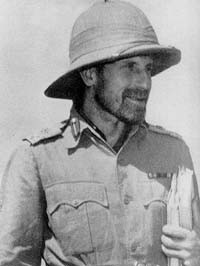
The Zionism of Orde Wingate: A Complex Origin


by Aaron Eitan Meyer
Covenant
August 2009


Abstract:
Orde Charles Wingate was a passionate Christian Zionist, whose innovative military genius would find root in Israeli military doctrine--an effect that lasts to this day. However, the origins of his Zionism are often simplified, or overlooked entirely. This article will seek to examine the complex factors that led this man, whose personal history should have inclined him to be pro-Arab, to become one of modern Judaism’s greatest friends.

Introduction

While it may seem strange to suppose that the year 1936 was in any way beneficial to the Jewish people, considering the state of affairs in Nazi Germany, and the dawning of the Arab Revolt in the British Mandate of Palestine, that year did also bring with it the beginning of a relationship that continues to benefit the Jewish people to this day. It was the year when Orde Charles Wingate—Scottish eccentric, military genius, visionary and one of the most passionate Zionists of his day—was assigned to a British Army Intelligence post in the British Mandate of Palestine, a move that would eventually make Wingate a hero of the Yishuv. And yet, while his assistance to the Zionist cause is well-known and appreciated in Israel, the origins of his commitment to the Jewish State are by no means clear, even to his biographers. Critics are apt to dismiss his Zionism with off-handed references to his Old Testament-heavy Christian upbringing or his affinity for the underdog as ‘the’ reason, but his real motivations are far more complicated. This essay sketches out the complexities that brought about Wingate’s Zionism, while attempting to refrain from the amateur psychoanalysis that plagues too many biographies of the man.

Before delving into the psyche of the man, it is worth mentioning the effect he continues to have in Israel. Traveling through Komemiyut in Jerusalem, at the intersection of Jabotinsky and David Marcus, one will see Kikar Orde (known also as Kikar Wingate). There are Wingate Streets in Be’er Sheva, Tel Aviv and Herzliya as well. In the Carmel Mountains, just south of Haifa, there is the Yemin Orde Wingate Youth Village, which serves hundreds of disadvantaged, at-risk and immigrant children from around the world. Israel’s national sports and health education institute in Netanya is fittingly named Machon Wingate, the Wingate Institute.

One might be wondering why so much was named after this man. In his book on the history of the Israeli army, Ze’ev Schiff called Wingate “the single most important influence on the military thinking of the Haganah.”[1] While a complete analysis of that influence would constitute an article of its own, Samuel M. Katz put it succinctly. “Wingate had a profound impact on the molding of Israeli military doctrine. Defense, when fighting a numerically superior enemy, meant offense, and offense meant fighting deep inside enemy territory where the opposition was most vulnerable.”[2] To this day, that concept remains the core of Israeli military strategy. And with that admittedly abbreviated digest, the focus may turn to the man himself.

Wingate’s Background Prior to 1936

Beginning with Christopher Sykes’ authorized biography of Wingate,[3] entire chapters have been devoted to Wingate’s life prior to his years in the Mandate and later distinguished service in restoring Haile Selassie to the throne of Ethiopia and Chindit operations in Burma. While that degree of detail is not possible here, a brief sketch is essential to framing the question of his eventual adherence to Zionism.

Orde Charles Wingate was born in Naini Tal, India, in 1903 to parents who were members of the Plymouth Brethren, a Puritan offshoot. He was raised to believe that an individual owed a duty to God, though he would never prove to be a religious man in any regular sense of the term. During his initial military service in the Sudan, the young Wingate wrote in his Letter-Journal to “Serve God not self.”[4] Wingate’s religious upbringing involved consistent study of the Old Testament. (Later, such study would amaze Jews in the Yishuv who were impressed by Wingate’s encyclopedic geographical knowledge of Israel[5]). But during his formative schooling years, including his military schooling, he felt alienated from his family’s religion. Indeed, as his lifelong friend Derek Tulloch pointed out, while Wingate was at the Royal Military Academy, Woolwich, he was in the midst of a rebellion against the religion he’d been brought up in, and that turmoil led to his not presenting “a very likable front to his fellow cadets.”[6]

After graduation from Woolwich as a member of the artillery corps, Wingate sought the advice of his ‘Cousin Rex’, Sir Reginald Wingate, Sirdar of the Sudan, regarding where he should get assigned. Unsurprisingly, he would find himself in the Sudan, where his native troops would bestow on him the title ‘His Worship the Judge’ in recognition of his erudition.[7] Perhaps of greatest importance for the purposes of this paper is the fact that prior to leaving for the Sudan, Wingate learned (and displayed a considerable aptitude for) Arabic, the ability that would eventually send him to the Mandate of Palestine, and his destiny.

During his stay in Britain after returning from the Sudan, Wingate met and fell in love with the brilliant, though considerably younger, Lorna Paterson, whom he would marry. No analysis of Wingate’s life could hope to be adequate without mention of the woman in whom Wingate found his intellectual equal, sounding board, and wife. Lorna Wingate herself became as passionate a Zionist as her husband, continuing to advocate for the Jewish Agency even after his death.

Indeed, it was Lorna Wingate who, in response to the utter lack of command-level officers available to Israel in 1948, convinced Ben Dunkelmann, a Canadian Jew, to fight for Israel, castigating him by stating that “Were my husband alive, he would not take no for an answer. He would demand that you go to Palestine and volunteer your services!”[8]

Upon the completion of his service in the Sudan, and a fruitless quest for the lost oasis of Zerzura, then-Captain Wingate found himself without an expected appointment to Staff College, which was at the time practically the only means for advancement in the military. After confronting the Chief of the Imperial General Staff with his complaint (and a copy of a published report on his quest for Zerzura), Wingate found himself given a post as an Intelligence Officer in Haifa.

Wingate in the Mandate

In the fall of 1936, Wingate arrived in Haifa, an Intelligence Officer chosen for that role in large part due to his fluent Arabic.[9] Up to this point in his life, he’d had extremely limited contact with Jews, and virtually no knowledge of or affinity for Jewish issues. As he would later express it, “In 1938 in spite of my natural sympathy with the Arabs and my understanding of their position I became during my official studies convinced that the Imperial, Jewish, and Arab interests all lay in in [sic] one direction.”[10]

Had Wingate’s interest been so limited to utilizing the Yishuv as war loomed, the matter might be settled there. However, Wingate did not merely see the Jews as a resource to be used – however essential they may be as a tool of British policy. He became such a committed Zionist himself that it never failed to amaze the leaders of the Yishuv.

But what actually led to that conviction? It is not only his critics who point to his early Bible-intensive education as a primary source. Yigal Allon referred to Wingate’s “extraordinary Zionist ardour inspired by the Bible…”[11]while Shabtai Teveth cited Haganah archives as describing Wingate as “an eccentric, a genius, a man more religious than rational, given to great pathos, a firm believer in the Bible, and fired with a sense of the special mission of the Jewish people.”[12] While describing Wingate as having a genius for “grasping and using new mechanical techniques,” Lowell Thomas did not argue against the conception that Wingate was also “a Scripture-reading crusader.”[13]

However, the complexity that formed the foundation for Wingate’s remarkable genius does not readily coincide with the notion that his Zionism was simply based upon the Bible. As Luigi Rossetto wrote, “Wingate had one quality which stands out above all others and that was his ability to examine the situation objectively and to draw on that part of his experience which applied while rejecting that which did not.”[14]

(Continue)