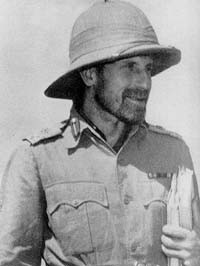
Showing posts with label Orde Wingate. Show all posts

Sunday, October 27, 2013

Such indeed, were the gifts of the Friend, and the Old Man

...“Both were farsighted men, fashioning their revolutionary military doctrines in obedience to the imperatives of the present with the distant past–the heroic tales of Scriptures–as their primary model. By teaching the Haganah units to patrol remote fields, plantations and roads, to ambush enemy paths, and to carry out raids against enemy bases which helped to check the enemy’s initiative, they effectively pulled the Haganah out of its trenches and barbed wire and into the open field, thus making it adopt a more active kind of defense.”

Robert Werdine..
Times of Israel..
25 October '13..

“Everyone’s against the Jews,” Orde Wingate once said, “so I’m for them.”

To his uncle, Wingate wrote:

“Islam in reality cares nothing for the Arabs of Palestine…The potential military strength of the Jews…is the equivalent to at least two army corps…I tell you that the Jews will provide better soldiery than ours.”

The histories of the Mandate period are full of instances of Englishmen who go so balmy and daft under the sway of Islam and the Arabs that they soon begin thinking themselves to be Arabs themselves. Like converts to a new religion, they become more orthodox than the Metropolitan. With Wingate, however, it was the Jews, not the Arabs, who stole his heart, and he soon became more Zionist than the Zionists themselves. The Jews, said Wingate, had made the desert “bloom like the rose.” The Jews referred to Wingate as the Hayedid (“The Friend”).

As the Arab revolt of the late 1930’s was suppressed in the cities by the mandate authorities, the Arab rebels ran wild and largely unopposed among the kibbutzim of the countryside, especially at night.

Wingate sought to hit back by terrorizing the terrorists. Hitting the enemy terrorists fast and hard under cover of darkness, and given their advantages of stealth, shock, and surprise, Wingate’s Special Night Squads took back the night, and shot fear and panic into the Palestinian irregulars, who now found themselves among the hunted.

General Slim once said of Wingate that, “To see Wingate urging action on some hesitant commander was to realize how a medieval baron felt when Peter the Hermit got after him to go crusading.”

With his elite Special Night Squads, Wingate had sought to “found a Jewish Army.” His guiding inspiration was Gideon of Ophrah, who with his three-hundred, defeated the mighty Midianites and the Amelekites who “lay along the valley like grasshoppers for multitude.” (Judges 7:12).

The few, by guile and boldness outfighting the many; in those “Special Night Squads” of barely a dozen or so fighters was born the ethos of the Haganah and the future IDF, and Wingate left to his Jewish comrades in arms a legacy, one that stressed the virtues of individual initiative, swift maneuver, and preemptive action by officers leading from the front–all attributes heartily absorbed by Night Squad veterans like Moshe Dayan, Yigael Yadin, and closely resembling those of another Haganah commander named Yitzhak Sadeh.

***

Yitzhak Sadeh was a soldier for soldiers to believe in. Gruff, burly, and built like a tank, the former circus wrestler and decorated First World War Russian combat veteran spent the night of the UN partition vote toasting each passing pro-partition vote with a glass of vodka. Soldier, poet, educator, and athlete, Sadeh was one of the founding fathers of the Palmach, the elite strike force of the Haganah. Those in the Palmach called him HaZaken (“The Old Man”).

Born in Lublin in 1890, he co-founded the Ha-Halutz (“The Pioneers”) movement in 1917 with Joseph Trumpeldor, and made aliya to Eretz Israel in 1920, where he helped found the Ghud-Ha-Avoda (“The Work Battalion”). He saw action as a Haganah commander in 1921 in Jerusalem, 1929 in Haifa, and in the Arab Revolt (1936-1939), where he established the Nodedet, a mobile troop patrol unit in the Jerusalem area that conducted offensive operations against enemy forces and bases, and the FOSH, a commando arm of the Haganah. One of the true forefathers of the IDF of today, Sadeh’s greatest feat of arms in defense of the Yishuv was still to come.


Sunday, March 25, 2012

Freund - Remembering a Christian warrior for Zion

Michael Freund..
Pundicity..
25 March '12..


Saturday marked the 68th anniversary of the passing of a great man, one whose contributions to the establishment of the State of Israel and its defense cannot be overstated.

And though his name graces numerous streets, thoroughfares and educational institutions throughout the land, Orde Wingate's unique role in helping to lay the foundation for the revival of Jewish sovereignty has nonetheless begun to fade from public memory.

Just ask any young Israeli about Wingate, and they will most likely think you are referring to the institute for physical education and sport in Netanya, rather than the man for whom it was named.

This is a grave injustice, one that simply cannot be allowed to occur. We are doing a great disservice to history, and to ourselves, by not doing more to remember him.

Put simply, Wingate was a Christian warrior for Zion, a man whose biblical passion and beliefs propelled him to defy the pro-Arab sentiments of the day and embrace the Zionist cause. He set a noble example of unapologetically fighting terror, staunchly rejecting appeasement both as a policy and a world-view.

In 1936, at the height of the Arab terror campaign known as the Arab Revolt, Wingate was serving as a captain in British intelligence. Assigned to British units posted in Mandatory Haifa, he quickly came to admire the Jewish people and their determination to reclaim the land that had been promised to them by the Creator.

Wingate began training Jewish volunteers, who served in active defense units that came to be called the Special Night Squads. They launched daring missions to protect Jewish communities from Arab terrorists, often undertaking operations that penetrated deep into Arab villages.

Friday, September 4, 2009

The Zionism of Orde Wingate: A Complex Origin


by Aaron Eitan Meyer
Covenant
August 2009


Abstract:
Orde Charles Wingate was a passionate Christian Zionist, whose innovative military genius would find root in Israeli military doctrine--an effect that lasts to this day. However, the origins of his Zionism are often simplified, or overlooked entirely. This article will seek to examine the complex factors that led this man, whose personal history should have inclined him to be pro-Arab, to become one of modern Judaism’s greatest friends.

Introduction

While it may seem strange to suppose that the year 1936 was in any way beneficial to the Jewish people, considering the state of affairs in Nazi Germany, and the dawning of the Arab Revolt in the British Mandate of Palestine, that year did also bring with it the beginning of a relationship that continues to benefit the Jewish people to this day. It was the year when Orde Charles Wingate—Scottish eccentric, military genius, visionary and one of the most passionate Zionists of his day—was assigned to a British Army Intelligence post in the British Mandate of Palestine, a move that would eventually make Wingate a hero of the Yishuv. And yet, while his assistance to the Zionist cause is well-known and appreciated in Israel, the origins of his commitment to the Jewish State are by no means clear, even to his biographers. Critics are apt to dismiss his Zionism with off-handed references to his Old Testament-heavy Christian upbringing or his affinity for the underdog as ‘the’ reason, but his real motivations are far more complicated. This essay sketches out the complexities that brought about Wingate’s Zionism, while attempting to refrain from the amateur psychoanalysis that plagues too many biographies of the man.

Before delving into the psyche of the man, it is worth mentioning the effect he continues to have in Israel. Traveling through Komemiyut in Jerusalem, at the intersection of Jabotinsky and David Marcus, one will see Kikar Orde (known also as Kikar Wingate). There are Wingate Streets in Be’er Sheva, Tel Aviv and Herzliya as well. In the Carmel Mountains, just south of Haifa, there is the Yemin Orde Wingate Youth Village, which serves hundreds of disadvantaged, at-risk and immigrant children from around the world. Israel’s national sports and health education institute in Netanya is fittingly named Machon Wingate, the Wingate Institute.

One might be wondering why so much was named after this man. In his book on the history of the Israeli army, Ze’ev Schiff called Wingate “the single most important influence on the military thinking of the Haganah.”[1] While a complete analysis of that influence would constitute an article of its own, Samuel M. Katz put it succinctly. “Wingate had a profound impact on the molding of Israeli military doctrine. Defense, when fighting a numerically superior enemy, meant offense, and offense meant fighting deep inside enemy territory where the opposition was most vulnerable.”[2] To this day, that concept remains the core of Israeli military strategy. And with that admittedly abbreviated digest, the focus may turn to the man himself.

Wingate’s Background Prior to 1936

Beginning with Christopher Sykes’ authorized biography of Wingate,[3] entire chapters have been devoted to Wingate’s life prior to his years in the Mandate and later distinguished service in restoring Haile Selassie to the throne of Ethiopia and Chindit operations in Burma. While that degree of detail is not possible here, a brief sketch is essential to framing the question of his eventual adherence to Zionism.

Orde Charles Wingate was born in Naini Tal, India, in 1903 to parents who were members of the Plymouth Brethren, a Puritan offshoot. He was raised to believe that an individual owed a duty to God, though he would never prove to be a religious man in any regular sense of the term. During his initial military service in the Sudan, the young Wingate wrote in his Letter-Journal to “Serve God not self.”[4] Wingate’s religious upbringing involved consistent study of the Old Testament. (Later, such study would amaze Jews in the Yishuv who were impressed by Wingate’s encyclopedic geographical knowledge of Israel[5]). But during his formative schooling years, including his military schooling, he felt alienated from his family’s religion. Indeed, as his lifelong friend Derek Tulloch pointed out, while Wingate was at the Royal Military Academy, Woolwich, he was in the midst of a rebellion against the religion he’d been brought up in, and that turmoil led to his not presenting “a very likable front to his fellow cadets.”[6]

After graduation from Woolwich as a member of the artillery corps, Wingate sought the advice of his ‘Cousin Rex’, Sir Reginald Wingate, Sirdar of the Sudan, regarding where he should get assigned. Unsurprisingly, he would find himself in the Sudan, where his native troops would bestow on him the title ‘His Worship the Judge’ in recognition of his erudition.[7] Perhaps of greatest importance for the purposes of this paper is the fact that prior to leaving for the Sudan, Wingate learned (and displayed a considerable aptitude for) Arabic, the ability that would eventually send him to the Mandate of Palestine, and his destiny.

During his stay in Britain after returning from the Sudan, Wingate met and fell in love with the brilliant, though considerably younger, Lorna Paterson, whom he would marry. No analysis of Wingate’s life could hope to be adequate without mention of the woman in whom Wingate found his intellectual equal, sounding board, and wife. Lorna Wingate herself became as passionate a Zionist as her husband, continuing to advocate for the Jewish Agency even after his death.

Indeed, it was Lorna Wingate who, in response to the utter lack of command-level officers available to Israel in 1948, convinced Ben Dunkelmann, a Canadian Jew, to fight for Israel, castigating him by stating that “Were my husband alive, he would not take no for an answer. He would demand that you go to Palestine and volunteer your services!”[8]

Upon the completion of his service in the Sudan, and a fruitless quest for the lost oasis of Zerzura, then-Captain Wingate found himself without an expected appointment to Staff College, which was at the time practically the only means for advancement in the military. After confronting the Chief of the Imperial General Staff with his complaint (and a copy of a published report on his quest for Zerzura), Wingate found himself given a post as an Intelligence Officer in Haifa.

Wingate in the Mandate

In the fall of 1936, Wingate arrived in Haifa, an Intelligence Officer chosen for that role in large part due to his fluent Arabic.[9] Up to this point in his life, he’d had extremely limited contact with Jews, and virtually no knowledge of or affinity for Jewish issues. As he would later express it, “In 1938 in spite of my natural sympathy with the Arabs and my understanding of their position I became during my official studies convinced that the Imperial, Jewish, and Arab interests all lay in in [sic] one direction.”[10]

Had Wingate’s interest been so limited to utilizing the Yishuv as war loomed, the matter might be settled there. However, Wingate did not merely see the Jews as a resource to be used – however essential they may be as a tool of British policy. He became such a committed Zionist himself that it never failed to amaze the leaders of the Yishuv.

But what actually led to that conviction? It is not only his critics who point to his early Bible-intensive education as a primary source. Yigal Allon referred to Wingate’s “extraordinary Zionist ardour inspired by the Bible…”[11]while Shabtai Teveth cited Haganah archives as describing Wingate as “an eccentric, a genius, a man more religious than rational, given to great pathos, a firm believer in the Bible, and fired with a sense of the special mission of the Jewish people.”[12] While describing Wingate as having a genius for “grasping and using new mechanical techniques,” Lowell Thomas did not argue against the conception that Wingate was also “a Scripture-reading crusader.”[13]

However, the complexity that formed the foundation for Wingate’s remarkable genius does not readily coincide with the notion that his Zionism was simply based upon the Bible. As Luigi Rossetto wrote, “Wingate had one quality which stands out above all others and that was his ability to examine the situation objectively and to draw on that part of his experience which applied while rejecting that which did not.”[14]

(Continue)