City of David..
cityofdavid.org..
First Posted 09 August '16..
Link: http://www.cityofdavid.org.il/en/news/temple-destruction-story-last-refugees
For those who are home, and for those who are on the way. For those who support the historic and just return of the land of Israel to its people, forever loyal to their inheritance, and its restoration.
![]() |
| Photo Credit: Uri Lenz |
Al-Aqsa Foundation for Endowment and Heritage (AFEH) issued a statement on Tuesday revealing that the occupation authorities had recently ratified a budget of four million shekels (more than one million dollars) to establish a Jewish center.
The center will be built under the name “audio-visual Museum”, at the entrance of Wadi Hilweh neighborhood, a few meters from the south of Al Aqsa Mosque. [a. it's much more than a "few meters". b. it is outside the walled enclosure. - YM] The foundation added that the site on which the center will be set up is a historic water well and a cavity of seven meters under the ground. The museum will be connected to the tunnels’ network dug by the occupation underground in the vicinity of Al-Aqsa Mosque.

This matters because many influential archaeologists, as well as Palestinian propagandists, have dismissed Jewish ties to Jerusalem by claiming that the Kingdom of David mentioned in the Bible was an insignificant entity and that its capital in Jerusalem was nothing more than a village.


The greatest achievement of all, however, belongs to Education Minister Gideon Sa'ar, who has doubled the number of schoolchildren visiting the Temple Mount and the City of David, from 200,000 two years ago to 400,000 since the start of the current school year. Under a new program drafted by the Education Ministry on the minister's orders, students are obligated to visit Jerusalem at least three times during their 12 years of school.
In theory, there is nothing wrong with this. Yet the visits tend to focus on sites like the Old City's Jewish Quarter, the Western Wall tunnels, Zion Gate and the archaeological excavations of the Temple Mount's southern wall - all disputed areas that are on the agenda during negotiations with the Palestinians, and are also associated with new Jewish settlement in East Jerusalem. Moreover, the tours, which are led by guides from the extreme right-wing organization Elad, blatantly ignore the Palestinians' existence and bear the clear stamp of religious nationalist indoctrination.

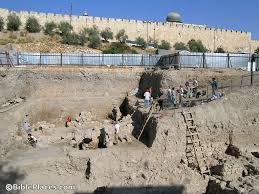
A huge fortification more than 3,700 years old, which is ascribed to the Canaanites (Middle Bronze Age 2), was uncovered in archaeological excavations the Israel Antiquities Authority is currently conducting in the “Walls Around Jerusalem" ational Park in the City of David, with funding provided by the ‘Ir David' Foundation. According to the director of the excavation, Professor Ronny Reich of the University of Haifa, together with Eli Shukron on behalf of the Israel Antiquities Authority, “This is the most massive wall that has ever been uncovered in the City of David, and it rises to a height of 8 meters. We are dealing with a gigantic fortification, from the standpoint of the structure’s dimensions, the thickness of its walls and the size of the stones that were incorporated in its construction. The walls appear to be a protected, well-fortified passage that descends to the spring tower from some sort of fortress that stood at the top of the hill. The construction of a protected passage such as this is a plausible solution that explains the innate contradiction of the situation whereby the spring – which is a source of life from the standpoint of the fortress’ inhabitants in time of emergency – is located in the weakest and most vulnerable place in the area. The construction of a protected passage, even though it involves tremendous effort, is a solution for which there are several parallels in antiquity, albeit from periods that are later than the remains described here. A small section of the fortification was discovered in 1909, and it has been ascertained in the present excavations that it was part of an enormous wall. This is the first time that such massive construction that predates the Herodian period has been discovered in Jerusalem”. During this period Jerusalem and the fields around it were an independent political entity with self-rule, similar to its neighbors Shechem to the north and Jericho to the east. Massive walls resembling the one that was just exposed in Jerusalem are known from Canaanite Hebron (Tel Rumeida), Shechem (Tell Balata) and Gezer. According to Professor Reich, “Even though it would seem we are dealing with impressive fortifications, the walls were after all primarily used to defend against marauding desert nomads who wanted to rob the city. These are the earliest fortifications in the region and they bear witness to the fact that from this point on the settlement had became an urban entity with a ruler who had the capability and resources to build such a structure. A small settlement would have been unsuccessful in organizing such construction”. The known section of the fortification is 24 meters long; however, it is thought the fortification is much longer because it continues west beyond the part that was exposed, at the top of the hillside. Professor Reich adds, “The new discovery shows that the picture regarding Jerusalem’s eastern defenses and the ancient water system in the Middle Bronze Age 2 is still far from clear. Despite the fact that so many have excavated on this hill, there is a very good chance that extremely large and well-preserved architectural elements are still hidden in it and waiting to be uncovered”. |
Press Release
Wednesday, September 23, 2009
In a Decision the High Court of Justice Handed Down Yesterday:
The Archaeological Research in the City of David is in the Public Interest
In the past week the Supreme Court, replying as the High Court of Justice,
dismissed two petitions that were submitted against the Israel Antiquities
Authority concerning the excavations the IAA is conducting within the
precincts of the "Walls Around the Old City" national park, at the City of
David in Jerusalem.
The petitions were submitted by residents who live near the place where the
excavations are being carried out, when in the opinion of the Israel
Antiquities Authority these residents are being incited by other factors
whose considerations are political and improbable.
One of the excavations is being conducted in an area known as the "Givati
Car Park", which is located south of the Old City's southern wall, adjacent
to Ophel Road. Numerous layers of antiquities were revealed in this
excavation. Among other things, a very impressive structure was found that
is probably a public building and dates to the Late Roman period. Remains
from the Early Islamic period were uncovered, as well as extraordinary
remains from the Second Temple period. All of the remains were
scientifically excavated, in meticulous work, whilst photographing and
documenting everything.
In the second excavation - for which a decision was handed down yesterday
(Monday) - a drainage channel structure from the Second Temple period was
exposed that extends over a distance of many dozens of meters. The drainage
structure is surprisingly well-preserved and one can walk through it
upright, for most of its length. The excavators were aware of the structure's
existence; nevertheless, the segment that was excavated was only recently
exposed.
The archaeological excavations that the Israel Antiquities Authority is
conducting in the City of David are exposing Jerusalem's magnificent past,
in all of the periods. These finds are of utmost importance to the Jewish
people in particular and world culture in general. The high court accepted
the position of the Israel Antiquities Authority pertaining to the great
importance of the excavations and the general public interest in uncovering
the antiquities.
Below is the concluding paragraph from the court's ruling issued by Justice
Edna Arbel: "The picture that was presented to us shows that the damage to
the property rights of the petitioners - as much as such damage does indeed
exist - is minor. As stated, the petitioners did not argue that any damage
was caused to their houses and the respondents explained that the activity
on the land is indeed underground, but does not extend as far as the houses
of the petitioners. Contrasting the asserted damage is the important public
interest in carrying out the work. Surely, revealing the secrets of the
past, which have been hidden for hundreds and thousands of years in the
bowels of the earth, is an essential part of the archaeologist's research.
From the standpoint of public interest, conducting this research is
multi-faceted, whether because of the contribution there is in understanding
the history of the country and the history of the Jewish people or because
of the contribution there is in understanding historic events that have
importance that is not just limited to the Jewish people and its history. In
this context I will refer to what I have already said in High Court decision
3702/05 - Ma'oz vs. Israel Antiquities Authority (unpublished, 11.106). It
is the legal position in the case that conducting an archaeological
excavation in a place where it benefits developing the infrastructure in the
region and improving the welfare of the residents is in the public interest.
This being the case, when the petitioners failed to point out real damage to
their property, it seems that there is no justification in harming or
restricting the public interest in conducting the excavation work on the
land. If my opinion will be heard, I will recommend to my colleagues that
the petition be rejected and the petitioners be required to pay the attorney
fees of each of the respondents for the sum of 10,000 NIS and court
expenses."
.