...Should the world reshape the Middle East map just because Muslims decided to recycle the political problems of the Umayyads 1250 years after the curtain came down on their role in history?
Dr. Mordechai Kedar..
Israel National News..
10 November '14..
The importance of Jerusalem for Jews and Christians is beyond dispute, since the connection of this city to Judaism and Christianity is part of universal concepts about history and theology. However, when it comes to modern politics, we hear over and over that Palestinians, Arabs and Muslims demand that Jerusalem become the capital of the future Palestinian state, owing to its holiness to Islam. The question is how and when this city became holy to Muslims.
When the Prophet Muhammad established Islam, he introduced a minimum of innovations. He employed the hallowed personages, historic legends and sacred sites of Judaism, Christianity, and even paganism, by Islamizing them. Thus, according to Islam, Abraham was the first Muslim and Jesus and St. John (the sons of Miriam, sister of Moses and Aaron) were prophets and guardians of the second heaven. Many Biblical legends ("asatir al-awwalin"), which were familiar to the pagan Arabs before the dawn of Islam, underwent an Islamic conversion, and the Koran as well as the Hadith (the Islamic oral tradition), are replete with them.
Islamization was practiced on places as well as persons: Mecca and the holy stone - al-Ka'bah - were holy sites of the pre-Islamic pagan Arabs. The Umayyad Mosque in Damascus and the Great Mosque of Istanbul were erected on the sites of Christian-Byzantine churches - two of the better known examples of how Islam treats sanctuaries of other faiths.
Jerusalem, too, underwent the process of Islamization: at first Muhammad attempted to convince the Jews near Medina to join his young community, and, by way of persuasion, established the direction of prayer (kiblah) to be to the north, towards Jerusalem, in keeping with Jewish practice; but after he failed in this attempt he turned against the Jews, killed many of them, and directed the kiblah southward, towards Mecca.
Muhammad's abandonment of Jerusalem explains the fact that this city is not mentioned even once in the Koran. After Palestine was occupied by the Muslims, its capital was Ramle, 30 miles to the west of Jerusalem, signifying that Jerusalem meant nothing to them.
Islam rediscovered Jerusalem 50 years after Muhammad's death. In 682 CE, 'Abd Allah ibn al-Zubayr rebelled against the Islamic rulers in Damascus, conquered Mecca and prevented pilgrims from reaching Mecca for the Hajj. 'Abd al-Malik, the Umayyad Calif, needed an alternative site for the pilgrimage and settled on Jerusalem which was then under his control. In order to justify this choice, a verse from the Koran was chosen (17,1 = sura 17, verse 1) which states (trans. by Majid Fakhri):
"Glory to Him who caused His servant to travel by night from the Sacred Mosque to the Farthest Mosque, whose precincts We have blessed, in order to show him some of Our Signs, He is indeed the All-Hearing, the All-Seeing."
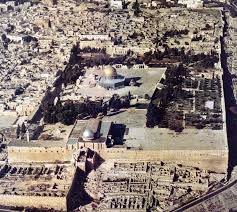
The meaning ascribed to this verse (see the commentary in al-Jallalayn) is that "the furthest mosque" (al-masgid al-aqsa) is in Jerusalem and that Muhammad was conveyed there one night (although at that time the journey took three days by camel), on the back of al-Buraq, a magical horse with the head of a woman, wings of an eagle, the tail of a peacock, and hoofs reaching to the horizon. He tethered the horse to the Western Wall of the Temple Mount and from there ascended to the seventh heaven together with the angel Gabriel. On his way he met the prophets of other religions who are the guardians of the Seven Heavens: Adam, Jesus, St. John, Joseph, Idris (=Seth?), Aaron, Moses and Abraham who accompanied him on his way to Allah and who accepted him as their master.
Thus Islam tries to gain legitimacy over other, older religions, by creating a scene in which the former prophets agree to Muhammad's mastery, thus making him Khatam al-Anbiya' ("the Seal of the Prophets"). According to this legend, Islam came to the world in order to replace Judaism and Christianity rather than to live side by side with them.




 Posts
Posts


