 Barry Rubin
The Rubin Report
05 September 09
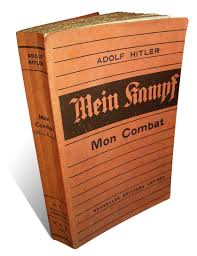
After publishing an op-ed by a radical Israeli professor urging a boycott of Israel, Los Angeles Times editorial page editor, Jim Newton, said, “Had Hitler submitted an excerpt from Mein Kampf in the late 1930's [I would have published it] because the world would have benefitted from exposure to evil ideas."
This is an interesting subject for discussion but first it should be noted that Newton misworded his answer, a rather serious mistake for a professional journalist and editor. Perhaps it is even a Freudian slip.
Presumably the world would have benefitted from the exposure of Hitler’s arguments as evil and dishonest. But does the world, to take Newton’s own phrase, benefit “from exposure to evil ideas,” that is, just giving them a bigger audience?
No. After all, those who spread evil ideas do so precisely to win over those who hear them. The world did get exposed to the evil ideas of fascism. One of the main results was a lot of support for it by millions of people in many countries.
And that’s certainly happening a lot nowadays for the contemporary equivalent evil ideas.
The media not only publicizes but reinforces evil ideas on many occasions. Newton’s error shows the problem: the media does not expose evil ideas as evil. It often portrays them as correct and accurate or good or at least just another credible opinion.
Newton’s point also raises another issue: the limits of what has been called “polite discourse.”
In societies practicing free speech—at least up until recently—anything could be said. The pernicious influence of the “hate speech” concept, first applied to Holocaust denial, has been terrible in limiting free and open discussion. In Canada, nominally one of the freest of countries, you can be tried and sentenced for saying or writing something that a group deems offensive.
Newton opposes this, correctly I believe, and upholds the concept of free speech. But, again, he’s not implying he’d publish Hitler because the German dictator had a right to express his views but rather precisely in order to expose them as evil. How does one know that they are evil?
Does this mean the newspaper must publish other material—even a critical introduction—to say that these are evil ideas?
Or does the readers’ common sense and political culture innately tell them these are evil ideas? Surely not all of them would see it as such, as Pat Buchanan, Hitler’s leading contemporary American admirer, or David Irving, his counterpart in Britain, repeatedly remind us.
[Let me digress here for a moment. Hitler’s book, Mein Kampf, makes interesting reading and I analyzed it in my book Modern Dictators to show parallels with Communist and Islamist thinking. This is not to say the three doctrines are alike but they do share a lot in their basic approach to politics, rationality, critique of Western democracy, and prescription of a dictatorship that controls all of society and its institutions.]
Yet when it comes to channels of communication limited by time and space—newspapers, wire services, radio, television, and book publishing—choices must be made. The people who make choices decide what will be published, printed, aired, or broadcast.




 Posts
Posts


