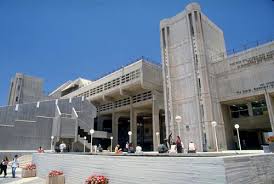
Showing posts with label Tel Aviv University. Show all posts

Saturday, December 22, 2012

Lecturers who support academic boycott of Israel have a lot to learn

Dozens of threats. Harjo at Tel Aviv University
(Photo: Ido Daniel)
Ido Daniel..
Israel Opinion..
21 December '12..

Quietly, without anyone knowing, Tel Aviv University avoided last weekend a first of a kind academic boycott. As always, those who stood up to defend the Israeli academia against the pro-Palestinian boycott of Israel was not the university itself, nor the Ministry of Education or other governmental offices, but rather the people on the ground - the students.

The biggest sin of Joy Harjo was that she has written on her Facebook page she's on her way to visit Tel Aviv. Harjo, a Native American poet and musician, was invited to perform for students of the Department of American Studies at TAU, and provide a glimpse into the rich, indigenous culture of the American continent. But the anti-Israel activists had other plans for her: Within a few hours after her announcement, Harjo's Facebook and Twitter accounts were filled with dozens of threats and hate talkbacks. Those who posted the comments, mostly anti-Israel activists from around the world who have never heard of Joy Harjo, accused this gentle 60-year-old woman of abuse of human rights and active participation in genocide and ethnic cleansing of Palestinians. Harjo was also accused of collaborating with the "apartheid university" of Tel Aviv, "because the entire city is built on occupied Palestinian territory."

Others have gone even further: Harjo received dozens of phone calls and messages from people who offered her money just to cancel her show and not "entertain apartheid." Among them was also a representative of "Coalition of Women for Peace" (CWP), an Israeli NGO that defines itself as a feminist organization that is "bringing together women from a wide variety of identities and groups" and an initiator of "public campaigns, education and outreach programs."

Monday, June 11, 2012

Tobin - Is Wagner Worse Than the Nakba?

Jonathan S. Tobin..
Commentary/Contentions..
10 June '12..


(As Jonathan Tobin has written here, Wagner has been, and continues to be a "touchy subject" within Israel, and while not concurring 100% with his thoughts on this matter, the question he raises, "Is Wagner worse than the Nakba?", is a powerful one. Y.)

It was probably inevitable. When the Eretz Israel Orchestra announced plans last month to hold a concert of works by Richard Wagner in Tel Aviv it was likely that somebody would find a way to cancel it. The music of the great anti-Semite has not been played in the country since the 1930s, and the ire of Holocaust survivors as well as the often-hypocritical efforts of those attempting to enforce the informal ban on Wagner was bound to generate pressure to spike the event.

The ban is hypocritical and foolish. Yet the cancellation of the concert planned by the Israeli Wagner Society is interesting not so much because preventing Wagner from being played live in the territory of the Jewish state is ridiculous, but because it was the result of a decision by Tel Aviv University, whose auditorium had been rented for the occasion. TAU revoked its permission for the concert because it claimed the sponsors had not revealed their purpose when they paid for the hall. True or not, it showed that there are just some things the university will not allow to take place on their property. But coming as it did less than a month after the same institution granted its approval for anti-Zionist students to hold a “Nakba Day” commemoration in which the founding of Israel is treated as a “disaster,” it does call into question the judgment of those at the school about what is truly offensive to Jewish sensibilities.

Thursday, May 13, 2010

'TAU restricts freedom of speech'


Zoe Fox
JPost
12 May '10

A Tel Aviv University board member is set to resign Wednesday following university President Joseph Klaffter’s refusal to bring a proposal he drafted to a vote. Mark Tanenbaum had proposed a resolution to the board of governors, requesting that the university senate investigate the political activity of professors who use the school’s name.

Tanenbaum’s proposal comes as a response to outspoken TAU professors advocating an academic boycott of Israel and the university. The proposal cites faculty bylaws “Breach of Discipline” restriction on faculty listing their affiliation with TAU on any document or statement of a political nature when participating in any domestic or international forums of political nature.

Tanenbaum described Klaffter yelling into the microphone that he would not tolerate any infringement on academic freedom within the university immediately after the proposal was read. Klaffter’s decision not to bring the proposal to a vote came at the end of a heated debate between the board members concerned about the university restricting freedom of speech.

“While he was blathering on about the right to free speech, he ironically denied me, a member of the board of governors, a former student, whose late father was one of the founding members of Canadian Friends of Tel Aviv University the right to free speech, and that is absolutely unacceptable,” Tanenbaum told The Jerusalem Post.

Tanenbaum on Wednesday will announce his resignation from all of his posts at TAU and his decision to join Bar-Ilan University. Until Tuesday, Tanenbaum had been a member of the TAU Board of Governors, the board of directors for the American Friends of Tel Aviv University, and the board of international Overseers of the Moshe Dayan Center at Tel Aviv University.

He is involved in a number of other philanthropic Israel-oriented organizations, both in Israel and in Miami. He describes himself as an “ardent Zionist who’s not embarrassed to use the word Zionist.”

(Read full story)

If you enjoy "Love of the Land", please be a subscriber. Just put your email address in the "Subscribe" box on the upper right-hand corner of the page.
.

Wednesday, February 17, 2010

Dr. Klafter’s dilemma


Fresnozionism.org
16 February '10

Dr. Joseph Klafter has a problem. He’s president of Tel Aviv University (TAU), where Dr. Anat Matar and Prof. Rachel Giora are members of the faculty, and Omar Barghouti is a graduate student.

Matar, a professor of Philosophy has called the IDF a ‘criminal army’, agrees with the conclusions of the Goldstone report that accuses Israel of deliberately targeting the civilian Palestinian Arab population for violence, and supports the boycott-divestment-sanctions (BDS) movement — including the academic boycott of Israeli institutions. She was arrested at a violent demonstration against the security barrier in Bili’in in 2005.

Giora, about whom I wrote previously, also a stalwart of the BDS movement, is member of the Linguistics Department. Her name appears first (followed, of course, by Matar’s) on a petition calling for “civil society institutions as well as concerned citizens around the world” to

Integrate BDS in every struggle for justice and human rights by adopting wide, context-sensitive and sustainable boycotts of Israeli products, companies, academic and cultural institutions, and sports groups, similar to the actions taken against apartheid South Africa;

(Read full post)
.

Monday, November 16, 2009

Terra Incognita: The (ir)responsibility of the academy


Seth Frantzman
JPost
15 November 09

(Thoughtful with interesting points)

Recent debates surrounding politics at university have usually juxtaposed two different political viewpoints against one another. The Right argues that the academy is overflowing with extreme-leftist professors who work to undermine the existence of the state at home and abroad. The Left argues that its freedom of expression is being threatened by the Right and that its campaigns for "justice" or "human rights" are part of making the state more humane.

The Left believes that if a few of its extremist voices call for boycotts of their own universities then that might be "misplaced," but it is part and parcel of a democratic society. Perhaps both sides are right. The academy is at the forefront of anti-Israel intellectual extremism. It is also a bastion of freedom of expression in a free society.

But what both sides are missing is a third view of the academy, namely one that sees it as enshrining certain values, three of which should be responsibility, decency and maturity. The extreme-leftist antics of some faculty members should not be curtailed by laws or by dismissal from the academy. Instead there should be an inculcation of self-control.

Instead of crying "Nazi" every time the IDF does something an academic disagrees with, one could hold his tongue. Instead of requesting the boycott of one's own university, one could have some restraint. Instead of signing petitions encouraging soldiers to desert their units or calling on European powers to immediately intervene to "save" the Palestinians from a "genocide," one could show some self-control.

It is apparent that the central problem with too many of Israel's academics is that they are unsure of their place in society, they misunderstand their relevance and they are embittered and hysterical in their pronouncements to the point of having a childlike "crying wolf" mentality when discussing the conflict in the Middle East.

Consider a few examples. Prof. Ada Yonath, fresh after receiving a Nobel Prize, instead of saying a few words of praise for a society that gave her the opportunities to succeed and excel, immediately launched into a barrage of opinions about Gilad Schalit. She declared that Israel should release all its Palestinian prisoners and that holding them was the real source of all Palestinian attacks on Israel.
(Continue to full article)
.

Monday, November 9, 2009

Tel Aviv students afraid to challenge leftist professors


Or Kashti
Haaretz
09 November 09

Tel Aviv University students are hesitant to express their political views in class, lest lecturers perceived to have left-wing political views penalize them with lower grades, the head of TAU's Department of Curriculum and Instruction wrote in an internal memorandum last month. Prof. Nira Hativa's comment in the faculty memo ignited controversy among professors, with some declaring that her sentiments should not be made public.

Hativa wrote: "There are no small number of students of lecturers with left-wing views who complain bitterly that they are extremely offended by the presentation of materials that oppose their views, but are fearful of expressing contrary viewpoints in class, lest it harm their grades."

In response to the uproar, Hativa, who is currently abroad, wrote Haaretz this weekend that "the things I wrote in the context of an internal disagreement are based on intuition and my personal impressions."

The chair of the university's students' union, Shahar Botzer, said his organization receives a number of complaints each year from students dissatisfied with what they view as lecturers' biased portrayal of material in favor of left-wing positions. He said that such complaints are the exception, however, rather than the rule.

"If lecturers express their views in class in a way that makes it illegitimate to express contrary views - that is inappropriate and unacceptable to us," Botzer said. "This university is founded on pluralism and on the ability to express a variety of opinions."

Hativa's statements were prompted by a story in the Haaretz English Edition on rightist activists monitoring lecturers who are considered to have leftist views, as well as an article in Maariv on what it described as the right-wing views of Daniel Schueftan, deputy director of the National Security Studies Center at the University of Haifa.

"At the end of each semester, I read comments from several hundred students on the teaching they receive," Hativa wrote on October 23. "I have come across many complaints from students about a small number of lecturers in various fields, who express radical left-wing opinions in their classes - that they are lashing out at the State of Israel, the army, the Zionist movement and worse."

TAU said in response that "informal discussions are held frequently on controversial issues, and people feel 'at home' in expressing opinions based on their understanding and intuition. The university is an institution where pluralism is a guiding principle."
.

Thursday, September 3, 2009

Neve Gordon Is Not The Problem


Daniel Gordis
Guest Columnist:JPost
03 September 09

Intentionally or not, Neve Gordon, senior lecturer and head of the Political Science Department at Ben-Gurion University, has unleashed a firestorm in Israeli academe. His recent op-ed in The Los Angeles Times declared that Israel is an apartheid state, and that it ought to be boycotted to "save Israel from itself."

Sensing a public relations debacle among their American supporters, the president and leadership of BGU distanced themselves from his comments and hinted that he ought to resign. Predictably, other Israeli academics leaped to Gordon's defense. Most interesting, however, was the outrage Gordon's column has evoked among many American Jews. Some are so beside themselves that they are now threatening to withhold their financial support from the university.

To be sure, Gordon's argument is deeply flawed. He writes as if Israel sought or enjoys controlling the Palestinians, making no mention of the fact that it captured the West Bank in a defensive war that it did not seek, or that more than once (most recently with Ehud Olmert's election in 2006) Israelis have chosen leaders whose campaigns called for relinquishing those territories. Add to that his failure to admit that the Palestinians still refuse to recognize Israel's right to exist and continue to call for its destruction, and one can appreciate the fury of Ben-Gurion University's American supporters.

The fury these American Jews are suddenly expressing illustrates how little these very supporters know about the system of higher education in Israel to which they are so deeply committed. Is this really their first glimpse into the widespread and long-standing hostility of Israeli academe to Jewish statehood? Gordon has been espousing this viewpoint for years. He regularly writes for anti-Israel publications, holed up with Yasser Arafat during the siege of Ramallah, and has on more than one occasion likened Israel to Nazi Germany. But he's always enjoyed the steadfast support of the university, to its very highest echelons. His views are widely held among his colleagues.

Nor is BGU unique here. Coming to Gordon's defense, Tel Aviv University professor Shlomo Sand stated outright that Israeli universities are not Zionist institutions and should not be. They are about scholarship, he insisted, not about the Jews or their state.

There are non-Jews and non-Zionists at these universities, he claimed, and the universities must serve them no less than anyone else. And at Hebrew University, the crown jewel of Israeli academe, the long-term influence of the binationalists involved in the university's founding has also been well documented.

Indeed, the only thing that is surprising about this latest turn of events is that American donors are surprised. For, to those who know even a bit about Israeli academe, the anti-Israel posture of many departments is really yesterday's news.

The important question in all this is what American philanthropists who are committed to Zionism and to Israel's higher education ought to do. Surely they can't really believe that universities will suddenly silence their professors or terminate tenure. What, then, are the options?

These philanthropists ought to look close to home for their answers. For many of America's great universities developed from an entirely different tradition. Woodrow Wilson, as president of Princeton, spoke unabashedly of "Princeton in the nation's service." Columbia College instituted its now-classic core curriculum as an explicit defense of Western civilization. Neither Princeton nor Columbia, like many other great American liberal arts colleges, saw any conflict between superb scholarship and inclusiveness on the one hand, and devotion to country and one's own civilization on the other.

Is it at all surprising that these colleges have produced an abundance of America's great leaders?

Israeli education needs more support from American Jews, not less. Rather than withholding their funds, a much more useful response would be to channel their support and their knowledge to create an Israeli version of the "college in the service of the nation."

How?

Those American philanthropists currently wringing their hands probably have no idea that Israel has not a single liberal arts college to its name. Typical Israeli undergraduates get none of the curricular breadth that an American education usually requires, and as a result, they know almost nothing about Western civilization, the majesty of Jewish intellectual history or even the competing philosophic currents inside Zionism.

In today's Israel, the People of the Book do not even read their own books. When they read or hear someone like Neve Gordon, nothing in their education has given them the tools to evaluate what he says, or to take him on. They are helpless.

TODAY'S NARROW model of education, in which students essentially study only one discipline, produces excellence, but excellence as technocrats. It does not produce the broadly read, intellectually nuanced people that the Jewish state so desperately needs.

Without dramatic change, Israeli universities will produce only more Neve Gordon's - scholars of varying quality, who feel no love for the very country that has saved their people. If it learned from American education, Israel might actually begin to cultivate a new wave of leadership, and with it, a generation of Israelis who actually love their nation.

Dr. Gordon is correct - Israel needs to be saved from itself. What Israel needs now is a reconceived notion of the educated Israeli.

It needs a liberal arts college, and the young people prepared to speak constructively about Jewish sovereignty, its challenges, its failures and its future that only that kind of college can produce.

A century ago, who could have imagined that the Jewish state would one day have a world-class army but a failing, collapsing educational system? Whether or not American Jews have the foresight to use their philanthropy to promote genuine change in Israeli academe still remains to be seen. But if they do, Neve Gordon's op-ed may ironically have goaded both Israel and the American Jewish community into taking the first steps needed to begin to save the Jewish state.

The writer is senior vice president of the Shalem Center in Jerusalem and the author of Saving Israel: How the Jewish People Can Win a War That May Never End (Wiley, 2009). He blogs at www.danielgordis.org.
.