Showing posts with label Suicide bombings. Show all posts

Wednesday, September 11, 2013

Palestinian Arabs genuinely, overwhelmingly believe in barbarism as a strategy

Nearly two-thirds of the people ruled by the clique of which Abed Rabbo is a leading member are committed to the most extreme forms of lethal terrorist attacks on Israelis. In that light, do we need to speculate about the intended effect when PA insiders like him dismiss so comprehensively the current round of talks between their side and Israel?

Frimet/Arnold Roth..
This Ongoing War..
11 September '13..


A Pew Research Global Attitudes report issued today demonstrates statistically that

Overall support for violence in the name of Islam has declined among Muslim publics during the past decade... In many of the countries surveyed, clear majorities of Muslims oppose violence in the name of Islam. Indeed, about three-quarters or more in Pakistan (89%), Indonesia (81%), Nigeria (78%) and Tunisia (77%), say suicide bombings or other acts of violence that target civilians are never justified.

But there is one demographic where a clear majority of respondents - 62% - told Pew's pollsters that "suicide bombing is often or sometimes justified". That demographic is Palestinian Arab Muslims.


Knowing the murderous intentions of the Palestinian Arab "street" concerning us ordinary Israelis (and keep in mind that Palestinian Arab terror is rarely directed at the Israeli military), it casts a deadly light on the current strategies of the Mahmoud Abbas regime's inner circle.

(Continue)

Updates throughout the day at http://calevbenyefuneh.blogspot.com. If you enjoy "Love of the Land", please be a subscriber. Just put your email address in the "Subscribe" box on the upper right-hand corner of the page.Twitter updates at LoveoftheLand as well as our Love of the Land page at Facebook which has additional pieces of interest besides that which is posted on the blog. Check-it out!
.

Thursday, November 25, 2010

Robert Pape: Blaming Suicide Bombings on the “Occupation”

Jared Sorhaindo
frontpagemag.com
24 November '10

Robert Pape, a political scientist at the University of Chicago, gave a lecture titled “Cutting the Fuse: Moving Beyond the War on Terror” on October 28, 2010, at Georgetown University. The room in which it was held was packed to full capacity, which gives an idea of his celebrity.

Pape has garnered much attention and influence in recent years for his thesis that the vast majority of suicide bombings—“well over 95 percent of them,” as he put it— are motivated by foreign military occupation. The goal is tactical: to kick out the occupying power. Pape expanded on this thesis, noting that he approaches the study of suicide bombings as an oncologist approaches the study of lung cancer and, as such, has concluded that foreign occupation triggers suicide bombings in the same way smoking triggers lung cancer. Therefore, he proposed, ending foreign occupation should eliminate the majority of suicide bombings. The remaining examples would just be “flukes,” such as victims of lung cancer who never smoked a day in their life.

Pape explained that while strong religious beliefs can serve as the immediate trigger for a suicide bombing, religious fervor is often a byproduct of helplessness, which, again, allegedly stems from occupation. He summed it up:

From Lebanon to the West Bank, from Iraq to Afghanistan…the main goal has been to gain self determination from a foreign occupier.

(Read full article)

If you enjoy "Love of the Land", please be a subscriber. Just put your email address in the "Subscribe" box on the upper right-hand corner of the page.
.

Sunday, November 7, 2010

From 452 suicide attacks in 2003 to 2 in 2007

Carl
Israel Matzav
03 November '10

How did Israel go from 452 suicide attacks in 2003 to two in 2007, bli ayin hara (warding off evil eyes)? Shin Bet (General Security Service) chief Yuval Diskin explains.

According to Yuval Diskin, Director, Israel Security Agency (ISA – Shin Bet), the winning formula developed by Israel’s security services is based on jointness – the ability of all services to work together, sharing operational concepts (CONOPS), with a clear definition of the combined objective for all the organizations engaged in homeland security and defense. Multidisciplinary intelligence activity, based on advanced technological and human intelligence, tailored and channeled through processing and dissemination, means to turn intelligence from raw data into an operationally valuable, real-time asset. “Operational systems must be adapted and learn to operate as efficiently as possible with such real-time intelligence assets” said Diskin.

(Read full post)

If you enjoy "Love of the Land", please be a subscriber. Just put your email address in the "Subscribe" box on the upper right-hand corner of the page.
.

Thursday, December 10, 2009

There is No Peaceful Solution to Terrorism

Daniel Greenfield
Sultan Knish
08 December 09

It has become fashionable in modern circles to believe that terrorism is the cry of the oppressed, that bombs on buses are the voice of the disempowered and that beheaded schoolteachers are the response of a people deprived of their human rights. They are of course wrong.


Terrorism is nothing more strategic atrocity, a horror show meant to shock and repulse, to weaken morale and bring about negotiations. Which is precisely what diplomats and peace activists willingly provide them. Their notion of a "peaceful solution" invariably ends with the butchers in charge and everyone else on the run. The result may indeed be a peaceful solution, insofar as anyone who disagrees has been executed or fled into exile, and a reign of terror insures that no one disturbs the peace.

The liberal premise is that terrorists are themselves victims who act violently only because they lack any alternative recourse. And yet when given a chance to rule, terrorists invariably demonstrate that they are not monsters because they are oppressed, but that they are oppressed because they are monsters. Communist terror on behalf of the oppressed peasants and workers before the Revolution, was nothing compared to the horrors that were unleashed under the USSR. Nazi violence on behalf of a dispossessed Germany proved to be forgettable compared to the genocide they unleashed as the ruling party. Palestinian Arab terror before the Oslo Accords seems almost simple in comparison to their reinvention of Suicide Bombings after the agreements granting them autonomous territory inside Israel.

From Shiite terror in Iran to the Taliban in Afghanistan. From Latin American Marxists to the Brown Shirts of Berlin to Mugabe and the Viet Cong -- empowered terrorists are not peaceful terrorists. A brutal thug before a treaty is no different than the same brutal thug after the treaty. The only difference is how much power he has.

There is no peaceful solution to terrorism, because terrorism is not a peaceful act. The only way to defend against force is with greater and smarter force. To try and make peace with terrorists is to reward their tactics and insure that they will be repeated over and over again. You cannot defeat terrorism by making peace with it. You can only bare your own throat to the knife.

That is a lesson that Israel has been demonstrating for 17 years during which every treaty, each agreement and concession has been met with greater and deadlier outbursts of violence and terrorism. Israeli concessions on Ramallah, led to suicide bombings in Tel Aviv. The forced evacuation of Jews from Gaza led to rockets raining down on Israeli villages. The willingness to negotiate after all this has turned Jerusalem into a war zone. If Israel agrees to the latest US-EU plan to divide Jerusalem-- the war will move on to the Galilee and the Negev. The apartments in Jerusalem that were once used for target practice by Jordanian snipers occupying half the city, will in turn be used for the same purpose again by Fatah and Hamas terrorists. But one thing is certain, the violence will grow and continue.

.

Thursday, October 8, 2009

MacEoin - Suicide Bombing as Worship

Dimensions of Jihad

Denis MacEoin..
Middle East Quarterly..
Fall 2009, pp. 15-24..

Many motives are cited for suicide bombings, from religious sanctification to revenge for Western foreign policy to hatred of Israel, but one thing ties them together: the boast that Muslims love death, whereas their enemies love life. From killing the infidel enemy through suicide attacks, to allowing the subordinate female to participate in suicide attacks, a pattern emerges. And just as honor killings are a perversion of the most basic of human ties, so love for martyrdom takes societies into a direct relationship with the darkest side of human nature. In trying to explain this, it may be feasible to identify routes to a possible solution.

Origins


Since the 1980s, killing oneself deliberately has become the most popular method of attacking and killing one's enemies in countries including Iraq and Afghanistan, in territories such as Chechnya or the West Bank and Gaza, and even in Western countries such as the United States and Great Britain. It was a real-life Shi'i fanatic, a thirteen-year-old boy called Hossein Fahmideh, who set things moving in 1981 when he died with a grenade in his hand, throwing himself under a tank during the Iran-Iraq war. He was followed by thousands of young Iranians carrying "keys to paradise," who walked and ran across minefields, ripping their bodies apart for God and the Islamic regime.[1] Two years later, the first suicide attack occurred against a Western target when a bomber drove a vehicle packed with explosives into the lobby of the American embassy in Beirut. Apart from himself, he killed 63 people: 32 Lebanese, 17 Americans, and 14 visitors. Iran denied all involvement in the attack, but its protégé, Hezbollah, soon claimed responsibility, and it was subsequently established that the killings had been approved and financed by senior Iranian officials. The Iranian role in many subsequent suicide bombings has been crucial, given the existence of a clerical elite that inherited a deeply-embedded Shi'i cult of martyrdom, whose traditions of flagellation, public weeping, passion plays, martyrdom sermons, and hagiographies of martyrs were pushed into overdrive after the revolution of 1979.

Monday, September 21, 2009

Is the U.S. About to Dump Syria?


Michael J. Totten
Contentions/Commentary
20 September 09

Hussain Abdul-Hussain reports in Kuwait’s Arabic-language daily Al Rai that the Obama administration has quietly decided not to return an ambassador to Syria as promised. He quotes unnamed officials who say president Bashar Assad is blackmailing the United States and its neighbors while conceding nothing in negotiations.

“Assad had started to count the American eggs in his basket before offering anything in return,” said an administration official, according to Tony Badran’s translation from Arabic. “Assad fires a rocket here or there [in south Lebanon] and expects us to run to him. . . . This kind of security blackmail no longer works on the United States.”

Syrian blackmail, though, has been working for decades. Bashar Assad’s government, like that of his late father, Hafez Assad, is an extortionist gangster regime that demands—and usually gets—the diplomatic equivalent of protection money. “The basic line is ‘Do what we want or we will kill you,’ ” said Barry Rubin, author of The Truth about Syria. “Yet at the same time they hold out the bait of great progress if only their demands are met. They play the West at times like a master fisherman reeling in his victim.”

There’s a case to be made, albeit a weak one, for buying off rogue regimes if they’ll behave. The biggest problem with bribing the Syrians, aside from the fact that it encourages more blackmail later, is that Assad won’t even hold up his end of the deal. “The Syrians,” Lebanese blogger Mustapha explained on his blog Beirut Spring, “try to sell, for a high price, water for fires they cause themselves, then they don’t deliver.”

No matter what the Syrian government is offered—normal relations, a looser sanctions regime, trade agreements—it has never rolled back support for international terrorist organizations. Syria refuses to hold peace talks with Israel or close down the local branches of Hamas and Islamic Jihad. Assad won’t stop obstructing the formation of a new Lebanese government nor will he shut down his terrorist pipeline into Iraq.

Lebanese politicians and journalists have been under siege by Syrian assassins and car bombers since 2005. Iraqis have been blown apart by Syrian-supported suicide-bombers since 2003. And Israelis have been under assault by terrorist groups backed by Damascus since the Assad regime came to power decades ago. “This is how Syria negotiates,” Lee Smith wrote in 2007 after Syrian agents blew up a bus on Mount Lebanon, “with its knife on the table and dripping with blood.”

“The impediment to real change in the Syrian regime’s behavior in a manner that would satisfy American decision-makers is structural and systemic,” wrote Tony Badran in NOW Lebanon. “Syria cannot abandon its support for violence and subversion, or its alliance with Iran, because those are the only tools allowing it to bolster its relevance above its political weight.”

Indeed, Assad and his father have made Syria an indispensable nation in the Middle East, despite its utter dearth of economic and military power, by exporting terrorism and suicide murder to neighboring countries. Henry Kissinger’s famous formulation, “No war without Egypt, no peace without Syria,” would be negated at once if Assad ceased and desisted his support for Palestinian, Lebanese, and Iraqi terrorist groups. Syria would become just another failed Soviet-style state with no more geopolitical power than Yemen.

The Obama administration has been a bit more accommodating of Assad than it should have been, but the same can be said for every American administration in recent decades. Barry Rubin warned about this possibility long before Barack Obama was even elected. “The next U.S. president might try to engage Syria and spend a year or so finding out that it doesn’t work,” he told me in 2007.

Bashar Assad does not play well with others, and he never has. Neither did his father. The Syrians, according to a U.S. official quoted by Abdul-Hussain, “don’t know the difference between normalizing relations and behaving like they’ve defeated the US in a world war.”

President Obama’s conciliatory nature meant a temporary rapprochement with Syria was likely, if not inevitable. Assad’s nature all but ensures it won’t last.

Related: The Syrian Paradox
.

Sunday, August 23, 2009

Lessons from the Palestinian 'War' against Israel

While not meant to be light reading this article is a good representation of Moshe Ya'alon's perspective and serious approach to a topic. I apologize to his recent critics who may not have the attention span to follow the entire presentation.


Policy Focus #64

Moshe Yaalon

Format: PDF, 35 Pages
Published: January 2007

Price: Free Download
File Size: 600 KB


Beginning in September 2000, Israel was confronted with an unprecedented wave of Palestinian violence in the form of suicide bombings, rocket attacks, and numerous other hostile acts. Since then, the conflict has undergone many evolutions, with both sides continuously changing their strategies and tactics. Although Palestinian attacks continue even during the current "lull" in the fighting, the relative calm provides an important opportunity to assess the war's many strategic and political lessons.


In this new Washington Institute Policy Focus, former Israel Defense Forces chief of staff Moshe Yaalon offers an inside look at Israel's evolving response to Palestinian violence. Drawing from his nearly four decades of military service, he discusses Palestinian tactics, analyzes Israel's shift from defensive to offensive measures, and outlines key principles of counterterrorism to help guide policymakers in Israel and elsewhere. As the United States and its allies struggle to deal with the "global jihad," sharing the lessons of Israel's war on Palestinian terrorism is more important than ever.

ABOUT THE AUTHOR

Lt. Gen. (ret.) Moshe Yaalon, former chief of staff of the Israel Defense Forces (IDF), joined The Washington Institute as a distinguished military fellow in November 2005. His thirty-seven-year career in the IDF included command positions in the IDF Paratroop Brigade, IDF Central Command, and an armored division. He is currently Vice Prime Minister and Minister of Strategic Affairs.

Thursday, August 20, 2009

Anti-Israel smears get new boost all across Europe....


.... as Pink Floyd star sprays preposterous remarks on security barrier
Robin Shepherd
Think Tank Blog
20 August 09

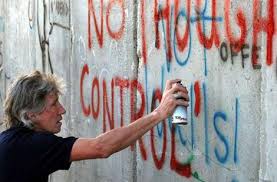
So what happens when you put together an ageing British rock star, a Finnish director, and a spokesman for the United Nations to launch a short film about Israel’s security barrier, sorry, “Apartheid Wall”? Let’s begin with the money quote. As Pink Floyd front man Roger Waters had it this week (using the catch line from one of his most famous songs) in a story quoted all across Europe by French news agency Agence France Presse (AFP):

‘”It fills me with horror, the thought of living in a giant prison,” Waters says as he spray-paints “We don’t need no thought control” on the wall.’

Oh dear, oh dear. One of the problems with political fanaticism, of course, is that the people who participate in it quickly lose all sense of what they are saying and doing. But this — ‘We don’t need no thought control’? — is preposterous even by anti-Israeli standards. Time then for a bit of loopy logic from the United Nations just to guarantee this particular piece’s entry into the idiotic-story-of-the-year competition.

For full effect, I have left the narrative and the quotations from the AFP story intact:

‘Philippe Lazzarini, the head of the UN Office for the Coordination of Humanitarian Affairs (OCHA) said he hoped the virtual disappearance of [suicide bombing] attacks in recent years would encourage Israel to rethink the barrier.

“The number of suicide bombings has dropped from about 38 a year to one in the last two years,” he said ahead of the premiere. “This might be an opportunity to reflect if the reasons still prevail for continued construction at the expense of tens of thousands of Palestinians.”‘

Hmmm. So let’s get this right. The security barrier has been highly successful in preventing suicide bombings. Since its success is now proven, this obviously means that it should be removed.

Make of that what you will.

The film, entitled ‘Walled Horizons’ and narrated by Waters, takes its cue from the fifth anniversary of the notorious ruling by the International Court of Justice in 2004 which said, in a purely advisory capacity, that the route of the security barrier was illegal and that it should be torn down.

Yohan Eriksson, the Finnish director of the film, was quoted by AFP as saying of his production:

“It is first and foremost a reminder that the world’s highest court has essentially said you cannot build a fence on your neighbour’s yard.”

Actually, in a world of sanity and decency it would “first and foremost” be a reminder of the brutal realities of Palestinian political culture which necessitated the barrier’s construction in the first place.

But as AFP reminds us: ‘The Palestinians view it as an “Apartheid Wall”‘. With which casual and seemingly innocent reference the notion of Israel as the modern day equivalent of Apartheid South Africa is once again pumped into Europe’s collective mind. And so it goes.
.

Thursday, August 13, 2009

Pacifist War on Israel


P. David Hornik
FrontPageMagazine.com
Tuesday, August 11, 2009

The San Francisco Jewish Film Festival’s recent screening of Rachel, commemorating the young anti-Israeli activist Rachel Corrie who was accidentally killed by a bulldozer while trying to disrupt an Israeli security operation, sparked a bitter controversy. It was no surprise that one of the two organizations that co-presented the film (the other was the far-Left Jewish Voice for Peace) was the American Friends Service Committee, which has a record of anti-Israeli activism.

AFSC, founded by Quakers as a pacifist organization back in 1917, claims it is “committed to the principles of nonviolence and justice” and believes in “the transforming power of love, human and divine.” Already in the 1920s, the best way the AFSC could find to express these ideals was through pro-Communist activism, and a Quaker author recalled that in the 1930s the organization “refused publicly to criticize the Soviet Union because building up cultural and personal contacts seemed the only way open to defuse hostilities.”

By the 1970s such proclivities still hadn’t waned, with the head of AFSC’s Indochina program praisingCambodia’s Pol Pot regime as “the example of an alternative model of development and social organization.” Even after the genocide in Cambodia was well known, “AFSC also distributed a printed defense of the Khmer Rouge….” Needless to say, throughout these decades and up to the present AFSC has considered the world’s worst malefactor to be the United States, pushing for its unilateral disarmament.

With this record of political perspicacity behind it, in recent decades AFSC has naturally also zeroed in on the “Little Satan”—Israel. AFSC’s own website features “Palestinian-Israeli Conflict” as one of its main categories, and among much else on that subject, it offers a “Palestine-Israel Timeline.” There one learns that Israel is the cruel, rapacious bully of its region.

In 1956 “Suez War begins when Israel, supported by Britain and France, attacks Egypt”; no mention at all of the years of Egyptian-supported terrorism taking hundreds of Israeli lives, or Egypt’s sealing access to Israel’s port of Eilat, that led to the “attack.” In 1967 “June (Six Day) War begins when Israel attacks Egypt, claiming it is acting preemptively”—as if the tricky Israelis fabricated this claim to grab more land; in 1981“Israel attacks Iraqi nuclear reactor”—no mention at all of the existential threat it posed to Israel—and so on. The “Great Satan” doesn’t do much better; in 1991 “U.S.-led coalition defeats Iraq”—no mention at all of that little matter of Kuwait.

By 2001 “Palestinian hard-liners continue suicide bombings against Israeli military and civilians; Israeli forces increase ‘targeted killings’ (assassinations) of Palestinians and armed incursions into Palestinian-controlled areas;…” The scare quotes convey that the term “targeted killings” is just another piece of Israeli trickiness, a verbal evasion for assassinating “Palestinians” (no mention that they were terror masters); and the suicide bombings are perpetrated by “hard-liners” while it is mainstream Israeli “forces” that commit the Israeli misdeeds.

Could the Israeli men, women, and children slaughtered in the suicide bombings—in the wake of Israel’s offer to the Palestinians of a state at Camp David—just have been victims of aggression? Could the Israeli forces just have been trying to succor them? In the AFSC worldview, never; Israel is nefarious to the core and always the source of harm.

Hence AFSC’s various endeavors against Israel. It sends activists to Gaza to help alleviate the alleged “siege” there, but you will search its website in vain for a reference to thousands of rockets falling on Israeli civilians; the “transforming power of love” doesn’t seem to stretch that far. AFSC urges visitors at the site to write to their legislators to endorse former president Carter’s book Palestine: Peace Not Apartheid—even though that book was widely denounced by Jews and others of varying political persuasions for its naked anti-Israeli bias.

AFSC also devotes a page to “Israeli conscious objectors”—or that small fraction of Israelis who find themselves too moral to take part in defending the country. AFSC says it “is now working to create an international solidarity network” for these objectors, and it links to a page calling for an end to U.S. military aid to Israel. Needless to say, you’ll search forever to find AFSC calling for an end to U.S. military aid to, say, Egypt, Jordan, or the Palestinian Authority. Does AFSC really think a disarmed Israel would thrive in the Middle East, or does it want to see the bully eliminated once and for all?

That an ostensibly pacifist impulse gets twisted into antipathy to decent countries, and warm sympathy for horrific human rights abusers from Stalin’s Soviet Union to the Khmer Rouge to Palestinian terror, is a strange thing. That such an organization is given a role in a “Jewish film festival,” despite its obsessive slander and subversion against the Jewish state, is even stranger.


P. David Hornik is a freelance writer and translator living in Tel Aviv. He blogs at http://pdavidhornik.typepad.com/. He can be reached at pdavidh2001@yahoo.com.