Showing posts with label Rabin. Show all posts

Thursday, September 29, 2016

The phony threat of a "Palestinian majority" - by Stephen M. Flatow

...All of which brings us to today. The "occupation" is long over. The "separation" that the S. Daniel Abraham Center is now demanding was already implemented 21 years ago. The "demographic time bomb" was defused. Israel is still both Jewish and democratic. Now you can see why the advocates of Palestinian statehood feel so frustrated. They've run out of cogent arguments. All they can do now is try to wind the clock back to the days before Oslo, so that they can portray Israel as an occupier. That is nothing less than a callous, cynical attempt to manipulate the public. 

Stephen M. Flatow..
JNS.org..
28 September '16..

A group advocating Palestinian statehood took out a full-page ad in The New York Times last week to warn that there will be "a Palestinian majority" in Israel in less than a decade unless such a state is created. A reader of the ad might think he had fallen into a time warp and ended up sometime prior to the signing of the 1993 Oslo accords.

The ad, sponsored by the S. Daniel Abraham Center for Middle East Peace, was headlined "Separation Between Israelis and Palestinians is Essential." It featured what it called a "population breakdown from the Mediterranean Sea to the Jordan River" - a frightening chart that showed the current Jewish population and that of projected estimates; in 2015, 52 percent Jewish; in 2020, 49 percent Jewish and in 2030, 44 percent Jewish.

Those statistics are not merely ignorant; they constitute deliberate deception.

(Continue Reading)

Updates throughout the day at http://calevbenyefuneh.blogspot.com. If you enjoy "Love of the Land", please be a subscriber. Just put your email address in the "Subscribe" box on the upper right-hand corner of the page.Twitter updates at LoveoftheLand as well as our Love of the Land page at Facebook which has additional pieces of interest besides that which is posted on the blog. Also check-out This Ongoing War by Frimet and Arnold Roth. An excellent blog, very important work. 
.

Sunday, January 17, 2016

Rabin, a Mythical Legacy and the Positions of Today’s Israeli Left

...perhaps the real legacy of his murder is this: his successors, whatever their actual instincts and regardless of conditions on the Palestinian side, felt impelled to go many extra miles to achieve Palestinian statehood. But Rabin’s dream was of peace, not Palestinian statehood. In short, his death consecrated a commitment to Palestinian statehood he never made; indeed, which he specifically repudiated. Accordingly, there is no warrant to pretend, as do the coterie of organizations listed above, that the Israeli government is “ignoring” Rabin’s legacy or that his legacy involves supporting the creation of a Palestinian state. Still less so, 15 years after Oslo foundered in bloodshed and terror launched by his putative peace partner.

Morton A. Klein/Dr. Daniel Mandel..
The Algemeiner..
15 January '16..

What would have happened if Israeli Prime Minister Yitzhak Rabin hadn’t been murdered? Would history have been altered?

Not according to former IDF Intelligence chief and Labor Party frontbencher Amos Yadlin, who said the following last week. “He would have lost the elections in any event to Binyamin Netanyahu in ’96. The public atmosphere in the country was that the Oslo process failed, the terror attacks of [Islamic] Jihad and Hamas were unacceptable and Rabin himself would have reconsidered Oslo. I have no doubt that he lost his trust, if he even had it, in Yasser Arafat.”

Yet, whether or not Yadlin is correct — and he might well be — Rabin’s murder actually did alter history. It created a mythology on which subsequent Israeli leaders have acted, or felt obliged, to act.

One need only read the pronouncements of some avowedly left-wing American Jewish groups last November on the twentieth anniversary of Rabin’s murder to see that mythology in full flight.

For example, J Street: “We stand for the legacy of Yitzhak Rabin — responsible leadership, bold vision, pursuit of peace. The current Israeli government has ignored that legacy.”

Indeed, J Street, American Friends of Peace Now, the New Israel Fund, Ameinu, T’ruah and Partners for Progressive Israel, and Living Rabin’s Legacy produced a ‘Statement of Principles,’ calling upon American Jews and Israelis to “recommit to carrying out Rabin’s legacy.”

This legacy was not defined by the Statement’s framers, but there is little mystery surrounding their meaning: the cause of creating a Palestinian state alongside Israel.

This might be regarded now as undebatable, given that the defunct Oslo peace process commenced under Rabin’s stewardship, but this is not so.

Why?

For an answer, go no further than Rabin’s last speech to the Knesset, delivered on October 5, 1995, just one month before his murder, in which he outlined in considerable detail his peace vision:

Sunday, November 22, 2015

What a difference 20 years can make: Saying goodbye to a victim of terror

...Late last week, As the news reports came in about the murder of Ezra Schwartz, the Massachusetts teenager also in Israel to study Torah, I wondered how the Israeli government would act when it was time to send him home to his parents. Would it stick its head in the ground, as did the Rabin government, at its failure to contain terrorists whose goal is not to rid the West Bank of settlers but to kill as many Jews as they can in a 100-year old genocidal war? Or would it allow Ezra to receive the tribute he deserved for standing up as a Jew in our homeland and casting his lot, as did Alisa, with the people of Israel.

Stephen M. Flatow..
Times of Israel..
22 November '15..

What a difference 20 years can make.

It was late Tuesday evening, April 11, 1995. 36 hours earlier I had arrived in Israel to be by the side of my daughter Alisa who had been mortally injured in a bus bombing. Now I was being ushered by Israeli protocol people into the VIP lounge at Ben Gurion Airport to await my El Al flight that would return me with Alisa’s body to the States.

I sat on a couch at one end of the room, next to a military chaplain who didn’t speak a word of English. On the opposite side were members of the press who asked a few questions. Frankly, I don’t remember what those questions were, or what I said in reply.

During a lull, I learned that students who knew Alisa wanted to have access to the airport in order to give Alisa a proper send off. The answer from the Rabin government was, “no.” No one would be allowed in the airport or on the tarmac while Alisa’s coffin was present in order to say goodbye. It was for safety reasons, I was told.

Shortly before the flight was to leave, I was brought along the tarmac to the rear of the plane. There was Alisa’s coffin, with an Israeli flag draped over it, and on top of that a wreath from the government of Israel. A protocol officer was there to extend her condolences and the chaplain who had joined me in the VIP lounge was there to say the kaddish.

But none of Alisa’s friends or fellow students was there, and there was no outpouring of public support at the airport in the face of the horrific murder of a 20-year old American college student studying Torah in Israel.

Monday, November 2, 2015

Actually Bill, It’s Not Up to Israel

...So far from advancing the cause of peace, speeches like Clinton’s actually retard it. Of course, if Clinton were to go to Ramallah and tell the Palestinians that it was up to them to finally make peace, he would not be greeted with thunderous cheers, as was the case in Tel Aviv. But it would be an important wake-up call for a people that are still trapped in its own rhetoric of delegitimization. Israel has taken plenty of risks for peace.

Jonathan S. Tobin..
Commentary Magazine..
01 November '15..

He should have known better. Bill Clinton spent the years after he left the White House loudly and bitterly lamenting the fact that Yasir Arafat cost him a Nobel Peace Prize. Clinton hosted a peace summit at Camp David in the summer of 2000 at which Israeli Prime Minister Ehud Barak offered the Palestinians an independent state including almost all of the West Bank, a share of Jerusalem and Gaza in exchange for peace. Arafat said no and months later launched a terrorist war of attrition. But in spite of this, Clinton told a huge crowd in Tel Aviv last night that “it is up to you” in order to make peace in the Middle East. Clinton was an honored guest at a peace rally/commemoration of the 20th anniversary of Yitzhak Rabin’s murder. President Obama also sent taped remarks along similar lines that were played at the event.

It is all well and good to praise the search for peace. It is quite another to tell them that it is up to them to decide whether there will be peace. Because if there is anything that the last 22 years have taught us it is that it clearly not up to the Israeli people.

According to Clinton:

I always thought the role of the United States was to provide whatever help necessary to ensure Israel’s security, maximize the benefits of peace and minimize the risks. But the decision is yours.

The next step in the magnificent story of Israel… the next step will be determined by whether you decide that Rabin was right, that you have to share your future with your neighbors, that you have to stand for peace, that the risk for peace isn’t as severe as the risk of walking away from it. We are praying that you will make the right decision.

Yet, as Clinton knows, Barak repeated the offer the next year, and Ehud Olmert sweetened it in 2008. Both times the Palestinians against refused. Then Benjamin Netanyahu offered withdrawals from most of the West Bank and committed himself to a two-state solution and still the answer was no. Before that, Ariel Sharon withdrew every soldier, settler and settlement from Gaza hoping to create an opening for peace and instead set the stage for the creation of an independent Palestinian state in all but name there that is an Islamist terrorist dictatorship. Each time Israel took the kind of risks for peace that its friends and critics had been urging it to do yet got neither peace nor credit for the sacrifice.

To be fair to Clinton, there’s little doubt that he cares about Israel and the Israeli people have always appreciated his genuine affection and returned it. That’s more than can be said for Obama, who, at best, regards Israel with condescension, restricting his praise for a mythical Israel of the past that didn’t face the real country’s terrible war and peace dilemmas.

But in spite of Clinton’s intimate knowledge of the peace process, he still clings to the notion that somehow it is within the power of the Jewish state to force an end to a century-long conflict with the Palestinians.

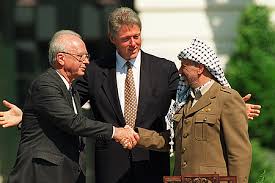
The signing of the Oslo accords on the White House lawn was a high point of Clinton’s presidency and sealed his relationship with Rabin. Clinton’s honoring a man who was tragically murdered is entirely appropriate. But the problem here is the implicit assumption that it was assassin Yigal Amir’s bullet that killed the peace process or the Israelis who peacefully demonstrated against their government for empowering terrorists and not the third man in the famous picture with Clinton and Rabin: Arafat.

Friday, December 14, 2012

When Israel considers policy recommendations, remember, caveat emptor (buyer beware).

Dr. Aaron Lerner..
IMRA Weekly Commentary..
13 December '12..

Weekly Commentary: A reminder from Oslo key man Beilin: Israeli Oslo leadership did not actually plan ahead

One can appreciate how hard it is for foreigners to accept that the half-baked ideas of Israelis with impressive military records or years of experience in Arab-Israeli affairs are really just that: half-baked ideas.

After all, one would hope and expect that someone who was able, for example, to reach the very pinnacle of the IDF would have both the common sense and integrity to think through their policy recommendations to the end before opening their mouths.

But this is nothing new.

From the very start of Oslo, opponents of Oslo maintained that it was a half-baked plan. That the Israeli leadership promoting Oslo did not really think it through to the end.

And thanks to Ari Shavit’s interview of Yossi Beilin ( "Yossi removes his glasses" Haaretz Magazine, March 7, 1997) we have confirmation from the key man of Oslo that this indeed was a half-baked program.

Here is my translation of some excerpts:

Thursday, December 2, 2010

The death of a frog

As the parable of the amphibian goes, will Israel reach the lethal boiling point where it has made one concession too many?

Martin Sherman
Op-Ed/JPost
29 November '10

“…if you place [a frog]… in a pot of tepid water…, it will float there quite placidly. As the water gradually heats up, the frog will sink into a tranquil stupor …and before long, with a smile on its face, it will unresistingly allow itself to be boiled to death.”
– Daniel Quinn, The Story of B

For anyone concerned with the fate of the nation-state of the Jews, there is a grave caveat in this citation from a well-known American author. It is a caveat that will be ignored only at great peril, and one that is becoming increasingly pertinent – especially in the light the ever-more perceptible signs of Prime Minister Binyamin Netanyahu’s readiness to embrace measures that he promised to eschew (such as a renewed building freeze); and the growing friction between him and ministers in his government (such as Moshe Ya’alon and Silvan Shalom) who are insisting that he in fact honor the promises he made.

In recent years, Israel has back-pedaled repeatedly on positions it has taken, continuously “adapting” to situations that expose it to ever-greater security risks and consenting to circumstances that would have seemed inconceivable in the not-too-distant past.

An appropriate point of departure to illustrate the severity of this disturbing phenomenon, and to gauge just how drastically Israel has allowed its positions to be eroded with the passage of time, is Yitzhak Rabin’s last address to the Knesset. On October 5, 1995, exactly one month before his assassination, Rabin sought Knesset ratification of the Oslo II agreements (or to give their full title “The Interim Agreement on the West Bank and the Gaza Strip”) that were signed two weeks previously.

Restoring public awareness of this erosion – and the comprehension of its significance – is crucial, particularly since the median age of the Israeli population is just over 28. This means that roughly half of all Israelis were not yet in their teens in the “Oslo period” and thus have no real personal recollection of the events that took place during those fateful days – other than what was provided by the misleading and distorted coverage in a biased press, both at home and abroad.

(Read full article)

If you enjoy "Love of the Land", please be a subscriber. Just put your email address in the "Subscribe" box on the upper right-hand corner of the page.
.

Monday, September 6, 2010

Tell Me Again--Why Is It A Novel Idea To Strike Back At Hamas During Peace Talks?


Daled Amos
05 September '10

...Yitzhak Rabin and Shimon Peres deemed the suicide bombings that followed the 1993 Oslo Accord “crimes against the peace process” and the victims, "sacrifices for peace".
Evelyn Gordon

Sacrifice: to surrender or give up, or permit injury or disadvantage to, for the sake of something else.
Dictionary.com


Israel may not have responded militarily to the murder of 4 Israelis by Hamas terrorists, but Al Jazeera reports Israel has responded to rockets fired from Gaza:
Israel has launched a series of air raids against targets in southern Gaza just hours after Palestinian fighters fired a rocket over the border.

Witnesses and Hamas security officials said late on Saturday that Israeli aircraft struck targets including smuggling tunnels running under the border with Egypt at Rafah within hours.

At least three people were wounded in the attacks, medical workers said.


(Read full post)

If you enjoy "Love of the Land", please be a subscriber. Just put your email address in the "Subscribe" box on the upper right-hand corner of the page.
.

Tuesday, August 24, 2010

Slow Learners?


Yosef
24 August '10

In the midst of reading "Arafat's War" by Efraim Karsh (2003), I was struck by the following incident and conclusions not learned. Have we moved beyond this? Time will tell.

At a closed meeting with South African Muslim leaders on May 10, 1994, Arafat claimed that the Oslo agreements fell into the same category as the Treaty of Hudaibiya that was signed by the Prophet Muhammad with the people of Mecca in 628, only to be reneged upon a couple of years later when the situation tilted in Muhammed's favor. Unknown to him, his words were recorded by a member of the Jewish community who managed to infiltrate the meeting disguised as a Muslim.

The Israelis were stunned. A week earlier they had signed the Gaza-Jericho Agreement (also known as the Cairo Agreement) on the establishment of a Palestinian Authority in these territories as a preliminary stage in the DOP's implementation, and here was their cosignatory presenting these agreements as a tactical ploy, that could be discarded at the first available opportunity. Rabin angrily demanded that Arafat "re-affirm his commitment to his agreement with us." So did the left-wing minister of the environment, Yossi Sarid, one of the most dovish members of the Israeli government."Arafat has to announce that his grave words at the Johannesburg mosque are null and void,"he said. "He should pronounce his complete adherence to the agreement with Israel and prove this abidance through an open and determined struggle against terrorism. Should he fail to do this, the crisis of confidence will persist and Arafat will be able to choose between being a mayor of Jericho or the ruler of Gaza. In such circumstances,
Gaza and Jericho will be the end of the process" (but Gaza and Jericho will remain turned over to Arafat and the PA. Y)

Arafat remained unperturbed.
(Efraim Karsh,
Arafat's War, p.60-61)


If you enjoy "Love of the Land", please be a subscriber. Just put your email address in the "Subscribe" box on the upper right-hand corner of the page.
.

Friday, April 2, 2010

Obama's Foolish Settlements Ultimatum


Steven Rosen
MEF
ForeignPolicy.com
01 April '10

U.S. President Barack Obama's decision to confront Israeli Prime Minister Benjamin Netanyahu on Israeli construction activity in East Jerusalem has been greeted by a hail of praise, especially from people impatient to proceed with peace negotiations with the Palestinians. The belief seems to be that meeting this issue head-on will accelerate progress toward an agreement ending a conflict that has festered for generations. The historical record suggests a different conclusion.

The assumption that a faceoff over construction in Jerusalem will advance negotiations has not been subjected to much scrutiny. But the last two decades show that progress has occurred not when this issue was put first, but when it was finessed and left for the final status negotiations on Jerusalem.

Consider this: If, 17 years ago, U.S. President Bill Clinton or Palestinian leader Yasir Arafat had insisted that Israeli Prime Minister Yitzhak Rabin freeze all settlement construction, including in Jerusalem, before Arafat would sit down with Rabin, there would have been no Oslo agreements. By Rabin's own account, in comments before the Knesset, Israel's parliament, he had to fudge the issue.

"I explained to the president of the United States," he said,"that I wouldn't forbid Jews from building privately in the area of Judea and Samaria ... I am sorry that within united Jerusalem construction is not more massive."

The same year as the famous handshake on the White House lawn, 1993, the Rabin government completed the construction of more than 6,000 units in the Pisgat Zeev neighborhood of East Jerusalem, out of a total of 13,000 units that were in various stages of completion in areas of the city that had been outside Israeli lines before 1967.

So Arafat did sit down with Rabin, even while Israel's construction in Jerusalem continued. And, on Sept. 13, 1993, the Oslo peace accord was signed -- by the same Mahmoud Abbas who refuses to sit down today. And on October 14, 1994, Rabin, who built homes for Jews in East Jerusalem, was awarded the Nobel Peace Prize.

Altogether, Israel completed 30,000 dwelling units in the West Bank, Gaza, and Jerusalem in the four years of Rabin's government. Even the Jan. 9, 1995, announcement of a plan to build 15,000 additional apartments in East Jerusalem neighborhoods beyond the 1967 borders (especially Pisgat Zeev, Neve Yaacov, Gilo, and Har Homa) did not stop negotiations, which resulted in the Oslo II accord of September 28, 1995. Israeli construction continued while Abbas and Rabin signed an historic accord.

And what was the American policy toward Rabin's construction of Jewish homes in East Jerusalem? Mild annoyance.

(Read full article)
.

Wednesday, March 31, 2010

Israel's Crisis and Opportunity


Steven M. Goldberg
American Thinker
31 March '10

(Perhaps a bit more on the dire side than my taste, but some interesting points)

Rahm Emanuel famously proclaimed, "You never let a serious crisis go to waste. And what I mean by that is it's an opportunity to do things you think you could not do before." Ironically, although the President's Chief of Staff has proven to be a false friend of Israel, the leadership of the Jewish State would do well to heed his advice.

That Israel is in peril is obvious. Israel's enemies sense the opportunity to destroy it through a perfect storm, a confluence of events that seem to leave Israel reeling and vulnerable. First and foremost is the unmistakable betrayal by the President of the United States, who has loudly broadcast his eagerness to sacrifice the security of the Jewish State to appease the Muslim world. Israel is under enormous duress to surrender vital territory to allow for the creation of a Palestinian state within its borders. That such a development would be catastrophic for Israel is apparent to anyone who knows history. As former Prime Minister Yitzhak Rabin stated, "The Palestinian state can only emerge on the ruins of Israel."

In addition, Iran is hell-bent on developing nuclear weapons, and it is clear that the international community will do nothing to stop it. President Obama appears to be pressuring Israel to refrain from military action to stop the Iranian threat. Hezb'allah and Hamas have restocked their arsenals of rockets and missiles, which now threaten to reach the center of Israel, including Tel Aviv. The European Union is championing the Fayed Plan, pursuant to which the Palestinian Authority would unilaterally announce the establishment of the Palestinian state, which would shortly thereafter be recognized by the United Nations Security Council. In view of President Obama's indifference and even antipathy to Israel, the United States cannot be counted on to exercise its veto.

(Read full post)
.

Saturday, March 13, 2010

Peres’s extracurricular clinchers


Sarah Honig
Another Tack/JPost
12 March '10

So who says you can’t accurately predict the future? admittedly, clairvoyance isn’t realistic in all circumstances, but in some instances not to sense what’s about to occur is to willfully avoid reality. In given situations what threatens to unfold is obvious.

So it was when Shimon Peres campaigned for the presidency in 2007.

I wrote then: “How Peres would exploit presidential office, given his past predilections, boggles the mind. A Peres presidency would be invitation to intrigue. It’s safe to assume he wouldn’t make do with a figurehead role, but would hyperactively preside over a parallel government and spawn an unimaginable surfeit of inventive visions, plans and proposals. Their common denominator would be the increasing Palestinization of this land and dangerous compromising of what Golda Meir called ‘the Jewish national interest.’”

There was plenty over the past few years to vindicate this forecast, but the most recent reports of Peres’s extracurricular activities are the clincher.

GET A load of the following samples from Haaretz (which fully approves of the president’s hijinks).

“Talks have recently been under way to arrange a summit meeting in Rome this April between President Shimon Peres and Palestinian Authority President Mahmoud Abbas. The talks have reportedly been carried out without the involvement or even the knowledge of Prime Minister Binyamin Netanyahu, whom Abbas has persistently refused to meet.”

Sounds familiar? Deja vu? The same old MO?

There’s more:

“The person behind the summit drive is Uri Savir, president of the Peres Center for Peace, who was one of the architects of the Oslo Accords and served as director-general of the Foreign Ministry when Peres was foreign minister.”

And more:

(Read full article)
.

Sunday, February 14, 2010

Were the Oslo Accords a state of mind?


Dr. Alex Grobman
Special to The Jewish State
05 February '10

Finding a solution to the Arab/Israeli conflict has been a constant source of frustration for American administrations. Each new U.S. president assumes he can resolve this intractable dispute either through the sheer force of his personality or his unique understanding of the problems in the region.

The Oslo Peace Accords -- which were officially signed at a public ceremony in Washington, D.C. on Sept. 13, 1993, in the presence of PLO chairman Yasser Arafat, Israeli Prime Minister Yitzhak Rabin, and U.S. President Bill Clinton -- is among the most glaring example of how American presidents are naive about how to settle the conflict.

In "Doomed to Failure?: The Politics and Intelligence of the Oslo Peace Process," Ofira Seliktar, a professor of political science at Gratz College and adjunct professor at Temple University, analyzes the environment in which the Oslo Accords evolved, and the reasons why the agreement failed. The downfall of the Soviet Union and the defeat of Iraq in the Gulf War in 1991 were viewed by the Israeli peace activists and their supporters in the West as a sure sign that the climate was ripe to start the Oslo negotiations that lead to the Declaration of Principles.

Shimon Peres, the most vigorous proponent of this view, believed that a new Middle East had emerged that would prevail over the "irrational" and "tribalist" attitudes like extreme nationalism and religious fundamentalism among the Arabs throughout the region. Once peace was achieved, peace activists expected there would be an added bonus: Israel would probably abandon its own "tribal-particularistic culture shaped by the ultraorthodox and national religious Zionists in favor of a more universalistic-secular creed."

Seliktar describes how the negotiations began, the principles upon which they were based, and the Labor party's attempt to implement the accord even as Yasser Arafat's legitimacy continued to be repudiated. She explores how the Likud government attempted to effect a midcourse modification of the agreement, and Labor's efforts to circumvent and ignore PA blatant violations of the interim provisions of the Accord in order to achieve a final peace settlement.

Those who want to understand the way in which Israel predicts and manages political change will find this book of special interest. Seliktar shows us why the Oslo Accords were doomed from the start.

(Read full article)
.

Friday, January 1, 2010

The Deadly Price of Pursuing Peace


Evelyn Gordon
Commentary Magazine
January '10

When the Oslo process began in 1993, one benefit its adherents promised was a significant improvement in Israel’s international standing. And initially, it seemed as if that promise would be kept: 37 countries soon established or renewed diplomatic relations with Israel; a peace treaty was signed with Jordan; five other Arab states opened lower-level relations.

But 16 years later, it is clear that this initial boost was illusory. Not only is Israel’s standing no better than it was prior to the famous handshake between Yitzhak Rabin and Yasir Arafat on the White House Lawn in September 1993, it has fallen to an unprecedented low. Efforts to boycott and divest from Israel are gaining strength throughout the West, among groups as diverse as British academics, Canadian labor unions, the Norwegian government’s investment fund, and American churches. Israeli military operations routinely spark huge protests worldwide, often featuring anti-Semitic slogans.

References to Israel as an apartheid state have become so commonplace that even a former president of Israel’s closest ally, the United States, had no qualms about using the term in the title of his 2007 book on Israel. European polls repeatedly deem Israel the greatest threat to world peace, greater even than such beacons of tranquility and democracy as Iran and North Korea. Courts in several European countries, including Belgium, Britain, and Spain, have seriously considered indicting Israeli officials for war crimes (though none has actually yet done so). And in October, when the United Nations Human Rights Council overwhelmingly endorsed a report that advocated hauling Israel before the International Criminal Court on war-crimes charges, even many of Jerusalem’s supposed allies refused to vote against the measure. In academic and media circles, it has even become acceptable to question Israel’s very right to exist—something never asked about any other state in the world. None of these developments was imaginable back in the days when Israel refused to talk to the Palestine Liberation Organization, had yet to withdraw from an inch of “Palestinian” land, and had not evacuated a single settlement.

Yet even today, conventional wisdom, including in Israel, continues to assert that Israel’s international standing depends on its willingness to advance the “peace process.” That invites an obvious question: if so, why has Israel’s reputation fallen so low despite its numerous concessions for peace since 1993?

(Read full article)
.

Friday, December 4, 2009

Netanyahu is positioning himself left of Rabin


Ari Shavit
Haaretz
04 December 09

(Those familiar with Ari Shavit will know which parts to discount, but there is definitely what to take notice of here.)

Benjamin Netanyahu made history twice. The first time was when he adopted the two-state solution in his Bar-Ilan speech, and the second was when he decided last week to freeze settlement construction. The Palestinians dismiss his steps and the Europeans say they're not enough. The skeptics are skeptical and the cynics are cynical. But the truth is that Netanyahu circa 2009 is situating himself to the left of Yitzhak Rabin circa 1995.

Unlike Rabin, Netanyahu now accepts the establishment of a demilitarized Palestinian state. Unlike Rabin, he is issuing orders prohibiting construction throughout the Jewish West Bank. Netanyahu has crossed the Rubicon, on both ideological and practical levels, and reinvented himself as a centrist.

At the beginning of this decade, Ariel Sharon underwent a similar process, with the road map his equivalent of Netanyahu's Bar-Ilan speech. The road map expressed his support for the two-state concept, while insisting that essential basic conditions be fulfilled before the establishment of a Palestinian state.
Advertisement
But a short time after accepting the road map, Sharon revealed that its trails led to a dead end. No Palestinians met the basic conditions, no Palestinians were capable of signing a final-status agreement, no Palestinians had the power to implement peace. When the father of the settlements finally came out in favor of dividing the land, it turned out that there were no Palestinian leaders likewise committed to dividing the land.

Thus was the disengagement born. Although Sharon was aware of its flaws, he realized that disengagement was the only plan of action a centrist Israeli leader could advance without a real partner for real peace.

Six years later, Netanyahu has reached the exact same point. He accepts the principle of two states, and receives no response. He suspends construction in the settlements, and is rejected. He courts Mahmoud Abbas, and is disparaged. The son of Ze'ev Jabotinsky's personal secretary wants a historic reconciliation with the Palestinians, and the Palestinians are slamming the door. He is offering the Palestinian national movement negotiations over the establishment of a Palestinian nation-state, and has found that there's no one to talk to and nothing to talk about. Zilch. A brick wall.

(Read full article)
.

Tuesday, November 17, 2009

A Bill Clinton Promise (1999)


A Bill Clinton Promise (1999) : Dry Bones cartoon.
Today's Golden Oldie is a Dry Bones cartoon from December 1999. Ten years ago next month.

I've posted this Golden Oldie because the ex-President is here in Israel to share his "wisdom" with us. According to the Associated Press (as quoted by Haaretz)

Bill Clinton in Israel: There would be peace if Rabin were still alive
"Former U.S. President Bill Clinton said on Saturday that if former prime minister Yitzhak Rabin were still alive, a peace accord would have been reached between Israel and all of its neighbors." -more
The impeached President, who broke his promise to free Pollard ten years ago, is now telling us that the ongoing, continuous, and relentless genocidal quest to destroy the Jewish State is because of Israel's political leadership!!?!

The man pushes the limits of hutzpah!

* * *
Ten years after Clinton's broken promise, Jonathan Pollard remains in Prison ... On November 21, 2009, Jonathan Pollard will enter his 25th year of a life sentence for his activities on behalf of Israel. The median sentence for the offense Pollard committed - one count of passing classified information to an ally - is 2 to 4 years. Pollard received his life sentence without a trial, as a result of a plea bargain which he honored and the U.S. government violated.

Monday, November 16, 2009

Bill Clinton pushes false State Department line


FresnoZionism.org
14 November 09

One sometimes forgets what a fool Bill Clinton was capable of being. And then he reminds us:

“In the last 14 years, not a single week has gone by that I did not think of Yitzhak Rabin and miss him terribly,” Clinton told a VIP gathering at the Yitzhak Rabin Center in Tel Aviv.

“Nor has a single week gone by in which I have not reaffirmed my conviction that had he not lost his life on that terrible November night, within three years we would have had a comprehensive agreement for peace in the Middle East.” — Ha’aretz


Oh really? What does Clinton think Rabin would have added to the already over-the-top offers made to the Palestinians at Camp David and Taba that would have caused Arafat to accept them?


Does he think Arafat would have refrained from sponsoring terrorism and educating a generation to be suicide bombers if Rabin had been alive? Does he think that any of the clear messages sent by the Palestinians to this day, that the only ‘peace’ deal that they would accept is unconditional surrender, would have not been sent if Rabin were around?


Either he really is a fool and actually believes this, or he is helping push the current State Department line (after all, his wife is the Secretary) that the reason that there isn’t ‘peace’ is that Israel isn’t giving up enough. Just like the helpful media, Clinton is reinforcing the message that the problem is Israel’s intransigence rather than Palestinian anti-Zionism.


“If you want it, it is no legend,” Herzl said. Unfortunately, this inspiring proposition is only sometimes true. Some people want a peaceful two-state solution next week, but this is one of those times that reality intervenes, and it doesn’t matter how much one wants it, it remains a dream.

.

Monday, August 17, 2009

The Oslo Syndrome: Delusions of a People Under Siege


Middle East Forum
A briefing by Kenneth Levin
(September 26, 2005)

(While this piece is 4 years it has withstood the test of time and is worth giving a 2nd look.)

Dr. Levin is the author of The Oslo Syndrome: Delusions of a People Under Siege. He earned an undergraduate degree in mathematics from the University of Pennsylvania, a B.A./M.A. in English language and literature from Oxford University, an M.D. degree from Penn and a Ph.D. in history from Princeton University. He is a clinical instructor in psychiatry at Harvard Medical School and maintains a private practice in psychiatry. Dr. Levin has written extensively on Israel and the Arab-Israeli conflict. His articles have appeared in The New Republic, The Boston Globe, The Washington Times, and The Jerusalem Post.

On the very evening of the handshake between Yitzhak Rabin and Yasir Arafat on the White House lawn in September of 1993, the latter went on Jordanian television and told his constituency that it should understand the Oslo accord as the first phase in the Phased Plan elaborated by the PLO in 1974, with the ultimate goal being the destruction of Israel. Arafat repeated this assertion at least a dozen times during the first month of Oslo. Why did Israel persist in the Oslo process when following Arafat's arrival in the territories in July of 1994 Israel experienced the worst terror attacks in its history?

The Oslo process was supposed to finally achieve genuine peace between Arabs and Israelis; instead it resulted in the worst terror that Israel has ever experienced. We must ask why this was the case. Why did Israel enter into multiple agreements with Arafat when he was openly stating his goal to be the annihilation of Israel?

According to Ari Shavit, a writer for Ha'aretz, during the Oslo accords enlightened Israelis were affected with a Messianic craze – they believed that the end of the old Middle East, the end of history, the end of wars and the end of conflict was near. They fooled themselves with delusions, bedazzled into committing an act of Messianic drunkenness.

To understand the why of this situation we must look at the psychology of chronically besieged populations. Almost invariably there are parts of the population that accept the indictments of the besiegers in the hope that they can win relief and peace. This is a psychological response to being besieged, and Jews have been besieged for 2000 years. As Max Nordau wrote over a hundred years ago, the greatest success of the anti-Semites was that they had gotten the Jews to see themselves through anti-Semitic eyes. Nordau saw the idea of a Jewish state as a refuge for all Jews, regardless of their politics, language, or nationality.

In the 1920's and 1930's within the Zionist movement the "new Jew" was cast as a secular socialist, without the accoutrements that enraged the wider gentile world. German Jewish intellectuals like Martin Buber cast their disapproval of a Jewish state in moral terms, and argued that Jews had moved beyond the need for a state, but were also concerned that they might lose their newly acquired nationalities if a Jewish state were formed.

From the creation of the Jewish state until 1977, Israel was run by socialist-Zionists. However, things changed in 1977, when for the first time, a non-socialist-Zionist government was elected. Between 1977 and 1992 the Labor constituency began to accept the idea that if Israel retreated to the 1967 lines the Arabs would allow them to peacefully coexist. The New History movement also supported the idea that in order to achieve peace Israel must acknowledge its guilt and accede to a retreat. Moreover, it proffered the notion that Israel bore primary responsibility for the hatred with which it was viewed by its neighbors. The post-Zionist movement argued that Israel was too Jewish and that it must abolish the law of return and change the flag and national anthem as they were unfair to Arabs.

Within a year of the 1992 election the Labor party had accepted some of these ideas. Still, the "peace movement" marched in the street against Prime Minister Yitzhak Rabin, arguing that he was not making concessions quickly enough. This movement continued to press for more concessions despite Arafat's statements that this was the first phase in the plan to annihilate Israel and despite the terror attacks that were perpetrated against Israel.

The Labor coalition was defeated in 1996, when Benjamin Netanyahu was elected Prime Minister. During his three years as head of the government Netanyahu's tone was less conciliatory but he continued to conduct a series of negotiations based on the principle of Israeli concessions in exchange for Palestinian assurances.

In 1999 Netanyahu was succeeded by Ehud Barak and a Labor-led coalition. Barak's approach was rhetorically and practically similar to Rabin's, whose successor he seemed. A series of intensive negotiations were undertaken, such as at Sharm el-Sheikh, but with each step terror attacks became more frequent and horrific.

The Barak approach of adding incremental concessions failed badly. In September 2000 when Arafat launched his terror war against Israel an increasing percentage of Israel's population came to the realization that neither retreat nor concessions would afford them the peace they so earnestly desired. The process culminated in the election of Ariel Sharon as Prime Minister in early 2001. The subsequent war of terror convinced many in the Israeli public that concessions had run their course.

Despite almost sixty years of being under siege Israel has created a free, vibrant, and creative society. The question is whether Israel will continue nurturing what it has built as it awaits true change in the Arab world or will Israelis, in their search for a genuine peace, continue to grasp at delusions of peace that will threaten everything they have created.


.