Showing posts with label Qom. Show all posts

Tuesday, November 17, 2009

IAEA Inspectors: We’re Shocked, Shocked at Iranian Duplicity


Jonathan Tobin
Contentions/Commentary
16 November 09

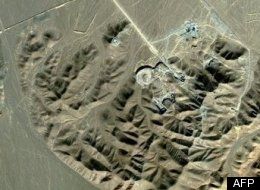
The findings of a report released today from the International Atomic Energy Agency’s inspectors about their survey of a previously secret underground nuclear-enrichment plant have apparently led the group to suspect that Iran may be concealing other nuclear factories. Surprise. Surprise. The unfinished facility near the holy city of Qom was built to accommodate enough centrifuges to produce a couple of nuclear weapons a year, but is, in fact, too small to be useful for civilian uses of nuclear power. That gives the lie to Iran’s protests that its nuclear program is for only peaceful intents, but it’s not as if anyone, either in Iran or elsewhere, actually believed that to begin with. But the point of the report is that this newly discovered plant only makes sense if it were part of a network of covert nuclear facilities that could feed it with “raw nuclear fuel.”

But anyone who is shocked about any of this hasn’t been paying attention to this issue for years. Only two years after the United States issued a ridiculous National Intelligence Estimate denying the reality of the Iranian program, even international bodies like the IAEA are no longer prepared to hedge their bets about Iranian intentions. The reality of the imminence of a nuclear Iran cannot be denied any longer, even by those who would prefer to ignore the peril this development poses to U.S. strategic interests as well as world peace. Experts differ as to the exact time line, but there’s little doubt that Mahmoud Ahmadinejad may be in a position to announce that an Iranian nuclear device will be ready sometime within the next few years at the latest.

This also brings into perspective President Obama’s diplomacy on Iran. Having both campaigned on negotiations with Tehran without preconditions and downplayed the human-rights disaster in that country in the wake of a stolen presidential election, Obama seemed to believe he could make a deal with the ayatollahs. But the Iranians rightly sensed weakness and have exploited Obama’s desire for talks at any price. They negotiated a pact to transport their enriched uranium to Russia for safekeeping and then renounced it within weeks without an explanation and have refused Obama’s desperate pleas for them to consider an even sweeter deal. With egg left on his face, Obama has been forced to go cap in hand to Russia and now China to beg them for support for sanctions on the recalcitrant Iranians. The Russians played along, to a certain extent, by expressing their unhappiness with Iran. But you have to forget everything we’ve learned about Vladimir Putin and his foreign-policy priorities in order to believe that the Russians will repudiate their Iranian trading partners to accommodate a prime U.S. strategic interest. Optimism about Chinese help is equally fantastic.

Obama’s amateur diplomacy of apologies and bows can take the U.S. just so far when it comes to manufacturing an international coalition behind the sorts of sanctions that could bring Iran to its knees. Having gambled on a losing diplomatic hand with Iran, the president is now scrambling to resurrect a policy that is clearly sinking under the weight of his naïveté. The latest UN report illustrates just how fast the clock is ticking toward a confrontation that the president seems ill equipped to handle.

.

Thursday, October 29, 2009

Never Give Up


Jennifer Rubin
Contentions/Commentary
29 October 09

Bob Kagan asks a salient question: What will the Obama administration do when it’s clear (well, clearer than it has been) that we’re being played by the Iranian regime? He explains:

So now the test results are in: Iran’s intentions, it seems, are not good. Tehran apparently will not accept the deal but will propose an alternate plan, agreeing to ship smaller amounts of low-enriched uranium to Russia gradually over a year. Even if Iran carried out this plan as promised — every month would be an adventure to see how much, if anything, Iran shipped — the slow movement of small amounts of low-enriched uranium does not accomplish the original purpose, since Iran can quickly replace these amounts with new low-enriched uranium produced by its centrifuges. Iran’s nuclear clock, which the Obama administration hoped to stop or at least slow, would continue ticking at close to its regular speed.

Kagan implores the Obama team to show some spine and move ahead with sanctions to show we mean business. And really, if we didn’t get snookered by the Russians, they, in exchange for our selling out the Poles and Czechs on missile defense, “should come through by joining in sanctions.” Right? But like Kagan, I find it hard to believe that any objective evidence of “failure” will be taken to heart. We’ll simply double down, extend the deadlines, and continue the “hard work of negotiating.”

We’ve already refused repeatedly to take no for an answer on a series of deadlines, and have already absolved Iran for maintaining the secret Qom site. So why should we suddenly show some fortitude? We’ve already beckoned the mullahs back into respectable international company. We’re going to be the skunk at our own garden party?

The Obama team’s devotion to engagement has become a religious-like devotion. Contrary facts are reinterpreted to maintain the core ideology. We must simply be faithful and patient. As Kagan notes, it’s hard to escape the conclusion that ”engagement is an end in itself, not a means to an end.” If engagement ever stopped, we would have to dosomething. And if the vision of a grand multilateral international community doesn’t quite match reality we might — oh my! — have to act on our own. The imposition of American military power we’ve already been warned isn’t going to “permanently” solve anything. (Not like shipping part of Iran’s uranium to Russia to be replaced in a year, huh?)

Much damage has already been done by the faux negotiating. The Iranian regime has solidified its position and taken on an air of legitimacy. News of its suppression of dissent and brutality is out of the headlines. We’ve been enablers in the snuffing out of Iranian democratic protests. (Defunding them certainly went a long way in that direction.)

So will Obama show us he is the savvy negotiator and tough guy his ardent fans think he is? C’mon, it’s not like we’re talking about Fox News or the Chamber of Commerce.

.

Saturday, October 10, 2009

If the World Won't Stop Iran's Genocide, Israel Must


Aggressors' intent has been made clear. So must Netanyahu's resolve and own nuclear means

Louis René Beres
U.S. News and World Report
08 October 09

Louis René Beres is a professor of political science at Purdue University and the author of many books and articles dealing with international law, strategic theory, Israeli nuclear policy, and regional nuclear war. In Israel, he served as chair of Project Daniel.

The International Atomic Energy Agency is not especially worried about Iran's newly discovered uranium enrichment operation, and plans to inspect this once secret facility near Qom on October 25. No matter what this inspection reveals, however, sanctions will never be able to protect Israel from a nuclearizing Iran. The Iranian president's frequent and unhidden threats express a clear declaration of intent to commit genocide. Such intent is actually criminalized by binding international law.

Though supported by law, Prime Minister Binyamin Netanyahu understands that the pre-emptive destruction of Iran's growing nuclear infrastructures would involve substantial difficulties. True, Israel has now deployed a system of ballistic missile defense, but even this superb system could not adequately protect Israel's civilians from a nuclear attack.

Even a single nuclear missile that manages to penetrate Israeli defenses could kill very large numbers. In addition, Iran could decide to share its nuclear assets with certain terror groups in the region, with enemies of Israel that could use automobiles and ships rather than missiles as launchers. These groups might also seek "soft" targets in selected American or European cities, such as schools, universities, hospitals, hotels, sports stadiums, etc.

While the IAEA fiddles, Iran continues to augment its incendiary intent toward Israel with a corresponding military capacity. Left to violate Non-Proliferation Treaty rules with effective impunity, Iran's president and his clerical masters might even be undeterred by any threats of retaliation. Such a possible failure of nuclear deterrence could be the result of a presumed lack of threat credibility, or perhaps of a genuine Iranian disregard for all expected harms. In the worst-case scenario, Iran, animated by specifically Shiite visions of "apocalypse," could become the individual suicide bomber writ large.

If Iran does become fully nuclear, Israel may then have to reassess its stance on nuclear ambiguity, and related policies of nuclear targeting. These urgent issues were openly discussed in the Project Daniel final report, first delivered by hand to then-Israeli Prime Minister Ariel Sharon on Jan. 16, 2003. Originally confidential, the report, titled Israel's Strategic Future , was the carefully informed product of a small group of senior American and Israeli figures drawn from the academic, military, and intelligence communities. Our major recommendation was that under no circumstances should Iran be allowed to "go nuclear."

In the end, Israel's security from Iranian attacks of mass destruction will depend considerably upon its selected targets, and on the precise extent to which these targets have been previously identified. It is not enough that Israel simply has "The Bomb." Rather, the adequacy of Israel's nuclear deterrence and pre-emption policies will depend largely upon the presumed destructiveness of these nuclear weapons, and on where these weapons are thought to be directed.

A nuclear war in the Middle East is not out of the question. Israel will need to choose wisely between "assured destruction" strategies and "nuclear war-fighting" strategies. Assured destruction strategies are sometimes called "countervalue" strategies or "mutual assured destruction." These are strategies of deterrence in which a country primarily targets its strategic weapons on the other side's civilian populations, and/or on its civilian infrastructures.

Nuclear war-fighting strategies are called "counterforce" strategies. These are systems of deterrence wherein a country primarily targets its strategic nuclear weapons on the other side's major weapon systems, and on that state's supporting military assets.

There are serious survival consequences for choosing one strategy over the other. Israel could also opt for some sort of "mixed" strategy. But, for Israel, any policy that might encourage nuclear war fighting should be rejected.

Israel, reasoned Project Daniel, should opt for nuclear deterrence based upon assured destruction. A counterforce targeting doctrine would be less persuasive as a nuclear deterrent, especially to states whose leaders could willingly sacrifice entire armies as "martyrs." If Israel were to opt for nuclear deterrence based upon counterforce capabilities, its enemies might also feel especially threatened. This condition could then actually enlarge the prospect of a nuclear aggression against Israel, and of a follow-on nuclear exchange.

Israel's decisions on countervalue versus counterforce doctrines will depend, in part, on prior investigations of enemy country inclinations to strike first, and on enemy country inclinations to strike all-at-once. Should Israeli strategic planners assume that an enemy state in process of "going nuclear" is apt to strike first and to strike with all of its nuclear weapons right away, Israeli counterforce-targeted warheads, used in retaliation, would hit only empty launchers. In such circumstances, Israel's only application of counterforce doctrine would be to strike first itself, an option that Israel completely rejects. From the standpoint of intra-war deterrence, a countervalue strategy would prove more appropriate to a prompt peace.

Should Israeli planners assume that an enemy country "going nuclear" is apt to strike first, and to hold some measure of nuclear firepower in reserve, Israeli counterforce-targeted warheads could elicit damage-limiting benefits. Here, counterforce operations could appear to serve both an Israeli non-nuclear pre-emption, or, should Israel decide not to pre-empt, an Israeli retaliatory strike. Still, the benefits to Israel of maintaining any counterforce targeting options are outweighed by the expected costs.

Regarding Iran, Israel's best course may still be to seize the conventional pre-emption option. Israel should reject any counterforce targeting doctrine. But if Iran is allowed to continue with its illegal nuclear weapons development, Netanyahu's immediate response should be to end Israel's controversial policy of nuclear ambiguity.

Notwithstanding IAEA assurances, the world has turned a blind eye to Iran's expressly genocidal intent toward Israel, and to Iran's nuclearization. There is no good reason to believe that Tehran would ever stop its plan for nuclear weapons solely because of assorted economic punishments. To Iran, both the U.N. and the U.S. should now finally understand, sanctions represent only a fly on the elephant's back.

No country can be required to become complicit in its own annihilation. Without a prompt change in the "civilized world's" appeasing attitude toward Iran, a law-enforcing expression of anticipatory self-defense may still offer Israel its only remaining survival option.
.
Tuesday, October 6, 2009

Why this man is laughing fit to explode


Melanie Phillips
The Spectator
05 October 09


There are clearly no lengths to which the world will not go to facilitate Iran’s pursuit of nuclear weapons.

Consider. A couple of weeks ago, the world was stunned to discover that Iran had a second uranium processing plant at Qom, thus proving beyond doubt that its pursuit of nuclear technology was to make not nuclear energy but a bomb.


Actually it wasn’t stunned at all, since this information was known to Barack Obama before he was even elected President. But anyway. This coup de théâtre was revealed, it seemed, to strengthen the world’s hand in dealing with Iran. After all, this autumn is the deadline set by the Obama administration for Iran to halt its nuclear weapons programme, after which the US said it was finally going to get really tough with Iran and do ... oooh, really tough things like sanctions.


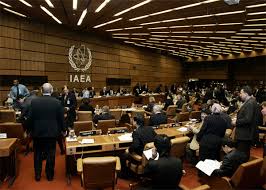
So what happened when the five permanent members of the UN Security Council plus Germany met Iran (its chief nuclear negotiator, Saeed Jali, pictured above)? A deal was reached which has been described as a ‘breakthrough’ and caused the IAEA head Mohammed al Baradei to pronounce himself ‘delighted with progress’. Unfortunately, it was Iran that made yet more progress in its path to the bomb.


Its agreement to allow the nuclear inspectors into Qom is worthless. As theWall Street Journal mordantly observed:


Inspectors from the International Atomic Energy Agency won't find anything incriminating at the Qom facility. Having lied about it for years, the Iranians now have plenty of time to clean the place out.


The real excitement was over Iran’s ‘agreement in principle’ to send approximately one nuclear-weapons worth of Iran's low enriched uranium to Russia for enrichment and then on to France for fabrication into fuel rods for Tehran’s research reactor. The point of this is that the uranium would be returned to Iran in the form of fuel pellets inside the rods, which could not be further enriched to weapons grade purity.


But in another WSJ article John Bolton points out what a farce this all is:


Iran’s Ambassador to Britain exclaimed after the talks in Geneva, ‘No, no!’ when asked if his country had agreed to ship LEU to Russia; it had ‘not been discussed yet.’ An unnamed Iranian official said that the Geneva deal ‘is just based on principles. We have not agreed on any amount or any numbers.’


... By endorsing Iran’s use of its illegitimately enriched uranium, Mr. Obama weakens his argument that Iran must comply with its ‘international obligations.’ Indeed, the Geneva deal undercuts Mr. Obama’s proposal to withhold more sanctions if Iran does not enhance its nuclear program by allowing Iran to argue that continued enrichment for all peaceful purposes should be permissible. Now Iran will oppose new sanctions and argue for repealing existing restrictions.


The president also said last week that international access to the Qom nuclear site must occur within two weeks, but an administration spokesman retreated the next day, saying there was no ‘hard and fast deadline,’ and ‘we don't have like a drop-dead date.’

Meanwhile, the Institute for Science and International Security has posted up on its website excerpts from the internal IAEA Document on Alleged Iranian Nuclear Weaponization, parts of which have already found their way into the media. This material was allegedly based on documents obtained by German intelligence, smuggled out of Iran by the wife of an Iranian nuclear scientist. Apparently there have been arguments inside the IAEA about how to interpret this document, but it states:


The Agency has information, known as the Alleged Studies, that the Ministry of Defence of Iran has conducted and may still be conducting a comprehensive programme aimed at the development of a nuclear payload to be delivered using the Shahab 3 missile system. The information, which originates from several Member States and the Agencys own investigations, points to a comprehensive project structure and hierarchy with clear responsibilities, timeline and deliverables. The information, which has been obtained from multiple sources, is detailed in content and appears to be generally consistent. The information refers to known Iranian persons and institutions under both the military and civil apparatuses, as well as to some degree to their confirmed procurement activities.”


Alleged Studies


“The Alleged Studies conducted by Iran refer, inter alia, to the development work performed to redesign the inner cone of the Shahab 3 missile re-entry vehicle to accommodate a nuclear warhead. The Studies further describe the development and testing of high voltage detonator firing equipment and multiple exploding bridge wire (EBW) detonators as well as an underground testing infrastructure and the probable testing of one full-scale hemispherical explosively driven shock system that could be applicable to an implosion-type nuclear device.


As Sky News’s Tim Marshall observed:


This new information, added to what was already known, suggests the Iranians now know how to make a nuclear bomb, have enough enriched uranium to make one, and have the capacity to deliver it. What is lacking is the finishing touches, and the testing.


The response of the world body to this terrifying and grim development has been to turn itself, in the eyes of the terror regime in Tehran, into a total laughing stock. It reached a transparently meaningless deal with the Iranian regime which it can flick aside with contempt – and in return for which the US, Britain and the rest have now accepted Iran back into the civilised world again, and all talk even of sanctions is now off the table. Thus America, Britain and the rest reward terror and ensure that it has the time to realise its terrible aim.


This is presumably what Obama meant when he said recently of Iran:

I'm not interested in victory. I’m interested in resolving the problem.

Well, if he doesn’t achieve victory over Iran, then Iran will achieve victory over America.

Business as usual in the genocide business!

.

Monday, October 5, 2009

Bad Options on Iran


An Israeli strike won't suffice

by Michael Rubin
Middle East Forum
National Review Online
October 5, 2009

On October 1, President Barack Obama ascended the podium in the Diplomatic Reception Room at the White House and declared negotiations with Iran a tentative success. "The P5-plus-1 is united, and we have an international community that has reaffirmed its commitment to non-proliferation and disarmament. That's why the Iranian government heard a clear and unified message from the international community in Geneva: Iran must demonstrate through concrete steps that it will live up to its responsibilities with regard to its nuclear program. In pursuit of that goal, today's meeting was a constructive beginning," Obama said, adding, "but it must be followed by constructive action by the Iranian government."

Where Obama sees tentative success, reality suggests failure. Faced with irrefutable evidence, Tehran acknowledged that it had built a second, covert nuclear-enrichment plant, squirreled away in an Islamic Revolutionary Guard Corps base near Qom. Neither Obama nor the director of national intelligence, Dennis C. Blair, acknowledged that Iranian confirmation of its second enrichment plant belied the veracity of the 2007 National Intelligence Estimate. Regardless, Tehran's decision to confess when confronted with proof of cheating should not be considered the same as Iranian transparency and goodwill. Many scientists within the International Atomic Energy Agency believe that the Iranian regime now has "sufficient information to be able to design and produce a workable" nuclear bomb.

Obama's supporters have rallied to put the best face on the P5+1 dialogue. "Obama . . . got more concessions from Iran in 7½ hours than the former administration got in 8 years of saber-rattling," Juan Cole, president of the one-man Global Americana Institute, wrote on his blog. Former Carter administration adviser (and October Surprise conspiracy theorist) Gary Sick was likewise effusive, calling the meeting a "historic moment after thirty years of mutual recriminations and hyperbole." The truth, however, is that any agreement was short of specifics. Iran pledged to allow inspections, but offered no specifics as to when and under what conditions. While Iranian authorities pledged to ship uranium to Russia for further enrichment, the West has no guarantee that Iranian scientists will not simply enrich the fuel further when it is repatriated to Iran.

Not surprisingly, the Iranian regime has been defiant in recent days. Ahmadinejad called Obama's criticism of Iran's second enrichment plant a "historic mistake," hardly a sign that the Iranian regime feels sincere about complying with international demands. Jomhouri-ye Eslami, a daily closely associated with the Islamic Republic's intelligence apparatus, editorialized, "The announcement of the enrichment facilities forced the West into a defensive position," and Kayhan, which voices the line of the "supreme leader," wrote, "The announcement of the enrichment facilities will be Iran's winning card in October negotiations."

The Obama administration may convince itself that it remains in control of the diplomatic process and has placed serious constraints upon any Iranian breakout capability, but countries with more at stake know better. Last month's Iranian test of ballistic missiles capable of hitting Saudi Arabia and Israel underscored both the danger and questions about Iranian sincerity.

Threat Perception

Different threat perceptions muddy the international approach to the Iranian nuclear challenge. For the European Union, the Iranian nuclear challenge revolves around the viability of the nuclear Non-Proliferation Treaty as well as the efficacy of European foreign policy on the international stage. After all, the Islamic Republic's proliferation activities marked the first international crisis in which the European Union consciously sought to lead. Should Iran go nuclear despite years of critical engagement, it would be a blow to the multilateralism-and-incentives approach favored by European foreign ministries.

For President Obama and most of the American foreign-policy apparatus, a nuclear-weapons-capable Islamic Republic would be strategically untenable. A nuclear Iran would embolden Tehran to act out conventionally and by proxy, hiding behind its own nuclear deterrence. Growing Iranian prestige and ability to project power would force other regional states to make accommodations with Tehran that might not be in the U.S. national-security interest. Any additional nuclear power in the Middle East would also unleash a cascade of proliferation: If Iran went nuclear, Saudi Arabia and Turkey would need to develop their own capabilities. If Saudi Arabia and Turkey went nuclear, Egypt and Greece would as well. A nuclear Egypt would lead Libya to reconsider its decision to abandon the bomb, which in turn might lead Algeria to reconsider its own position. In short, a nuclear Islamic Republic would be a game-changer that would complicate U.S. interests in the region for decades to come. That said, Washington need not fear that an Iranian leadership with a handful of nuclear weapons would cause the U.S.'s demise.
(Full Article)
.

Wednesday, September 30, 2009

Intelligence Gamesmanship


Jennifer Rubin
Contentions/Commentary
29 September 09

Rich Lowry observes that the discovery of the secret Iranian nuclear facility puts a stake through the 2007 National Intelligence Estimate, which was vilified at the time by conservatives. (Thomas Joscelyn: “As many noted at the time, the language and logic of the NIE were nonsensical. There were transparent flaws in its analysis, including the arbitrary decision to set aside concerns over Iran’s overt uranium enrichment and ballistic missile development efforts — both of which continued apace.”) That would be the same NIE report that was heralded by Obama and his fellow liberals.

Lowry writes:

In November 2007, US intelligence agencies wrote a National Intelligence Estimate concluding, “We judge with high confidence that in fall 2003, Tehran halted its nuclear weapons program.” . . .

The 2007 NIE had a very circumscribed definition of a weapons program, but it included “covert conversion-related and uranium enrichment-related work.” Exactly what Qom is for. What do the Iranians have to do to convince US intelligence they have a weapons program?

Iran has been very lucky in its watchdogs. The 2007 NIE, which stands exposed as about as worthless as then-CIA Director George Tenet’s prewar talk of a “slam-dunk” on Iraq’s WMD, crushed any thought of the politically weakened Bush administration moving against Iran. And the punch-pulling International Atomic Energy Agency has been suppressing damaging material, concerned more with forestalling a conflict over Iran’s nuclear program than forestalling the program itself.

But apparently at some point not even the Obama team bought the NIE’s conclusions. Obama after all was quick to admit that Iran’s Qom facility wasn’t configured for peaceful uses. And the ever changing and highly suspect conclusions about Iran’s nuclear intentions keep dribbling out. The Iranians aren’t much interested in long-range missile development, we were told—a conclusion that fit (magically!) with the Obama team’s fervent desire to give something away (missile defense) to butter up Putin.

We are left with only one conclusion: the incessant reassurances that we have little to fear from Iran are the product of wishful thinking and a high degree of “self-delusion,” as Lowry puts it. Unfortunately, the intelligence bureaucracy that churns out the feel-good estimates has a willing consumer for its defective product in the president. He is only too eager to believe what is being peddled — or ignore what’s unhelpful.

The public and our allies, however, are waking up to the gamesmanship here—and may begin to wonder why the president isn’t the least bit upset that the intelligence community got it exactly wrong in 2007. When that happened under Bush, we had a torrent of outrage and a mob of investigative committees. Yet hardly a peep here. Funny how that works.
.