 |
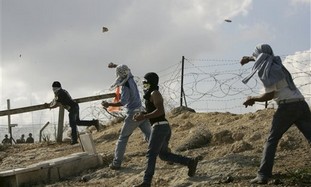
| Demonstrators slinging rocks at Bil'in Photo: AP |
The Algemeiner..
18 February '13..
Five Broken Cameras (2011), a documentary currently up for a 2013 Oscar and co-directed by the film’s narrator and videographer, Palestinian Emad Burnat, and Israeli filmmaker Guy Davidi, attempts to erase the complexity of the Israeli-Palestinian conflict. The film unfolds as a Palestinian fairy tale, narrated in a soothing, storytelling voice:
Once upon a time, a poor Palestinian farmer lived in a West Bank village called Bil’in. He had four sons, a doting wife, and many friends. A few of the men worked, while the women spent their days cooking, cleaning, raising children and otherwise being invisible. The men smoked, danced, watched soccer games and occasionally picked olives. Life seemed perfect. One day, big bad Israelis erected a “barrier” through Bil’in, seemingly for the sole purpose of irritating the villagers. For the next five years, chronicled through the life of the farmer’s youngest son, the farmer and his friends nonviolently protested this fence. Some got hurt and some even died because of Israeli soldiers’ unprovoked and excessive use of force. Then, because of the villagers of Bil’in, the fence came down. Moral of the fairy tale: Israelis are bad; Palestinians are good; the farmer’s son is very cute and has tragically suffered his loss of innocence because of Israel. An intelligent viewer walks away feeling highly manipulated without knowing why.
The film portrays reality through a broken lens. Its manipulative narration and visual editing craft a seemingly simple story of Palestinian nonviolent resistance to Israel’s security fence, but its covert intent is to denigrate Israel. The film is part of an aggressive industry whose sole aim is to delegitimize and blame only Israel with predictable key techniques, all of which the film utilizes.
First, the film provides absolutely no context. Why is there a security fence? Emad alludes to a “barrier” being erected to “secure and separate the settlers.” Wrong. Israel temporarily built a security fence in response to the second intifada (2000-2005). The fence literally prevents Palestinian terrorists from walking from their villages, like Bil’in, into Israeli cities, like nearby Modi’in, and blowing themselves up. While it must be frustrating for a Palestinian farmer to walk through a gate to get to his field (as seen in the movie), it is surely more inconvenient for an Israeli girl to lose her parents and three siblings to a suicide bomber (as happened during the Jerusalem Sbarro restaurant suicide bombing on August 9, 2001). It seems that the fence is so troublesome that it has erased all of Emad’s memory as to why it is there in the first place.


 Posts


