Showing posts with label Churchill. Show all posts

Monday, March 2, 2015

Trying to Avert War - Netanyahu, Churchill and Congress

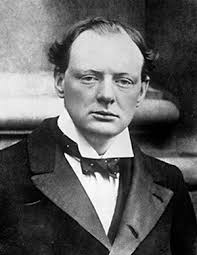
...There are striking similarities between the objectives of Churchill's speech nearly 75 years ago and Netanyahu's today; both with no less purpose than to avert global conflagration. And, like Churchill's in the 1930s, Netanyahu's is the lone voice among world leaders today. There is no doubt abut Iran's intent. It has been described as a nuclear Auschwitz. Israel is not the only target of Iranian violence. Iran has long been making good on its promises to mobilize Islamic forces against the US, as well as the UK and other American allies. Attacks directed and supported by Iran have killed an estimated 1,100 American troops in Iraq in recent years. Iran provided direct support to Al Qaeda in the 9/11 attacks....It is not yet too late to prevent Iran from arming itself with nuclear weapons. In his 1941 speech to Congress, Churchill reminded the American people that five or six years previously it would have been easy to prevent Germany from rearming without bloodshed. But by then it was too late.

Richard Kemp..
Gatestone Institute..
01 March '15..

In a few days, Israeli Prime Minister Benjamin Netanyahu will address the US Congress for the third time. The only other foreign leader to have had that privilege was Winston Churchill. Like Churchill when he first spoke to Congress in December 1941, Netanyahu is taking a risk.

For Churchill the risk was to his life -- he had to make a hazardous transatlantic voyage aboard the battleship HMS Duke of York through stormy, U-boat infested waters. For Netanyahu the risk is to his own political life and to his country's relationship with the United States, given the intense presidential opposition to his speech.

But like Churchill was, Netanyahu is a fighting soldier and, like Churchill, a tough political leader, unafraid to shoulder such risks when so much is at stake. And in both cases, the stakes could not be higher, greater than their own lives, political fortunes or rivalries and affecting not just their own countries and the United States, but the whole of the world.

There are striking similarities between the objectives of Churchill's speech nearly 75 years ago and Netanyahu's today: both with no less a purpose than to avert global conflagration.

Speaking days after the Japanese attack on Pearl Harbor, Churchill summarized the course of the war thus far but then concluded with a dramatic appeal to the American people for Anglo-American unity to prevent conflict in the future, reminding them that "twice in a single generation, the catastrophe of world war has fallen upon us."

"Do we not owe it to ourselves, to our children, and to mankind," he asked, "to make sure that these catastrophes do not engulf us for the third time?"

No less profound, and no less far-reaching, will be Netanyahu's appeal for American-Israeli unity in the face of a new danger. A danger perhaps even greater than Churchill was able to comprehend in pre-nuclear 1941. Whereas Churchill spoke of a future, as yet unknown peril, Netanyahu will focus on the clear and present threat to world peace if Iran is allowed to produce nuclear weapons.

And like Churchill in the 1930s, Netanyahu's is a lone voice among world leaders today.

In pursuit of both uranium and plutonium tracks to a bomb, as well as the development of long-range ballistic missiles, there is no doubt about Iran's intent. It has been described as a nuclear Auschwitz.

It is Netanyahu's duty to sound the alarm against such a prospect. It is Israel's survival that is at stake. It is Israel that will have to conduct military intervention if the US will not. And it is Israelis who will die in any subsequent regional conflagration.

But this is not only an existential threat to Israel -- it is a danger to other states in the Middle East and to us all. Doubtful of Western resolve, Saudi Arabia, Egypt and Turkey are already investigating the development of their own nuclear capabilities.

An agreement that leaves Iran with the potential to achieve nuclear breakout will trigger a Middle East arms race that will exponentially increase the risks of global nuclear war, a risk multiplied by the vulnerability of regional governments to overthrow by extremists.

Iran's ballistic missile program, inexplicably outside the scope of current P5+1 negotiations, brings Europe into Iran's range, and future development will extend Tehran's nuclear reach to the US. The world's number one sponsor of terrorism, the regime of the ayatollahs would have no qualms about supplying their terrorist proxies with nuclear weapons.

This is the greatest threat the world faces today. Yet all the signals suggest that the P5+1, driven by President Obama's apparent desperation for détente with Tehran, is already set on a path towards 1930s-style appeasement that will end with Iran's acquisition of nuclear weapons.

Friday, August 13, 2010

Netanyahu, the anti-Obama


George F. Will
Washington Post
12 August '10

(From George Will, a different perspective with a wide circulation.Y.)

JERUSALEM Two photographs adorn the office of Israeli Prime Minister Binyamin Netanyahu. Together they illuminate a portentous fact: No two leaders of democracies are less alike -- in life experiences, temperaments and political philosophies -- than Netanyahu, the former commando and fierce nationalist, and Barack Obama, the former professor and post-nationalist.

One photograph is of Theodor Herzl, born 150 years ago. Dismayed by the eruption of anti-Semitism in France during the Dreyfus Affair at the end of the 19th century, Herzl became Zionism's founding father. Long before the Holocaust, he concluded that Jews could find safety only in a national homeland.

The other photograph is of Winston Churchill, who considered himself "one of the authors" of Britain's embrace of Zionism. The Balfour Declaration of 1917 stated: "His Majesty's Government view with favour the establishment in Palestine of a national home for the Jewish people." Beginning in 1923, Britain would govern Palestine under a League of Nations mandate.

Netanyahu, his focus firmly on Iran, honors Churchill because he did not flinch from facts about gathering storms. Obama returned to the British Embassy in Washington the bust of Churchill that was in the Oval Office when he got there.

(Read full article)

If you enjoy "Love of the Land", please be a subscriber. Just put your email address in the "Subscribe" box on the upper right-hand corner of the page.
.

Wednesday, January 20, 2010

Useful idiots


David Harris
In the Trenches/JPost
19 January '10

In 1933, shortly after Adolf Hitler became the German chancellor, the Oxford Union famously adopted a resolution which said "That this House will in no circumstances fight for its King and Country." The measure was passed by a vote of 275 to 153.

Winston Churchill reacted by saying that "one could almost feel the curl of contempt upon the lips of the manhood of Germany, Italy, and France when they read the message sent out by Oxford University in the name of Young England."

Shortly afterward, his son, Randolph, tried to have the resolution stricken from the books, but the motion was resoundingly defeated by the Oxford Union.

In other words, otherwise bright students at a distinguished British university are capable of foolish things. At least in this case, it must be said, "Young England" rose to the occasion six years later, when the Second World War began, and revealed its true colors of patriotism, courage and grit.

Recently, another British student union was presented with a controversial proposal. The London School of Economics (LSE) debated whether to seek the twinning of this world-renowned institution with the Islamic University of Gaza (IUG).

After a spirited discussion, the motion was carried by a vote of 161 to 133. The university administration distanced itself from the decision.

As an alumnus of LSE, I am ashamed of the student action. Sure, LSE has a reputation for feisty politics, but this is taking it a bit far.

(Read full post)
.

Saturday, September 26, 2009

The History Behind Netanyahu’s History


Rick Richman
Contentions/Commentary
25 September 09

Benjamin Netanyahu’s speech to the United Nations was steeped in history–history denied by some members of the UN, and lessons of history ignored by others. He ended by stating that peace would ultimately depend on whether the international community confronted, or accommodated, the forces led by Iran. His concluding paragraphs offered a quotation from Churchill:

Over seventy years ago, Winston Churchill lamented what he called the “confirmed unteachability of mankind,” the unfortunate habit of civilized societies to sleep until danger nearly overtakes them.

Churchill bemoaned what he called the “want of foresight, the unwillingness to act when action will be simple and effective, the lack of clear thinking, the confusion of counsel until emergency comes, until self-preservation strikes its jarring gong.”

I speak here today in the hope that Churchill’s assessment of the “unteachability of mankind” is for once proven wrong.

There is a history behind the Churchill quotation, unspoken by Netanyahu, that is necessary to recount in order to appreciate its full import.

The quotation came from Churchill’s speech to the House of Commons on May 2, 1935, on German rearmament, which had proceeded much more rapidly than the government’s intelligence had indicated and had already reached a stage that was beyond the power of “engagement” to reverse. It caused Churchill to ask why steps had not been taken two or three years before, when “alarm bells [had been] set ringing, and even jangling:”

It is possible that the dangers into which we are steadily advancing would never have arisen. . . . [But] when the situation was manageable it was neglected, and now that it is thoroughly out of hand we apply too late the remedies which then might have effected a cure.

Then Churchill provided his own answer to why England had allowed the situation to reach the point where the Germans, through rearmament, would shortly be able “if they chose — and why should they not choose? — to reverse the results of the Great War:”

There is nothing new to the story. It is as old as [Rome]. It falls into that long, dismal catalogue of the fruitlessness of experience and the confirmed unteachability of mankind. Want of foresight, unwillingness to act when action would be simple and effective, lack of clear thinking, confusion of counsel until the emergency comes, until self-preservation strikes its jarring gong — these are the features which constitute the endless repetition of history.

Netanyahu left out Churchill’s references to “the fruitlessness of experience” and the “endless repetition of history.” The omission was undoubtedly intentional, reflecting Netanyahu’s concluding hope that the history he had recounted would be a teachable moment, not another instance of the “unteachability of mankind,” and that the world would not be condemned to repeat that history.

His history lesson was reinforced by the speech from the same podium by the president of Iran–who has repeatedly expressed intentions at least as clear as those Churchill discerned in 1935 and who presides over an armament program even clearer and more dangerous than Germany’s at that time.

But Netanyahu was also preceded by the president of the United States, who delivered an extraordinarily self-referential speech, with no sense of either history or the storm gathering before him. Obama’s speech may someday stun historians–except, perhaps, for those aware he began his term by packing up the bust of Churchill and writing on it “Return to Sender.”
.