
Commentary Magazine..
03 September '15..
In his speech yesterday on the Iran deal, Secretary of State Kerry mentioned “Israel” or “Israeli” 26 times – protesting a bit too much about his concern for the ally put at existential risk by the Obama administration’s cascade of concessions. Even eerier was the similarity of Kerry’s words to those of Neville Chamberlain in the British parliamentary debate on the Munich agreement in 1938. Here is Kerry’s assertion about Israel, together with his concluding words:
The people of Israel will be safer with this deal, and the same is true for the people throughout the region. … [H]istory may judge [the Iran agreement] a turning point, a moment when the builders of stability seized the initiative from the destroyers of hope, and when we were able to show, as have generations before us, that when we demand the best from ourselves and insist that others adhere to a similar high standard – when we do that, we have immense power to shape a safer and a more humane world. That’s what this is about and that’s what I hope we will do in the days ahead.
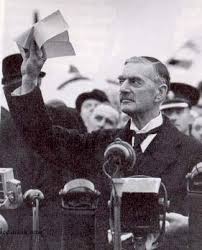
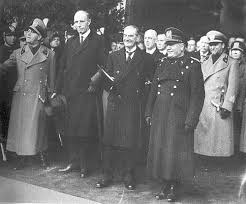
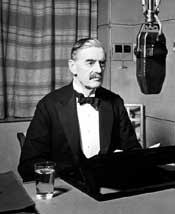
In the debate on the Munich agreement, Chamberlain’s claims were actually more modest than Kerry’s. He acknowledged the criticism he had received for saying that the agreement signaled “peace for our time,” and he said he hoped Members of Parliament would not “read into words used in a moment of some emotion, after a long and exhausting day, after I had driven through miles of excited, enthusiastic, cheering people – I hope they will not read into those words more than they were intended to convey.” He said he knew “weakness in armed strength means weakness in diplomacy” and he had a program to accelerate Britain’s re-armament. Then he described the effect of the agreement on Czechoslovakia and his hopes for the future:
It is my hope and my belief, that under the new system of guarantees, the new Czechoslovakia will find a greater security than she has ever enjoyed in the past…. Ever since I assumed my present office my main purpose has been to work for the pacification of Europe, for the removal of those suspicions and those animosities which have so long poisoned the air. … The question of Czechoslovakia is the latest and perhaps the most dangerous [obstacle]. Now that we have got past it, I feel that it may be possible to make further progress along the road to sanity.




 Posts
Posts


