Showing posts with label Abraham. Show all posts

Wednesday, December 2, 2009

the Promise to Abraham


the Promise to Abraham : Dry Bones cartoon.

The Bible quote is from the first of the five books of Moses. The King James translation renders the promise to Abraham in Genesis 12:3 as:
"And I will bless them that bless thee, and curse him that curseth thee: and in thee shall all families of the earth be blessed."
In my recent American speaking tour I discovered that the folks who once believed that George W. was either demonic or stupid now have perfect faith in Obama as a glowing Messianic figure.

I thought I'd do a cartoon about President Obama's surprising string of failures, but these days any criticism of the politician from Chicago is a violation of Political Correctness ...and an invitation to being called a racist!!?!

So I did this cartoon about "playing it safe".

Your thoughts?

Thursday, November 5, 2009

Holy Laughter


And Abraham called the name of his son who was born to him that Sarah bore him, Yitzchak. (Genesis 21:3)

In Hebrew, the name Yitzchak means, "he will laugh." Actually, laughter is a very serious matter. Healthy humor is a mechanism that balances life and puts things in their proper perspective. The best humor is laughter at oneself. After all, how can a person take himself seriously in the face of the Creator of the world?

And Sarah said: God has made laughter for me; every one that hears will laugh on account of me. (Genesis 21:6)

There is good laughter and bad laughter. Laughter that highlights the weakness and smallness of a person in the face of the Creator is good, holy laughter. Bad laughter inflates the person laughing at the expense of everyone else. "He and I cannot live in the same world," says G-d of this type of laughter.

There is another, dangerous type of laughter: And Sarah saw the son of Hagar the Egyptian, whom she had borne unto Abraham, making sport. (Genesis 21:9)

The laughter of the son of the maidservant is the laughter of murder, the laughter of immorality, the laughter of idol worship. It is the laughter that convinced Sarah to drive him out of her home. And G-d sided with her.

And she said to Abraham: Drive out this maidservant and her son, because the son of the maidservant will not inherit with my son, with Yitzchak. (Genesis 21:10)

A woman who had immigrated from Libya once told me the following story:

"When I was a young girl, my mother sent me to care for my grandmother, who was ill in a Jerusalem hospital. The patient in the bed next to her was an elderly Arab woman. The two women became friendly and spent a number of weeks chattering in Arabic, while I listened on.

One day, the Arab asked my grandmother:
"Why did you come here? Why did you leave Libya?"
"Because this is my Land," my grandmother answered.
"Why do you think it is yours?" the Arab woman asked.
"Because I received it as an inheritance from my father," my grandmother replied.
"Who is your father?" asked the Arab woman incredulously.
"Abraham!" my grandmother answered without missing a beat.
The old Arab woman thought for a moment and then said, "But Abraham is also my father!"
"That is true," my grandmother answered pointedly. "Abraham is also your father. But I am the daughter of the lady of the house, and you are the daughter of the maidservant."

How funny and how true.

Shabbat Shalom,

Moshe Feiglin

Wednesday, October 28, 2009

Abraham's Simple Sincerity


And G-d said unto Abram: Go forth from your country, and your kindred, and from your father's house, unto the land that I will show you.
And I will make of you a great nation, and I will bless you, and make your name great; and you will be a blessing.
And I will bless those that bless you, and he who curses you will I curse; and in you shall all the families of the earth be blessed.'
(Genesis 12: 1-3)

Abraham is no longer a child; he is 75 years old. The Creator does not choose him by coincidence. After the creation of the world in the Torah portion of Breishit and the re-formatting of humanity in the Torah portion of Noach, G-d chooses Abraham to go to his unique Land and to give birth to the Nation with a unique task; to make the fact that G-d is King known to the entire world. Abraham was chosen for the starring role because he had already been the driving force behind one world revolution and had also survived the fires of Nimrod's furnace.

And now, at the age of 75, when a normal person is already retired and enjoying his grandchildren, the King of the world finally reveals Himself to Abraham. From here on in, it sounds like the going will be easy. All that Abraham has to do is to go to the Chosen Land, to grow, to be blessed and to merit the recognition of the nations.

But that is not what happens in reality. Famine, exile, his wife is abducted, internal wars and war with his surroundings - the entire Torah portion of Lech Lecha is almost the complete opposite of what Abraham was promised. At least through human eyes.

And then, at the age of 99, Abraham has another Divine revelation:

And when Abram was ninety years old and nine, G-d appeared to Abram, and said to him: 'I am God Almighty; walk before Me, and be simply sincere.'(Genesis 17:1)

"Do not lose your simple sincerity," the King of the world says to the father of the Jewish nation. Even when 'reality' shows that there is no hope, and when the very opposite of what was promised happens, simple sincerity is the secret weapon that will make the blessing reality.

From then until this very day, the Jewish world belongs to the simply sincere. When G-d tells them to "go forth," they simply get up and go. All the rest; the Sadducees, Karaites, Reform, Hellenists, Enlightened, pragmatists and intelligentsia - appear on stage for a short time and then fall into the depths of forgotten Jewish history.

Sometimes, simple sincerity can be confused with passivity. "We will simply learn Torah and everything will work out," say some. Or: "We will simply build new settlements." Or: "We will simply become top officers in the army." Or: "We will simply play the political game." Or: We will simply make a lot of money and everything will work out." Each person seems to have a form of passivity that keeps him comfortable. But Abraham does not confuse simple sincerity with passivity. He teaches Torah, makes wars, builds the Land, is actively involved in politics, makes a lot of money and does not forgo any human endeavor. He keeps going all the time - but with simple sincerity as his guiding light.


Shabbat Shalom,

Moshe Feiglin

Friday, August 28, 2009

Remembering the Hebron Massacre


Until 1929, Jews had lived in the city for three millennia.

Jerold S. Auerbach
Wall Street Journal
27 August 09

No theme is more deeply embedded in Jewish history than exile and return. The biblical exodus from Egypt to the promised land, the return from Babylonian exile, and, most recently, the establishment of the state of Israel all affirmed the enduring determination of the Jewish people to return to their homeland.

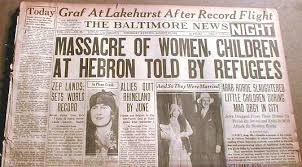
Yet another wrenching exile and return, now rarely remembered, occurred 80 years ago this week. On Aug. 23-24, 1929, the Jewish community of Hebron was exiled following a horrific pogrom. The tragedy is known as Tarpat, an acronym for its date in the Hebrew calendar.

Until 1929, Jews had lived in Hebron for three millennia. There, according to Jewish tradition, Abraham purchased the cave of Machpelah to bury Sarah. It was the first parcel of land owned by the Jewish people in their promised land. Ever since, religious Jews revered Hebron as the burial site of their matriarchs and patriarchs. Conquered, massacred and expelled over the centuries, Jews always returned to this sacred place.

After 1267, under Muslim rule, no Jews were permitted to pray inside the magnificent enclosure, built by King Herod in the 1st century, that still surrounds the burial caves. But following the expulsion of Jews from Spain at the end of the 15th century, a small group of religious Jews rebuilt a community of study and prayer in Hebron.

In August 1929, that community was suddenly and brutally attacked. Incited by the Grand Mufti of Jerusalem—who claimed that Jews were endangering Muslim holy sites on the Temple Mount in Jerusalem—Arab rioters swept through Palestine. In Hebron, the carnage was horrendous.

It began on Friday afternoon when Arabs attacked Jews with clubs and murdered a yeshiva student. The next morning, joined by local villagers, Arabs swarmed through Hebron screaming "Kill the Jews." They broke into the home of Eliezer Dan Slonim, where many Jews had gathered for safety. There they wielded knives and axes to murder 22 innocents. In the Anglo-Palestine Bank, where 23 corpses were discovered, blood covered the tile floor. That day, three children under the age of five were murdered. Teenage girls, their mothers and grandmothers were raped and killed. Rabbis and their students were castrated before they were slain. A surviving yeshiva student recounted that he "had seen greater horrors than Dante in hell."

When the slaughter finally subsided, 67 Jews had been murdered. Three days later, British soldiers evacuated 484 survivors, including 153 children, to Jerusalem. The butchery in Hebron, Zionist and religious officials alleged, was "without equal in the history of the country since the destruction of the Temple." Sir Walter Shaw, chairman of an exhaustive British royal investigation, concluded that "unspeakable atrocities" had occurred.

Tarpat extinguished the most ancient Jewish community in Palestine. With synagogues destroyed, Jewish property converted into storerooms and barns for livestock, and the ancient cemetery desecrated, few signs remained that there had ever been a Jewish presence in Hebron.

But nearly 40 years later, after the Six-Day War of 1967, a small group of religious Zionists returned to Hebron to rebuild the destroyed community. "What was in the past in Hebron," declared their matriarch Miriam Levinger, "is what will happen in the future. Always!" So it would be.

The Jewish community of Hebron—some 700 people—recently celebrated the 40th anniversary of their return. This month they commemorate the 80th anniversary of Tarpat. All the other ancient peoples mentioned in the Bible have vanished. But Jews, a community of memory, still live in Hebron.

Hebron Jews are relentlessly vilified as fanatics who illegally occupy someone else's land. As religious Zionists, they are the militant Jewish settlers whom legions of Jewish and non-Jewish critics love to hate. It is seldom noticed that their most serious transgression—settlement in the biblical land of Israel—is the definition of Zionism: the return of Jews to their historic homeland.

Mr. Auerbach, a professor of history at Wellesley College, is the author of "Hebron Jews: Memory and Conflict in the Land of Israel," published in July by Roman & Littlefield.
Related: Mr. Obama, Hebron is the eternal home for Jews
.