Monday, December 17, 2012
(Video) Yaffa Tevuah and Kever Rachel - The Children Have Returned Home
24 October '12..
In 1945, Yaffa Tevuah was a 22 year old Lehi fighter imprisoned by the British in the women's prison in Bethlehem. While being taken back and forth to Jerusalem for questioning at the Russian Compound, the British Police headquarters in Mandatory Palestine, she passed by Kever Rachel (Rachel's Tomb) and recognized the landmark from pictures that hung in her home as a child in Moldavia. Seeking courage when facing her British interrogators, she drew strength from Rachel Imeinu (Mother Rachel) and comfort from her sense of returning home.
Toldot Yisrael (http://www.toldotyisrael.org) presents its firsthand accounts from Israel's founding generation.
Produced by Toldot Yisrael in cooperation with the iCenter and the Jim Joseph Foundation.
Cinematography and editing: Eitan Wetzler
Interviewer: Peleg Levy
Updates throughout the day at http://calevbenyefuneh.blogspot.com. If you enjoy "Love of the Land", please be a subscriber. Just put your email address in the "Subscribe" box on the upper right-hand corner of the page.Twitter updates at LoveoftheLand as well as our Love of the Land page at Facebook.
.
Tuesday, November 8, 2011
Mama Rachel, Pray for Us!
Kumah
07 November '11
http://www.kumah.org/2011/11/mama-rachel-pray-for-us/
The sun has descended, bringing in the 11th day of Cheshvan, the yartzeit of our mother Rachel. There are so many traits we may hope that we have inherited from her: her beauty, her determination, her compassion, her strength. Yet of all her lofty characteristics, one is most noteworthy – that is her unremitting, passionate love for her children.
Maybe you are a lonely Jew in a far off place, wishing you were connected to the greater Jewish brotherhood. Perhaps you sit quietly in the park, watching other women push baby carriages as your heart breaks and your arms lie empty. Maybe you shed tears for the pain of the exile, praying to return to the bosom of the Holy Land. Or you watch your baby sleep in her biblical homeland, knowing that enemies lurk in the mountains or in the streets outside, and pray that she comes to no harm.
These are the dear ones of Rachel, our matriarch. These are the special charges of the one who ceaselessly cries for her children. May we each take part in ending the suffering of the other, so we can ease the suffering of our mother. And when we do our part – and return to our borders – may we give her joy and pride.
I may have few accomplishments in my name. But of one thing I can always take satisfaction – I came home to Israel, and lessened the crying of Rachel. May we all merit to say the same.
“Thus said Hashem: A voice is heard on high, wailing, bitter weeping. Rachel weeps for her children, she refuses to be consoled for her children, for they are gone. Thus said Hashem: Restrain your voice from weeping and your eyes from tears, for there is reward for your accomplishment – the word of Hashem – and they will return from the enemy’s land. There is hope for your future – the word of Hashem – and your children will return to their border.” (Jeremiah 31:14-16)
If you enjoy "Love of the Land", please be a subscriber. Just put your email address in the "Subscribe" box on the upper right-hand corner of the page.
.
Tuesday, January 18, 2011
PA gives new names to historical Jewish sites
JPost
01/18/2011 10:06
http://www.jpost.com/MiddleEast/Article.aspx?id=204104
Since 2001 Palestinian civil studies books, "with the help of Arab and Islamic centers," change Rachel's Tomb to Bilal Ibn Rabah Mosque.
A new report by the Institute for Monitoring Peace and Cultural Tolerance in School Education (IMPACT-SE) stated on Tuesday that the Palestinian Authority gave new names to historical Jewish sites, among them Rachel's tomb, in schoolbooks.
The report was recently prepared by IMPACT-SE following a UNESCO decision recognising Rachel's Tomb as a mosque only. According to the report, in school books from 1995 Rachel's Tomb was mentioned by its historical name. Since 2001 the civil studies books' editors reported to their students that they have decided "with the help of Arab and Islamic centers" to change its name to Bilal Ibn Rabah Mosque.
The decision to rename the mosque has turned the feminine Rachel into a masculine Bilal. According to tradition, Bilal was a slave who was set free and then converted to Islam after meeting Muhammad of the Quraish tribe; he was later buried either in Bader near Amman or in Damascus, the legend says.
According to the CEO of the institute and the author of the report, Shelley Elkayam, the phenomenon is characterised by a few levels of significance, among them gender symbolism alongside subversive logical undermining and a slipping away from the modern-historical to the mythical-legendary.
Thursday, November 11, 2010
Ottoman imperial decrees debunk Erdogan’s claim
Jerusalem Post Staff
08 November '10
Turkish Prime Minister Recep Tayyip Erdogan, whose government has been described as “neo- Ottoman” in outlook, told the Saudi paper Al-Watan in March that the Cave of the Patriarchs and Rachel’s Tomb “were not and never will be Jewish sites, but Islamic sites.”
But Erdogan’s statement contradicts firmans (imperial decrees) issued by the Ottoman authorities in Turkey recognizing Jewish rights at Rachel’s Tomb, the Jerusalem Center for Public Affairs has pointed out in a new research paper.
In 1830, the Turks issued the firman that gave legal force to Rachel’s Tomb being recognized as a Jewish holy site. Additionally, notes the JCPA’s Nadav Shragai, the governor of Damascus sent a written order to the mufti of Jerusalem to fulfill the sultan’s order:
“This is our order to you: [The following matter] was submitted to us by the subject of our order, the sage representative of honored Jerusalem’s Jewry and his translator that the tomb of esteemed Rachel, the mother of our Lord Joseph... They [the Jews] are accustomed to visit it from ancient days; and no one is permitted to prevent them or oppose them [from doing] this... It turned out that at this holy site, theyhave been visiting since ancient times, without any person preventing them or trespassing on their property and they [have it] as was their custom. In accordance with the respected judgment, I order that our commandment be issued to you so you will treat them accordingly without addition or without subtraction, without hindrance and without opposition to them by anyone in any way whatsoever – written August 10, 1830.”
(Read full story)
If you enjoy "Love of the Land", please be a subscriber. Just put your email address in the "Subscribe" box on the upper right-hand corner of the page.
.
Wednesday, November 10, 2010
Rachel's Tomb, a Jewish Holy Place, Was Never a Mosque
Jerusalem Center for Public Affairs
No. 580
November-December '10
UNESCO has declared that Rachel's Tomb near Jerusalem is the Bilal ibn Rabah mosque - endorsing a Palestinian claim that first surfaced only in 1996 and which ignores centuries of Muslim tradition.
As opposed to the Temple Mount and the Cave of the Patriarchs which also serve as the location of mosques, Rachel's Tomb never served as a mosque for the Muslims. The Muslim connection to the site derives from its relation to Rachel and has no connection to Bilal ibn Rabah, Mohammed's first muezzin.
Rachel's Tomb, located some 460 meters south of Jerusalem's municipal boundary, has been identified for over 1,700 years as the grave of the Jewish matriarch Rachel. Many generations of Jews have visited the place for prayer. The depiction of Rachel's Tomb has appeared in thousands of Jewish religious books, paintings, photographs, stamps, and works of art.
There is a Muslim cemetery on three sides of the compound mainly belonging to the Bedouin Taamra tribe, which began burying its dead at the site due to its proximity to a holy personality. Members of the Taamra tribe harassed Jews visiting the tomb and collected extortion money to enable them to visit the site. With this background, Moses Montefiore obtained a permit from the Turks to build another room adjacent to Rachel's Tomb in 1841 to keep the Muslims away from the room of the grave and to help protect the Jews at the site.
Jewish caretakers managed the site from 1841 until it fell into Jordanian hands in 1948. In contravention of the armistice agreement, Jordan prevented Jews from accessing the site during all the years of its rule (1948-1967). On October 19, 2010, the anniversary of her death, some 100,000 Jews visited Rachel's Tomb.
In 1830 the Turks issued the firman that gave legal force to Rachel's Tomb being recognized as a Jewish holy site. The governor of Damascus sent a written order to the Mufti of Jerusalem to fulfill the Sultan's order: "the tomb of esteemed Rachel, the mother of our Lord Joseph...they (the Jews) are accustomed to visit it from ancient days; and no one is permitted to prevent them or oppose them (from doing) this."
Ironically, Turkish Prime Minister Erdogan, whose government has been described as "neo-Ottoman" in outlook, told the Saudi paper al-Watan (March 7, 2010) that the Cave of the Patriarchs and Rachel's Tomb "were not and never will be Jewish sites, but Islamic sites."
On October 21, 2010, UNESCO (the UN Educational, Scientific, and Cultural Organization) declared that Rachel's Tomb near Jerusalem is the Bilal ibn Rabah mosque - endorsing a Palestinian claim that first surfaced only in 1996 and which ignores centuries of Muslim tradition.
In a series of decisions condemning Israel, the UNESCO board called upon the government of Israel to rescind its decision in February to include Rachel's Tomb and the Cave of the Patriarchs in Hebron on Israel's official list of national heritage sites. The sharp protests by Israeli Ambassador to UNESCO Nimrod Barkan to the UN body's decision were expunged from the record by the chairman of the session, the Russian representative, on the pretext that they were too aggressive.1
A scrupulous examination of testimonies and historical sources demonstrates that defining Rachel's Tomb as a mosque does an injustice to historical facts and traditions anchored in both Muslim documents and Jewish sources, and constitutes distortion, bias, and deception. As opposed to the Temple Mount and the Cave of the Patriarchs which also serve as the location of mosques, Rachel's Tomb never served as a mosque for the Muslims. The Muslim connection to the site derives from its relation to Rachel and has no connection to Bilal ibn Rabah, Mohammed's first muezzin.
(Read full article)
If you enjoy "Love of the Land", please be a subscriber. Just put your email address in the "Subscribe" box on the upper right-hand corner of the page.
.
Saturday, November 6, 2010
Ibrahim and Ibn-Rabah
Another Tack
04 November '10
Quite incredibly, representatives of Western democracies on UNESCO’s executive delivered a self-destructive blow to their own heritage when demanding that Rachel’s Tomb in Bethlehem and the Cave of the Patriarchs in Hebron be removed from the inventory of Jewish heritage sites. UNESCO’s resolution redefined them as mosques – as if Muslim from time immemorial. It sought to detach seminal biblical place-names from any Jewish connections.
It’s one thing to willfully subscribe to mind-blowing colossal deception; it’s quite another to shake the foundations beneath one’s own civilization.
Politically incorrect as it may be in our postmodern, multicultural existence, Europe’s and America’s democracies are constructed on Christian foundations. By accepting Muslim deconstructionist diktats, the West not only injures the Jews, it injures its own legacy.
To be fair, the world’s current most inveterate revisers of the past, the Muslims, are relative newcomers to the fanciful world of fabricated historiography. Long before Islam existed, Christians were obsessed with their own retrospective rewriting and they were preceded by pagans. Perhaps it was all already foretold by the biblical Balaam, who prophesied (Numbers 23:9) that Israel shall be “a people who dwells alone and shall not be counted among the nations.”
(Read full story)
If you enjoy "Love of the Land", please be a subscriber. Just put your email address in the "Subscribe" box on the upper right-hand corner of the page.
.
Thursday, March 4, 2010
Tell me what your heritage sites are...

Israel Harel
Haaretz
04 March '10
(You'll have to read the full piece to get to the punch line, but it's got punch. Y.)
Everyone expected Benjamin Netanyahu to surprise us once again by distancing himself from the Likud platform, just as he did when he adopted the two-state "vision" in his speech at Bar-Ilan University. But at last month's Herzliya Conference, the prime minister surprised us from a different direction. Israel's existence, he declared, "depends first and foremost ... on our ability to explain the justness of our path and demonstrate our affinity for our land. ... If our feeling of serving a higher purpose dissipates, if our sources of spiritual strength grow weak, then - as Yigal Allon said - our future will also be opaque."
Less than a month after that speech, the cabinet members went to Tel Hai, a foundational site in the pioneering Zionist ethos, and decided during a festive meeting to "rehabilitate and strengthen the infrastructure of our national heritage, which expresses the national heritage of the nation of Israel in its land." In accordance with this decision, two maps will be "branded and rooted" in the public consciousness: "the map of the historical Jewish story" and "the map of the Israeli-Zionist experience."
The map of the "historical story" will include foundational sites such as Al-Kanatir, Dir Aziz, Hamam Midya, El-Umdan, Qeiyafa, Anim and Madras. It will not include - doubtless because they truly are the "historical Jewish story" - the Tomb of the Patriarchs in Hebron, Rachel's Tomb, Mount Gerizim and Mount Ebal, Tel Shilo (which was the capital of the ancient Israelite polity for 300 years before it moved to Hebron), Givon, Tel Jericho, the ancient Shema Yisrael mosaic in Jericho, or many other sites located in the heart of the land of the Bible.
Heletz, Beit Haya'aran and the Timna mines are three sites on the second map, that of the "Israeli-Zionist experience." And they, no less than the sites chosen for the map of the "historical Jewish story in the Land of Israel," faithfully reflect the best of the Zionist experience, as chosen by a task force comprising more than 100 people, led by Cabinet Secretary Zvi Hauser. According to the task force's concluding report, the choices were "based on criteria that reflect our vision."
(Read full article)
.
Tuesday, February 23, 2010
The Palestinian Authority and the Jewish Holy Sites in the West Bank: Rachel's Tomb as a Test Case
Nadav Shragai
Jerusalem Center for Public Affairs
Originally published
22 Kislev 5768 / 2 December '07
HEBRON, February 22, 2010 (WAFA- PLO news agency) - Palestine Liberation Organization (PLO) condemned an Israeli decision to add the holy sites Ibrahimi Mosque in the West Bank city of Hebron and Bilal Ben Rabah Mosque (Rachel's Tomb) in Bethlehem to the list of Israeli heritage sites.
Rachel's Tomb lies on the northern outskirts of Bethlehem, about 460 meters (about 500 yards) south of the Jerusalem municipal border, and for more than 1,700 years has been identified as the tomb of the matriarch Rachel. "The building with the dome and olive tree" became a Jewish symbol, appearing in thousands of drawings, photographs, and works of art and depicted on the covers of Jewish holy books. However, today the little domed structure has been encased in a sleeve of reinforced concrete with firing holes and defensive trenches, and covered with camouflage netting.
According to the armistice agreement signed on April 3, 1949, Jordan was to allow Israel "free access to the Holy Places and cultural institutions and use of the cemetery on the Mount of Olives." In practice, Jordan did not allow Jews free access to their holy places, and for 19 years, until 1967, Jews could not go to the Western Wall, Rachel's Tomb, the Tomb of the Patriarchs in Hebron, Joseph's Tomb in Shechem (Nablus), or other sites sacred to Jews which remained in Jordanian hands.
The Gaza-Jericho Agreement signed in May 1994 stated: "The Palestinian Authority shall ensure free access to all holy sites in the Gaza Strip and the Jericho Area." The Israeli-Palestinian Interim Agreement, signed on the White House lawn on September 28, 1995, dealt with the status of 23 places holy to Jews. The Palestinians promised to assure freedom of access to those places. However, the Palestinians either made access extremely difficult or prevented it entirely.
In October 2000, Joseph's Tomb in Nablus was attacked, set ablaze and desecrated. Druze Border Police Corporal Yusef Madhat bled to death on October 4 because Palestinians refused to allow his evacuation. The "Shalom al Israel" synagogue in Jericho was also attacked. Holy books and relics were burned, and the synagogue's ancient mosaic was damaged.
In 2000, after hundreds of years of recognizing the site as Rachel's Tomb, Muslims began calling it the "Bilal ibn Rabah mosque" - a name that has since entered the national Palestinian discourse. The Palestinian claim ignored the fact that Ottoman firmans (decrees) gave Jews in the Land of Israel the right of access to the site at the beginning of the nineteenth century. Israel's experience since the Oslo agreements has shown that the responsibility for Jewish holy sites or the roads leading to them should remain in Israeli hands.
(Read full article)
.
Wednesday, January 20, 2010
Rachel’s tomb and the protection of Jewish holy sites
Meryl Yourish
Yourish.com
19 January '10
Protocol Additional to the Geneva Conventions of 12 August 1949, and relating to the Protection of Victims of International Armed Conflicts (Protocol I), 8 June 1977.
Part IV : Civilian population #Section I — General protection against effects of hostilities #Chapter III — Civilian objects
Article 53 — Protection of cultural objects and of places of worship
Without prejudice to the provisions of the Hague Convention for the Protection of Cultural Property in the Event of Armed Conflict of 14 May 1954, and of other relevant international instruments, it is prohibited:
(a) to commit any acts of hostility directed against the historic monuments, works of art or places of worship which constitute the cultural or spiritual heritage of peoples;
(b) to use such objects in support of the military effort;
(c) to make such objects the object of reprisals.
If, as Dickens wrote, “The law is a ass …” then, pardon the crudity, international law is donkey crap. Once upon a time, Rachel’s Tomb – where, according to tradition, the Matriarch, Rachel is buried in Bethlehem – was, as depicted in the mural below, located in an open area.
(Read full article)
.
Monday, December 14, 2009
What if a Synagogue Were Burned and Other Silly Questions
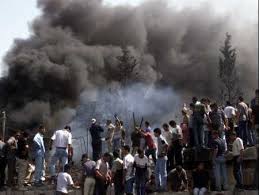
Arab mob burning Tomb of Joseph, October 2000
Contentions/Commentary
14 December 09
The New York Times reports that the “West Bank Is Tense After Arson at Mosque,” which is believed to be the work of Jewish extremists. Palestinian Arabs are rightly upset at this crime. So are Israelis. And therein hangs the tale of Middle East peace.
The fire at the mosque in the village of Yasuf appears to have been set last week by some Jewish settlers demonstrating their anger toward Israeli Prime Minister Benjamin Netanyahu’s plan to temporarily freeze building in Jewish communities in the West Bank. Extremists have vowed to counter such moves by increasing tensions with the Arabs. This is clearly madness and is rejected not only by the overwhelming majority of the people of Israel but also by the overwhelming majority of the approximately 300,000 Jews who live in the settlements. Local Jewish religious leaders attempted to visit Yasuf to express their condolences, but they were prevented from going there. So instead they met with Munir Abbushi, the Palestinian Authority’s regional governor, and presented him with new Korans. Abbushi accepted the Korans but then stated that Palestinian independence would mean that all Jews would have to be removed from the region. The Palestinians reject the right of Jews to live in their midst under any circumstances and regardless of who has or has not committed crimes.
But if you really wanted to get a feel for how differently the two communities think about these things, ask yourself what would happen if, instead of a mosque, a synagogue had been burned down. But this is not a hypothetical question.
Arab mobs burning synagogue, Gush Katif 2005
In October 2000, at the start of the Palestinians’ second intifada, the Tomb of Joseph, a Jewish holy site in Nablus that served as a synagogue and religious school, was literally torn to pieces by an Arab mob. As Palestinian Authority “police” looked on, the mob destroyed the building and burned the sacred texts inside. But instead of treating the crime as an embarrassment to the national cause, among Palestinians it was treated as a cause for celebration. Another ancient synagogue in Jericho was also burned down that month. And even before the intifada, the Tomb of Rachel, a Jewish shrine near Bethlehem, was subjected to continual attacks. It had to be surrounded by fortifications to keep both the building and worshipers from harm.
.