 Barry Rubin
The Rubin Institute
29 September 09
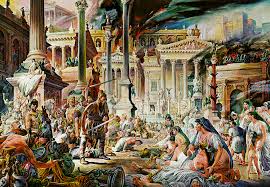
Next year marks an important anniversary of one of the most important events in the last two thousand years which, as far as I know, has been pretty much ignored. It was 1600 years ago, on August 24, 410, that Rome fell to the Visigoths under Alaric. Historians mark this date as the end of the Roman Empire.
The collapse of the Roman Empire brought to a close the Classical era of history and high civilization in general. While the truth is somewhat more complex, it can be said that it took humanity, certainly in the West, 1200 years to return to the intellectual and cultural level that had existed then.
While there has been a long and complex debate on why Rome and ancient civilization collapsed, clearly there were both internal and external reasons. Among the former can be counted: a loss of civic pride and patriotism, refusal of citizens to fight for their country, and decay of traditional values. The latter factors include the assault by other peoples with a strong religious and national sense of identity who were still willing and even eager to fight, and the flooding of the empire by immigrants who had a different world view and agenda aimed at taking it over.
People are free to draw conclusions regarding a comparison with contemporary conditions, but the subject should certainly be considered seriously. The study of Roman history has also undergone some change which seems to coincide with Political Correctness. The classical explanations for the decline and fall of Rome included moral corruption and the loss of identity. Many more recent writers speak of the Romans not being nice enough to the Gothic immigrants, on whom they depended for their army.
Of course, the Empire’s decline was a longer-term affair and Byzantium lived on. Also, as one of the relatively few people who can claim direct descent from the Empire’s victims, I have somewhat mixed feelings about the glory that was Rome which was also, of course, an aggressive and repressive dictatorship.
(Here one can insert some sarcastic and humorous remark about what the world would be like if Rome existed today. An emperor who apologized for all its past conquests or the representative of Caligula or Nero chairing the UN Human Rights Commission? I leave the choice of appropriate examples to readers.)
Still, if many experiences remind one of personal mortality, this is an event that should make us think about civilizational mortality, something we hopefully won’t be finding out about directly.
.




 Posts
Posts


