Showing posts with label Qassam. Show all posts

Sunday, September 19, 2010

Cops? Terrorists? Gazans know they're all the same


Arnold/Frimet Roth
This Ongoing War/A Blog
19 September '10

The analysts at Honest Reporting make a significant observation today that goes to the heart of how terrorism is thoroughly interwoven in the day-to-day operations of the jihadist Hamas regime in Gaza.

They remind us about the wrangling over the Gaza war's casualty count, when Hamas (and a good part of the mainstream media) argued against Israel over the definition of civilians? They point out today that Hamas has confirmed that, really, there's no distinction between the Hamas regime's civilian police and the Hamas regime's "resistance" groups who attack Israelis, preferably Israeli civilians (that's what makes them terrorists).

(Read full post)

If you enjoy "Love of the Land", please be a subscriber. Just put your email address in the "Subscribe" box on the upper right-hand corner of the page.
.

Wednesday, November 18, 2009

Trevor Norwitz, Open Letter to Judge Goldstone, 19/10/09


A devastating letter from a NY lawyer, Trevor Norwitz, laying out the multiple flaws with the Goldstone Report. Required reading.


New York, New York

October 19, 2009

Judge Richard Goldstone

Head of the UN HRC Fact Finding Mission on Gaza

Via email


Dear Richard:


I have finally completed my review of your Report( 1) which, by its very length, defends itself against the risk of being read quickly or widely, to paraphrase that infamous war criminal (by your definition) Winston Churchill. I am profoundly disappointed by the contents of your Report, but I am also troubled by the ad hominem attacks that have been directed towards you. I offer this analysis and critique in the spirit of your article in the Jerusalem Post today2, looking only at the substance of your Report and relying neither on its authors’ motives nor their reputation. I do so in an effort to advance the cause of truth and in the hope that you may yet be willing to take actions to mitigate the terrible injustice and damage that your Report is causing. To that end, I am respectfully including some suggestions for you at the end of this letter (which is longer than the one I sent you on July 14 – attached again for your reference – but which I hope you will take time to read).


In a nutshell, your Report is a deeply flawed document that is not only unbalanced and inflammatory, but reflects a procedurally deficient rush to judgment incapable producing any meaningful findings, least of all charges as grave, politically loaded and emotionally laden as those of “war crimes” and “crimes against humanity”.


I acknowledge at the outset that your Report was difficult to read not only because of its obvious lack of balance, but also because it does raise some hard questions about the precise manner in which Israel reacted to the years of rocket attacks against its towns and people and the threats it faces.(3) I hope that, to the extent it has not already done so, Israel will investigate and explain the incidents you have highlighted which have undoubtedly been part of a chain of events that has resulted in much human suffering. Sadly though, because your Report is so one-sided and unfair, these important questions may receive less attention than they deserve.


As someone who had expected4 a relatively fair and balanced investigation because of your involvement, I am struggling to understand why you would go out of your way and beyond even the “very lopsided unfair resolution” (to use your own words(5)) of the group(6) that authorized your Mission to demonize Israel while legitimizing and even whitewashing Hamas. (For while you may object to that characterization, that is indeed what your Report does, as I describe below.)


I do not intend to focus on factual inaccuracies in your Report (which others better placed that I are already starting to address(7)), but wish to emphasize rather the manner in which your investigation was conducted and its “findings” reported. The imbalance and partiality that [p.2] permeate your Report are evident at many levels. They are manifested in the methodology you adopted to conduct your investigation and reach your conclusions, in the way in which you chose to characterize your Mission and select which incidents you would investigate and which you would ignore, in the fundamental premises which underlie your investigation and conclusions, in the manner in which you have misrepresented the history of the Middle East conflict, and in your use of language both throughout your Report and in your subsequent public statements. Of course this letter can not be comprehensive but can only illustrate a few of the many examples where this one-sidedness shows through your purported factual and legal findings.

(Read full letter)


.

Wednesday, September 16, 2009

Israel's Analysis and Comments on the GAZA FACT FINDING MISSION REPORT


Communicated by the Foreign Ministry Spokesperson

General:

· Israel is appalled and disappointed by the Report published on 15 September 2009 by the Gaza Fact Finding Mission. The Report effectively ignores Israel's right of self defense, makes unsubstantiated claims about its intent and challenges Israel's democratic values and rule of law.

· At the same time the Report all but ignores the deliberate strategy of Hamas of operating within and behind the civilian population and turning densely populated areas into an arena of battle. By turning a blind eye to such tactics it effectively rewards them.

· The Report barely disguises its goal of instigating a political campaign against Israel, and in its recommendations seeks to involve the Security Council, the General Assembly the International Criminal Court, the Human Rights Council, and the entire international community in such a campaign.

The Mandate of the Mission:

· The one-sided mandate of the Gaza Fact Finding Mission, and the resolution established it, gave serious reasons for concern both to Israel and to the many states on the Council which refused to support it - including the member states of the European Union, Switzerland, Canada, Korea and Japan.

· It also troubled many distinguished individuals, including former High Commissioner for Human Rights Mary Robinson, who refused invitations to head the Mission and admitted that it was "guided not by human rights but by politics".

The Conduct of the Mission:

· These concerns were exacerbated by the conduct of the Mission itself, including reports in the Palestinian media that, throughout its visits to Gaza, it was continuously accompanied by Hamas officials and its refusal to recuse members of the mission with clear political views on the issues under investigation. One mission member signed a letter to the Sunday Times saying that Israel's actions against Hamas attacks were acts of "aggression not self-defense", prejudging the investigation before it had even begun.

· The unprecedented holding of telecast hearings also gave cause for concern. The fact that all the witnesses were prescreened and selected, and none were asked questions relating to any Palestinian terrorist activity or the location of weaponry and terrorists in civilian areas only supports concerns that they were part of an orchestrated political campaign.

A "non-judicial" document

· Justice Goldstone as Head of the Mission repeatedly insisted that the Mission was not a judicial inquiry and so "could not reach judicial conclusions". On this basis that he justified the inclusion of partisan mission members, admitting that their involvement "would not be appropriate for a judicial inquiry'. The Report however is highly judicial in nature, reaching conclusive judicial determinations of guilt, and including 'detailed legal findings' even in the absence of the sensitive intelligence information which Israel did not feel able to provide. These determinations are made notwithstanding the Report's admission that it does "pretend to reach the standard of proof applicable in criminal trials".

Elements Ignored by the Report:

· The Report all but ignores the deliberate terrorist strategy of operating in the heart of densely populated civilian areas which dictated the arena of battle. Even when the Hamas terrorists mixed among civilians, the Report rejects the notion that there was an intention to put the civilian population at risk.

· Astonishingly, despite the many widely reported instances in the international press of the abuse of civilian facilities by terrorist groups, and the statements of Hamas own leaders praising women and children who acted as human shields, the Report repeatedly stated that it could find no evidence of such activities. This, even despite its admission that those interviewed were "reluctant to speak about the presence or conduct of hostilities by the Palestinian armed groups".

· The Report also ignores Israel's extensive efforts, even in the midst of fighting, to maintain humanitarian standards. While it does, reluctantly, acknowledge Israel's "significant efforts" to issue warnings before attacks, it does not find any of these efforts to be effective

· While the Report passes judgment against Israel in respect of almost any allegation, it seeks to absolve the Hamas of almost any wrongdoing. The word "terrorist" is almost entirely absent. Soldier Gilad Shalit, now held incommunicado in captivity for over three years, was "captured during an enemy incursion" and the Hamas members that the Mission met with in Gaza are thanked as the "Gaza authorities" for extending their full cooperation and support to the Mission.

· Even the thousands of rocket attacks against Israelis which necessitated the Gaza Operation are given the most cursory treatment, and indeed the Report indirectly blames Israel even for these by terming them "'reprisals".

Rejection of democratic values:

· In a Report which relies so heavily on Israeli human rights organizations and which also petitions on sensitive security issues to Israel's Supreme Court the Report devotes considerable attention to "repression of dissent in Israel". It bases this assertion in large part on the widespread support for the military operation in the Israeli public, assuming that Israel has "created a political climate in which dissent is not tolerated. The notion that the majority of Israelis genuinely supported action to bring years of continuous rocket and missile attacks against Israeli civilians to an end does not appear to have occurred to the members of the Mission.

· The Report is also critical of Israel internal investigations even though these compare favorably to investigations of allegations in military matters in most western countries, and have regularly resulted in criminal investigations and convictions.

Recommendations:

· The Report's recommendations are as one-sided as its findings. It seeks to harness the Human Rights Council, the Security Council the General Assembly, the Office of the High Commissioner of Human Rights and the International Criminal Court and the international community as parts of its hostile political campaign.

· Despite token recommendations in respect of the Palestinian side, all the international pressure is directed solely against Israel.

· The true test of such a Report can only be whether in future conflicts it will have the effect of increasing or decreasing respect for the rule of law. Regrettably a one-sided report of this nature, claiming to represent international law, can only weaken the standing of law in future conflicts. At the same time, it will broadcast a deeply troubling message to terrorist groups wherever they are that the cynical tactics of seeking to exploit civilian suffering for political ends actually pays dividends.


MFA Links: Gaza Facts – The Israeli Perspective

Behind the Headlines: Human Rights Council/Goldstone Fact-Finding Mission


Non-MFA Related: Goldstone’s Report: Fundamentally Flawed or a Step Towards Sanctions?

The Goldstone Show-Trial

The Assault On Israel's Right to Self-Defense

.


Monday, September 7, 2009

School Bells and Rocket Sirens


Anav Silverman
IsraelNationalNews.com
04 September 09

Although the third Hamas-Israel ceasefire is still in effect, Sderot schoolchildren began the 2009 school year both excited and yet apprehensive.

Two days before the doors to Sderot's nine schools opened, two rockets fired from Gaza triggered the city's rocket warning system known as the Color Red siren, and sent residents racing for a shelter on Sunday evening, August 30.

"I was scared but not surprised," says Rotem, a 16-year-old Sderot student, beginning eleventh grade at a local Sderot high school. "We know that the rocket attacks will begin again and I don't think that anyone here really believes that the quiet will last. We've lived here [in Sderot] long enough to know that," she says. Although the third Hamas-Israel ceasefire is still in effect, Sderot schoolchildren began the 2009 school year both excited and yet apprehensive.

Two days before the doors to Sderot's nine schools opened, two rockets fired from Gaza triggered the city's rocket warning system known as the Color Red siren, and sent residents racing for a shelter on Sunday evening, August 30.

"I was scared but not surprised," says Rotem, a 16-year-old Sderot student, beginning eleventh grade at a local Sderot high school. "We know that the rocket attacks will begin again and I don't think that anyone here really believes that the quiet will last. We've lived here [in Sderot] long enough to know that," she says.

Dina Huri, principal of a Sderot elementary school, made sure that the opening school year would offer everything for her first to sixth grade students and that also included upgrading the school shelters against future rocket attacks.

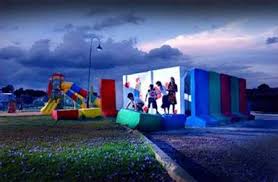
"During the summer, I had the 3 school bomb shelters transformed into "kid-friendly" shelters," she says. Huri had the shelter painted in bright colors and installed rugs so that the children would feel more comfortable. Huri doesn't remember the exact date of when the shelters were first installed-- "they have been around for a while"--but she says that the original concrete grey slabs made children feel like they were imprisoned. "Last year, every time the siren blared, the students had to run into these concrete structures, wondering when they could leave. Now these shelters are places that the students want to play in."

In any case, Sderot residents had another reason to expect rocket fire on the opening day of this school year.

Two years ago, 10 Qassam rockets slammed in and around Sderot, throughout the first week of the September 2007 school year. One rocket landed between a Sderot daycare center and elementary school, where 12 kindergarten children were hospitalized for shock at Ashkelon's Barzilai hospital.

Iranian-backed, Palestinian Islamic Jihad claimed responsibility for that rocket attack, proclaiming them "a present for the start of the new school year," on the terror group's website.

Sixteen-year-old Rotem stated that she was surprised that rockets had not been fired at Sderot on the first day of school. "I woke up in the morning expecting to hear the siren. It is strange--instead of being surprised by rocket attacks, I am surprised when there are no rockets. I thought for sure they would want to destroy the excitement of the first day of school."

In recent days, Palestinian terror groups have increased terror activities, with mortar and Qassam rockets being fired towards Israel for three straight days. On Saturday morning, August 29, a rocket exploded in the western Negev, and on August 24, an Israeli soldier was injured by a Gaza mortar.

Two weeks before, on August 10, two mortar rockets were fired at the Erez Crossing, just yards away from ambulances transferring a Palestinian heart patient to Israel, according to the Jerusalem Post. Palestinians suffering from illness cross almost daily into Israel for treatment through the Erez Crossing, the major crossing point for Palestinians entering Israel.

Dina Huri says that she and her staff continue to pray for a quiet year for everyone. "Today our students sent balloons up into the air with Jewish New Year messages calling for a peaceful year--for all of us in this region and the rest of Israel."

Anav Silverman is the international correspondent for the Sderot Media Center. A native of Maine, she made aliyah to Israel in 2004.
.

Saturday, August 1, 2009

Remembering Gush Katif


Prolific commemoration enterprise prevents us from forgetting Gaza pullout

Hagai Segal
08.01.09,
Ynet/Israel Opinion

As if we have a shortage of national days of morning in the month of Av around here, the second Sharon government contributed a few more to our national psyche.

Of all the months of the year, it chose to raze the Gush Katif communities precisely in Av. The original date scheduled for the beginning of the onslaught was the Ninth of Av itself, because our determined and sensitive leaders failed to notice that August 15, 2005 coincides with the day both our Temples were destroyed.

Religious media outlets raised a hue and cry and the operation was postponed by a day. Perhaps someone whispered to Sharon that religious IDF officers fast that day too and it would be difficult for them to evacuate settlers on an empty stomach.

Were the new national memorial days etched on the nation’s proverbial heart? Apparently they were. The Gush Katif wounds reopen every summer time and again. The refugees are interviewed on television, most newspapers write about them, a new law calling for the establishment of a commemoration center had been legislated, and a Gush Katif museum was inaugurated in Jerusalem last year already.

In the past four years, at least 15 books about the disengagement were published. Independent producers made 10 documentaries. Seven of them were aired on television.

What did we gain from it?

When we evacuated Yamit in the framework of the peace treaty with Egypt, we only dedicated two documentaries to it. In the 27 years that have passed since then, only seven books about the evacuation were published; all of them sold just a few copies.

The general public did not wish to read, while the evacuated residents preferred to forget. Most Israeli citizens today barely know that the Yamit region and Sinai were once home to 17 prospering Hebrew communities.

Yet they remember Gush Katif. The prolific commemoration enterprise thwarts the schemes of forgetfulness and enables us to engage in a thorough historic examination of the very act: Why did we need all this great sorrow? What did we gain from it, aside from Qassam rockets, Grad missiles, Operation Cast Lead, and Gilad Shalit’s captivity?
.