Showing posts with label Maccabees. Show all posts

Saturday, December 24, 2016

The Maccabees cherished Judea, Samaria and Gaza, the entire Land of Israel - by Michael Freund

...Both in ancient and modern times, the miracles of Hanukka have been directly associated with Judea, Samaria and Gaza, those portions of the Land of Israel that the world is so keen to take away from us. Now, in particular, when international pressure is mounting on the Jewish state to forgo these areas, it is all the more important that we appreciate the deep connection between the Festival of Lights and Israel's heartland.


Michael Freund..
Pundicity/JPost..
First Posted 11 December '15..
Link: http://www.michaelfreund.org/18256/judea-samaria-gaza-hanukka

As Jews around the world gather this week to celebrate Hanukka, it is worth taking a moment to consider an aspect of the holiday that is often overlooked.

Both in ancient and modern times, the miracles of Hanukka have been directly associated with Judea, Samaria and Gaza, those portions of the Land of Israel that the world is so keen to take away from us.

Now, in particular, when international pressure is mounting on the Jewish state to forgo these areas, it is all the more important that we appreciate the deep connection between the Festival of Lights and Israel's heartland.

Consider the following: many critical chapters in the Maccabean wars, when God "delivered the mighty into the hands of the weak, the many into the hands of the few," took place in the territories that the world now accuses us of "occupying" and "colonizing."

In 166 BCE, at Beit Horon, which is west of what is now Ramallah, Judah the Maccabee defeated the Seleucid governor Seron and routed his forces in a crushing defeat. This victory followed shortly after Judah and his men had vanquished Apollonius, the Seleucid commander, at Ma'aleh Levona near Shechem (Nablus) in Samaria.

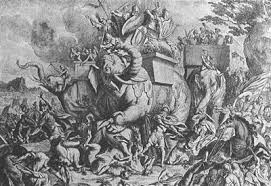
In Beit Zecharia, in what is now Gush Etzion, Judah's brother Elazar was killed when confronting elephants deployed by Antiochus against the Jewish rebels.

And it was in the hills around Beit El that many of the Hasmoneans found refuge from the Seleucid tyrant's forces of oppression.

Indeed, in Samaria one can visit the remains of fortresses that were erected by the Hasmonean dynasty, such as the one on the Horn of Sartaba, a mountain overlooking the Jordan Valley, where the Alexandrion fortress was built by King Alexander Yanai.

The list goes on, and it underlines the incontrovertible fact that Mattathias and the Maccabees fought to expel foreign invaders from Judea and Samaria and reclaim this central part of our ancestral patrimony.

All this took place some 800 years before Islam was founded, and more than two millennia prior to the establishment of the United Nations, giving the lie to claims that Israel has no right to these areas.

Friday, December 11, 2015

The Hanukka connection: Judea, Samaria and Gaza by Michael Freund

...Both in ancient and modern times, the miracles of Hanukka have been directly associated with Judea, Samaria and Gaza, those portions of the Land of Israel that the world is so keen to take away from us. Now, in particular, when international pressure is mounting on the Jewish state to forgo these areas, it is all the more important that we appreciate the deep connection between the Festival of Lights and Israel's heartland.


Michael Freund..
Pundicity/JPost..
11 December '15..

As Jews around the world gather this week to celebrate Hanukka, it is worth taking a moment to consider an aspect of the holiday that is often overlooked.

Both in ancient and modern times, the miracles of Hanukka have been directly associated with Judea, Samaria and Gaza, those portions of the Land of Israel that the world is so keen to take away from us.

Now, in particular, when international pressure is mounting on the Jewish state to forgo these areas, it is all the more important that we appreciate the deep connection between the Festival of Lights and Israel's heartland.

Consider the following: many critical chapters in the Maccabean wars, when God "delivered the mighty into the hands of the weak, the many into the hands of the few," took place in the territories that the world now accuses us of "occupying" and "colonizing."

In 166 BCE, at Beit Horon, which is west of what is now Ramallah, Judah the Maccabee defeated the Seleucid governor Seron and routed his forces in a crushing defeat. This victory followed shortly after Judah and his men had vanquished Apollonius, the Seleucid commander, at Ma'aleh Levona near Shechem (Nablus) in Samaria.

In Beit Zecharia, in what is now Gush Etzion, Judah's brother Elazar was killed when confronting elephants deployed by Antiochus against the Jewish rebels.

And it was in the hills around Beit El that many of the Hasmoneans found refuge from the Seleucid tyrant's forces of oppression.

Indeed, in Samaria one can visit the remains of fortresses that were erected by the Hasmonean dynasty, such as the one on the Horn of Sartaba, a mountain overlooking the Jordan Valley, where the Alexandrion fortress was built by King Alexander Yanai.

The list goes on, and it underlines the incontrovertible fact that Mattathias and the Maccabees fought to expel foreign invaders from Judea and Samaria and reclaim this central part of our ancestral patrimony.

All this took place some 800 years before Islam was founded, and more than two millennia prior to the establishment of the United Nations, giving the lie to claims that Israel has no right to these areas.

Monday, December 7, 2015

(Video) Chanukah - Against All Odds


Chanuka is a time for miracles, both in those days and ours.


Torah Live

To see more Torah Live Chanuka videos, 
visit http://www.youtube.com/user/TorahLive

Updates throughout the day at http://calevbenyefuneh.blogspot.com. If you enjoy "Love of the Land", please be a subscriber. Just put your email address in the "Subscribe" box on the upper right-hand corner of the page.Twitter updates at LoveoftheLand as well as our Love of the Land page at Facebook which has additional pieces of interest besides that which is posted on the blog. Also check-out This Ongoing War by Frimet and Arnold Roth. An excellent blog, very important work as well as a big vote to follow our good friend Kay Wilson on Twitter.
.

Tuesday, December 23, 2014

Thoughts on a Maccabean solution for the Gaza Strip

...Just as the Hanukka candles that we kindle each night stand ramrod straight, giving off light in defiance of their surroundings, so too must Israel now do the same, taking the initiative to forestall the possibility of thousands of rockets raining down on the country in 2015 or beyond. It took the Maccabees nearly five decades to realize that Gaza had to be totally and unconditionally defeated. Let's learn from their experience and put an end to this problem once and for all.

Michael Freund..
Pundicity/JPost..
23 December '14..

This past Friday, Palestinian terrorists in Gaza fired a rocket into southern Israel without any provocation, setting off air-raid sirens and rekindling fears of a return to this past summer's hostilities.

Indeed, although barely four months have passed since the end of Operation Protective Edge, Hamas is said to be actively preparing for the next round of conflict, rebuilding its network of terror tunnels and working to improve the accuracy of its arsenal.

It is no wonder, then, that Israel's Military Intelligence is forecasting a possible resumption of fighting in 2015.

The Gaza conundrum, which has been a nettlesome thorn in the Jewish state's side for years, in particular since the Hamas takeover of the area, continues to befuddle successive Israeli governments. Pinpoint air-strikes, restrictions on the importation of goods, limited ground incursions and larger-scale military operations have all failed to quash the growing threat posed by Hamas in Gaza, leaving many to wonder if there is any way to put an end to this ongoing peril.

The answer is a resounding "yes!" and we need only look to the Maccabees, the heroes of Hanukka, to see how it can be done.

It was in the year 145 BCE, some two decades after the liberation of the Temple in Jerusalem and the miracle of the oil, that the Hasmonean king Jonathan, the youngest of Matityahu's five sons, attacked Gaza and its hostile population.

Following in the footsteps of his older brother Judah the Maccabee, Jonathan heroically proceeded to subdue his foes.

As the historian Josephus writes in his The Antiquities of the Jews (Volume 13, 5:5), "[H] e set a part of his army round about Gaza itself, so with the rest he overran their land, and spoiled it, and burnt what was in it. When the people of Gaza saw themselves in this state of affliction... so they sent to Jonathan, and professed they would be his friends, and afford him assistance." In other words, Jonathan conquered the area, pacified it thoroughly and compelled Gaza's residents to plead for peace.

Nonetheless, despite their professions of amity, Gaza's residents continued to agitate against Israel, leading Simon the Maccabee, who had succeeded Jonathan, to conclude what his brother had started.

As recounted in the First Book of Maccabees, "In those days, Simon camped against Gaza and besieged it round about. He made also an engine of war and set it by the city, and battered a certain tower and took it."

Simon's soldiers entered Gaza city, which led the local populace to "cry with a loud voice beseeching Simon to grant them peace." They implored the Maccabee: "Deal not with us according to our wickedness but according to your mercy."

Simon agreed, but not before taking a series of measures to try and ensure that Gaza would never again pose a threat.

Among these, he "placed such men there as would keep the law, and made it stronger than it was before," essentially reimposing security on the unruly strip of land. Simon also sent Jews to settle the area, and he even built himself a home in Gaza, as if to underline the fact that the Jewish people had every intention of remaining.

But even these measures did not quell the Gaza problem.

It was only when Alexander Jannaeus, Matityahu's great-grandson, captured the city in the year 100 BCE that the threat was finally ended and the southwestern border of the Hasmonean Jewish state enjoyed some long-sought peace. Alexander, Josephus tells us, "had utterly overthrown their city... having spent a year in that siege."

Sunday, December 9, 2012

(Video) Against All Odds


Chanuka is a time for miracles, both in those days and ours.


To see more Torah Live Chanuka videos, 
visit http://www.youtube.com/user/TorahLive

If you enjoy "Love of the Land", please be a subscriber. Just put your email address in the "Subscribe" box on the upper right-hand corner of the page.
.

Friday, December 23, 2011

Appelbaum - The First War of National Liberation

Diana Muir Appelbaum
Jewish Ideas Daily
21 December '11

http://www.jewishideasdaily.com/content/module/2011/12/21/main-feature/1/the-first-war-of-national-liberation

This is the 2,179th anniversary of the world's first war of national liberation. There have been many since. To a surprising extent, such wars have followed the pattern first established by the Maccabees. They, like later heads of independence movements, were leaders of a people conquered and occupied by a great empire. They fought to claim the right of national self-determination.

Resentment of foreign rule may simmer for a long time, but war is often remembered as beginning in a dramatic incident. In Switzerland, this memory belongs to William Tell. He was the national hero who in 1307 refused to bow to a hat belonging to the Hapsburg governor, which was set on a tall pole in the center of Altdorf for the sole purpose of forcing Swiss freemen to genuflect to it. Tell's defiance sparked the fight for Swiss independence.

The story about Tell may be true, but it was not recorded until the 1560s. The Jewish "William Tell" moment occurred in the Year 167 B.C.E., when a priest named Matityahu (Mattathias) refused an order to make a sacrifice to a Greek god. Matityahu's story is better documented than Tell's, since it comes from the Book of First Maccabees (not the later II, III, and IV Maccabees), a text actually written in the Maccabean period.

At the time, the wealthy and powerful Jewish residents of Jerusalem had made a "covenant with the Gentiles": They followed Hellenistic ways, had their circumcisions surgically effaced, and built a Greek gymnasium for training in Hellenistic sports, literature, ethics, and philosophy. But the Seleucid Emperor Antiochus IV Epiphanes upset the equilibrium, ordering that Jewish texts be destroyed and Jews forced to eat pork and break the Sabbath.

Matityahu, with his sons, fled Jerusalem for his ancestral village of Modi'in. There, a Seleucid officer ordered him to make a public sacrifice to Zeus. Matityahu refused. "I and my sons and our kinsmen," he said, "shall follow the covenant of our fathers."