Showing posts with label Karine-A. Show all posts

Thursday, November 5, 2009

Shipped in Plain Sight


J.E. Dyer
Contentions/Commentary
05 November 09


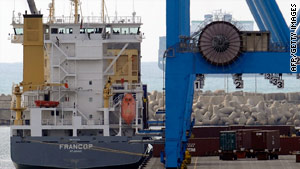
As the tale of the “New Karine A” develops, one alarm bell it sets off concerns the ease with which the arms transshipment was brought off in plain sight. The ship the Israelis caught with the arms was M/V Francop, a freighter operated by Cyprus-based United Feeder Services. The crew onboard didn’t know what they were carrying, and didn’t carry it from Iran anyway: they picked their cargo up in Damietta, Egypt. The Israelis had tracked Francop from Beirut to Damietta and knew the cargo was loaded there. That means the arms themselves were shipped from Iran to Egypt by other means. Sounds like a story we’ve heard before about Port Sudan and overland convoys to Gaza, right?

Not really. The port of Damietta is neither a remote spot in the desert nor a sleepy Sudanese port. It’s one of Egypt’s premier seaports, located on the Mediterranean near the entrance to the Suez Canal. Damietta has some distinctive claims to fame: it’s in a heavily promoted Egyptian free-trade zone and is operated by DIPCO, an international consortium of private maritime-service companies whose pathbreaking development project at Damietta serves as a model for a global trend toward the private development and operation of ports.

Private administration of customs and cargo verification, the functions that might detect arms shipments, is not unusual. But under these conditions, transshipments of cargo through free-trade zones — shipments offloaded only to await further transportation to another country — are especially likely to receive a hand wave. The port operator’s priority is to tally containers and assess fees, not to break open containers and inspect their contents. Damietta’s convenient location in the eastern Mediterranean means that transshipments represent a large majority of its container traffic. Most of what stops there is merely waiting onward transportation and interests neither Egypt nor the port-services operator.

A big shipment from Iran, meanwhile, would raise no eyebrows in Damietta. Iran’s state shipping line, IRISL, was one of the first shipping companies to contract with DIPCO for services in Damietta, and two of IRISL’s subsidiaries make regular stops there. Containers bearing the IRISL logo are routinely present.

It would be hard to dream up a set of circumstances more conducive to perfunctory supervision of cargo. But these same circumstances represent a cash cow for Egypt. Private companies optimizing the profitability of port operations are a moneymaker, not only for growing economies but also for the Middle Eastern nations in which many of the companies (like DIPCO’s leader, Kuwait & Gulf Lines Ltd.) are based. The beneficiaries of this trend will kick hard against any inefficiency introduced by the administration of UN sanctions. Ultimately, intermediate transshipment ports aren’t going to represent effective pressure points for arms interdiction. The most effective pressure point would, as usual, be Iran itself, and that reality demands not so much administrative meticulousness as political will.

Related: Israel Navy Intercepts Iranian Shipment,

The New Karine A

.

Wednesday, November 4, 2009

The New Karine A


Noah Pollak
Contentions/Commentary
04 November 09

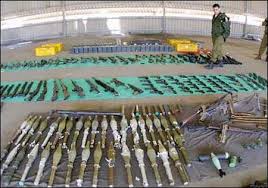
Israeli Navy commandos seized a cargo ship last night en route from Iran to Syria. It contained 10 times the arms that the Karine A attempted to deliver from Iran to the Palestinians in 2002, enough weapons, according to the head of the Israeli Navy, to keep Hezbollah supplied in a hot war for a month. Along with 3,000 rockets, the ship contained:

107-millimeter rockets, 60-millimeter mortars, 7.62-rifle Kalashnikov-ammunition, F-1 grenades and 122-millimeter Katyusha rockets. On the side of some of the cases inside the containers the words “parts of bulldozers” was written.

The Syrian foreign minister, Walid Moallem, soared to Baghdad Bob levels of hilarity by trying to deny the reality of what the Israelis discovered.

“Unfortunately there are official pirates disrupting the movement of goods between Iran and Syria,” he told reporters on a visit to Teheran. “I stress, the ship was not carrying Iranian arms bound for Syria, nor was it carrying material for manufacturing weapons in Syria. It was carrying [commercial] goods from Syria to Iran.”

Moallem says there were no arms on board. The IDF has released a video of the ship’s weapons being unloaded in the port of Ashdod — rows and rows of mortar shells, rockets, and crates filled with grenades.

What will Obama say about all this? Being that evidence of Iranian-Syrian hostile intent complicates the administration’s desire for “engagement,” whatever that means anymore, the answer is: probably nothing.

What will the human-rights hustlers say? Where is Judge Goldstone? Where is the flurry of outraged press releases from Human Rights Watch? These weapons are intended for one purpose only — to terrorize Israeli civilians and drag the region into war. Shouldn’t this be an easy call for peace-loving human-rights activists? HRW has condemned Israel for violating international law over the way it funds public schools. I would bet a large sum that HRW will say nothing about the 500 tons of arms Iran just tried to send to Hezbollah. Priorities, you see.

And where is the UN Security Council? The arms ship violates numerous UNSC resolutions banning Iran from exporting weapons and forbidding the arming of Hezbollah. Don’t expect any leadership from the Obama administration on this score, either; to make a big deal out of Iranian bad faith would be tantamount to admitting that the engagement policy is the stuff of fantasy.

.

Tuesday, September 1, 2009

The Palestinian Movement, Iran, Hizballah, and Arms Smuggling


Barry Rubin
The Rubin Report
31 August 09

It is because the Middle East’s history—even most recent history—is continually ignored does Western policy tend to go in a cycle, the same mistakes are repeated, and disasters occur predictably.

Consider, for example, the Palestinian Authority's Iran connection and lust for war rather than peace.

Fuad Shubaki, one of Arafat’s closest aides, has been sentenced to 20 years in prison by an Israeli military court for weapons’ smuggling. This is not a new issue and the details are what’s interesting. Shubaki, whose office was practically next to that of the PLO, Fatah and Palestinian Authority (PA) leader, financed the shipment of arms on the Karine-A cargo ship—including 50 tons of Katyusha rockets, ammunition, and explosives--which Israeli forces seized in 2002. Shubaki testified he was only carryout out (Arafat’s) orders.

Lessons of the Shubaki case:

--Arafat had forged close relations with the Islamist regime in Iran which was to supply the weapons, showing the cooperation between the Palestinian movement and the Iranians.

--The middle man in the deal was Hizballah special operations’ chief Imad Mugniyah, since assassinated. So Hizballah was brokering Iran-PA relations and the PA was working closely with a terrorist responsible for attacks on Americans and the deaths of U.S. soldiers.

--The large amount of weapons would have greatly escalated the Second Intifada fighting, resulting in thousands of Israeli and Palestinian casualties. It is a wonderful example of how the Palestinian side tries to foment bloody wars even though it will lose, infrastructure destroyed, and casualties suffered (which can then be blamed on Israel).

--The incident persuaded the Bush administration that Arafat was not a partner for peace and played a key role in setting U.S. government policy. If the Bush administration is criticized for not doing more on Arab-Israeli negotiations during its term, that was because the White House was convinced that the Palestinians wanted war not peace.

--The PA, Fatah, and the PLO is currently run by Arafat’s lieutenants, the same people who were in power in 2002.

--In recent weeks, several leading Fatah officials have spoken about the idea of turning toward an alliance with Iran against, among others, the United States.

--Fatah is now moving into a more radical phase, with its designated next leader being more radical than Arafat.

--If a Palestinian state were to be established, it might well invite in Hizballah and Iranian forces, import large amounts of arms, and renew the war with Israel.
.