Showing posts with label Israel-PA talks.. Show all posts

Wednesday, May 12, 2010

Obama's Talk with Mahmoud Abbas: A Recital of U.S. Policy


Barry Rubin
The Rubin Report
11 May '10

The White House released what it calls a "Readout of the President’s Call with President Abbas of the Palestinian Authority" which summarizes President Barack Obama's telephone conversation with Palestinian Authority (PA) leader Mahmoud Abbas. Let's analyze it.

"The President congratulated President Abbas on the start of Israeli-Palestinian proximity talks."

The U.S. government wants to encourage continued talks and to ensure that nothing should interfere with them continuing. These talks are the administration's main (sole?) "achievement" in foreign policy and woe to he--unless "he" is on the Palestinian side--who jeopardized their continuation.

"He reiterated his strong support for the establishment of an independent, viable Palestinian state living in peace and security with Israel."

Today, in honor of Yom Yerushalayim, a very special video - Jerusalem Day: Reflections by Rabbi Yisrael Ariel

This is the basic stance of U.S. presidents going back at least to the Oslo agreements of 17 years ago: the Palestinians get a state, Israel gets security, both get peace. In many ways, the Obama Administration has not changed the framework of U.S. policy as it was under Bill Clinton and George W. Bush. It is the atmospherics that are done quite differently, and often counterproductively.

"The President and President Abbas discussed the need for both parties to negotiate seriously and in good faith, and to move from proximity talks to direct negotiations as soon as possible in order to reach an agreement on permanent status issues."

So the U.S. goal is to get the talks going directly--which is possible--and to obtain a full peace agreement--which isn't. The key question is how much will the Obama administration push in that direction. Will it be satisfied to let the indirect talks go on for many months? I tend to think that the White House isn't going to go all-out for a final-status agreement it knows isn't going to happen. But the effort to make these two transitions--indirect to direct, general talks to negotiations--is going to be the centerpiece of U.S. policy on this issue during the rest of this term.

(Read full article)

If you enjoy "Love of the Land", please be a subscriber. Just put your email address in the "Subscribe" box on the upper right-hand corner of the page.
.

Tuesday, May 4, 2010

What Do the New Israel-Palestinian Indirect Talks Mean?


Barry Rubin
The Rubin Report
04 May '10

The question of the day is whether the Israel-Palestinian Authority (PA) indirect talks will make progress in the "peace process" or result in failure. One wonders at this point how many naive people believe that peace is at hand, and how many misled people think that the lack of peace is Israel's fault.

What is needed to understand the issue is precisely what is not presented by policymakers, academics, and all-too-much of the mass media: The PA neither wants nor is capable of delivering a compromise peace agreement.

Radicalism within its ranks, in public opinion, and the ever-present challenge from Hamas ties the hands of leaders who are not so moderate themselves. Belief that if they continue the struggle or keep saying "no" or subvert Western support for Israel they will get everything they want without giving up much is too tempting.

But can these specific talks at this specific time bring progress or failure?

Depends on what you mean by "progress"; depends on what you mean by "failure."

(Read full post)

If you enjoy "Love of the Land", please be a subscriber. Just put your email address in the "Subscribe" box on the upper right-hand corner of the page.

.

Abbas prefers occupation, stalls negotiations


Jonathan Boyko
The Middle East Informer
03 May '10

Fearing the incoming pressure from the Americans to begin either direct or indirect talks, Mahmoud Abbas chose a tactic to disrupt any possibility of such, by setting various preconditions:

Ynet:

Palestinian President Mahmoud Abbas says he will demand already in the stage of proximity talks that Israel transfer vast areas in the West Bank, including those currently under full and partial Israeli control, to sole Palestinian control.

Abbas said that he would also demand that the Jordan Valley be included in the territories to be transferred to the Palestinians, although Israel has made it clear that it will not accept any pre-conditions to peace talks.

(Read full post)

If you enjoy "Love of the Land", please be a subscriber. Just put your email address in the "Subscribe" box on the upper right-hand corner of the page.

.

Monday, May 3, 2010

Arabs allow indirect talks


Soccer Dad
02 May '10

In Arabs Back Indirect Talks Between Palestinians - NYTimes.com, Michael Slackman reports:

Arab ministers gathered late Saturday at the offices of the Arab League here at the request of the Palestinian leadership, which sought regional support before agreeing, again, to enter into indirect talks.

But while the Palestinians and the Arab ministers agreed to endorse jump-starting peace talks that have been stalled for more than a year, they did not give ground on the issue of settlements.

We keep hearing how important the issue of Palestine is to the Arab world. The collection of unelected kings and despots who rule these countries are touchingly concerned about the self determination of the Palestinians. Yet if it's so important, why do the Palestinians require "regional support" to participate in "indirect" negotiations with Israel?

This reminds me of a 27 year old observation by Daniel Pipes:

Recognizing the critical role of Arab help has several implications for Middle East politics. First, it means that the PLO has very little of the political power so often ascribed to it. The PLO may appear to shape the policy of most Arab states, but in fact it reflects their wishes. It brings up the rear, echoing and rephrasing the weighted average of Arab sentiments. This suggests that it will moderate only when its Arab patrons want it to; so long as the Arab consensus needs it to reject Israel, the PLO must do so. Aspiring peacemakers in the Middle East must therefore not make settlement of the Arab-Israeli dispute contingent on PLO concurrence, for this is to give a veto to the organization least prone to compromise.

If the Palestinian Authority require support (or perhaps permission) to negotiate however gingerly with Israel, maybe it isn't quite so independent as advertised.

(Read full post)

If you enjoy "Love of the Land", please be a subscriber. Just put your email address in the "Subscribe" box on the upper right-hand corner of the page.
.

Sunday, May 2, 2010

On the Verge of Israel-Palestinian Authority Talks and What Comes After?


Barry Rubin
The Rubin Report
02 May '10

Gradually, the U.S. government is constructing the basis for indirect Israel-Palestinian talks which will be simultaneously meaningless and hailed--at least by the U.S. government--as a great achievement. The latest two developments are the Arab states' approval of the talks and a U.S. pledge to the Palestinian Authority (PA) that there will be no Israeli construction in the West Bank or Jerusalem outside the 1967 line.

All of these details are interesting. It is a sign of the weakness of the PA and its leader, Mahmoud Abbas, that it needs the cover of Arab regimes. Incidentally, an amazing thing happened when the PA last did this a few months ago. The Syrian government opposed giving approval and the New York Times simply edited this material out of the Syrian statement it quoted. It was a graphic example of how slanted the media is today, in that case trying to show that Syria was moderate when that was most untrue.

As for the construction freeze, the U.S. government neither tried nor delivered to Israel any comparable concession on the PA's part. Anti-Israel incitement on the media and elsewhere will continue as will, no doubt, the PA's official honoring of terrorists who killed Israeli civilians. This imbalance will also not be reported generally.

The Obama Administration has basically signalled to the PA that it is in the driver's seat. The more it sabotages talks, Abbas and his colleagues have been shown, the more pressure might be put on Israel. But no real pressure will be put on the PA. Thus, U.S. policy has given the PA every incentive to be intransigent.

(Read full report)

If you enjoy "Love of the Land", please be a subscriber. Just put your email address in the "Subscribe" box on the upper right-hand corner of the page.
.

Sunday, January 10, 2010

Mitchell fails to understand Palestinian goals


FresnoZionism
09 January '10

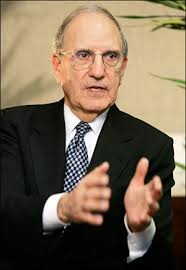
Quoted in Steve Rosen’s blog, a snippet from an interview with US Mideast envoy George Mitchell:

George Mitchell: …Israel annexed Jerusalem in 1980….for the Israelis, what they’re building in, is in part of Israel. Now, the others don’t see it that way. So you have these widely divergent perspectives on the subject. …The Israelis are not going to stop settlements in or construction in East Jerusalem. They don’t regard that as a settlement because they think it’s part of Israel….

Charlie Rose: So you’re going to let them go ahead even though no one recognized the annexation.

GM: When you say let them go ahead, it’s what they regard as their country. They don’t regard — they don’t say they’re letting us go ahead when we build in Manhattan or in the Bronx or –

CR: But don’t the international rules have something to do with what somebody can do to define as their country?

GM: There are disputed legal issues. .. And we could spend the next 14 years arguing over disputed legal issues or we can try to get a negotiation to resolve them in a manner that meets the aspirations of both societies. [my emphasis]

This is remarkable, both because Mitchell appears to understand and appreciate the Israeli position, and because he doesn’t spout the usual rubbish about ’settlements are illegitimate’ that we’ve heard from both Barack Obama and Hillary Clinton.

(Read full post)
.

Friday, January 8, 2010

Interesting George Mitchell Interview


Steve Rosen
Middle East Forum (MEF)
07 January '10

Mideast Envoy George Mitchell made some interesting observations in an interview with Charlie Rose.

Obama's Demand for a Settlement Freeze

Charlie Rose: The New York Times editorial [says] that the past year has not been successful because the administration stressed a settlement freeze....By focusing on a settlement freeze, which Israelis were unlikely to agree to, you created disappointment from the beginning, because it was an unachievable objective.

George Mitchell: If you want to get 60 percent, do you begin by asking for 60 percent?

Charlie Rose: No. You ask for a hundred.

George Mitchell: Oh, there you go, Charlie. You've already figured out negotiations. So what we got was -- what we got was a moratorium, ten months, far less than what was requested, but more significant than any action taken by any previous government of Israel for the 40 years that the settlement enterprise has existed, ten months of no new starts in the West Bank, less than what we asked, much, much greater than any prior government has done. And we think over time it's going to make a significant difference on the ground.

Getting Talks Started

Charlie Rose: You hope to accomplish this in two years. The moratorium is for ten months....That gives you an incentive to say to the parties ...better get something done before the moratorium ends because I don't know if we can get it again.

George Mitchell: Charlie, will you come with me on my next visit and make that little spiel? Because it might sound better coming from you. I have made it several times....We have suggested to the Israelis .. a series of steps and actions that they could take that would encourage President Abbas to enter the—

Charlie Rose: So why can't you tell me what they are, that's my question.

George Mitchell: Well because I want to discuss it with them before I discuss it you.

(Read full article)
.

Thursday, December 17, 2009

The Palestinian Authority Sets its New Strategy: Tempts Obama Administration with Instant Peace if it Pressures Israel


Barry Rubin
The Rubin Report
17 December 09

We now have Mahmoud Abbas’s answer regarding short-term Palestinian Authority (PA) strategy. He says that if Israel stops all construction now—in Jerusalem and the 3000 apartments being completed—and accepts in advance the 1967 borders and there will be peace within six months. This is the basic story we’ve been hearing since around 1988: one or more Israeli concessions and everyone will live happily ever after.

This is clearly bait being dangled for President Barack Obama, offering him an “easy” way out of his dilemma of not having any peace talks after almost a year in office: pressure Israel to give up more and you will look good, with plenty of photo opportunities of you presiding over Israel-PA talks.

Of course, what Abbas wants to do is to remove one of the main points of Israeli leverage, the borders to be agreed upon and the status of east Jerusalem. Moreover, is leaving out both the additional demands he will be demanding (all Palestinians who want to can go live in Israel) and all the Israeli demands he will be ignoring (recognition of Israel as a Jewish state, the end of the conflict and dropping all Palestinian claims, security guarantees, an unmilitarized Palestinian state, settling all refugees in Palestine).

(Continue article)
.